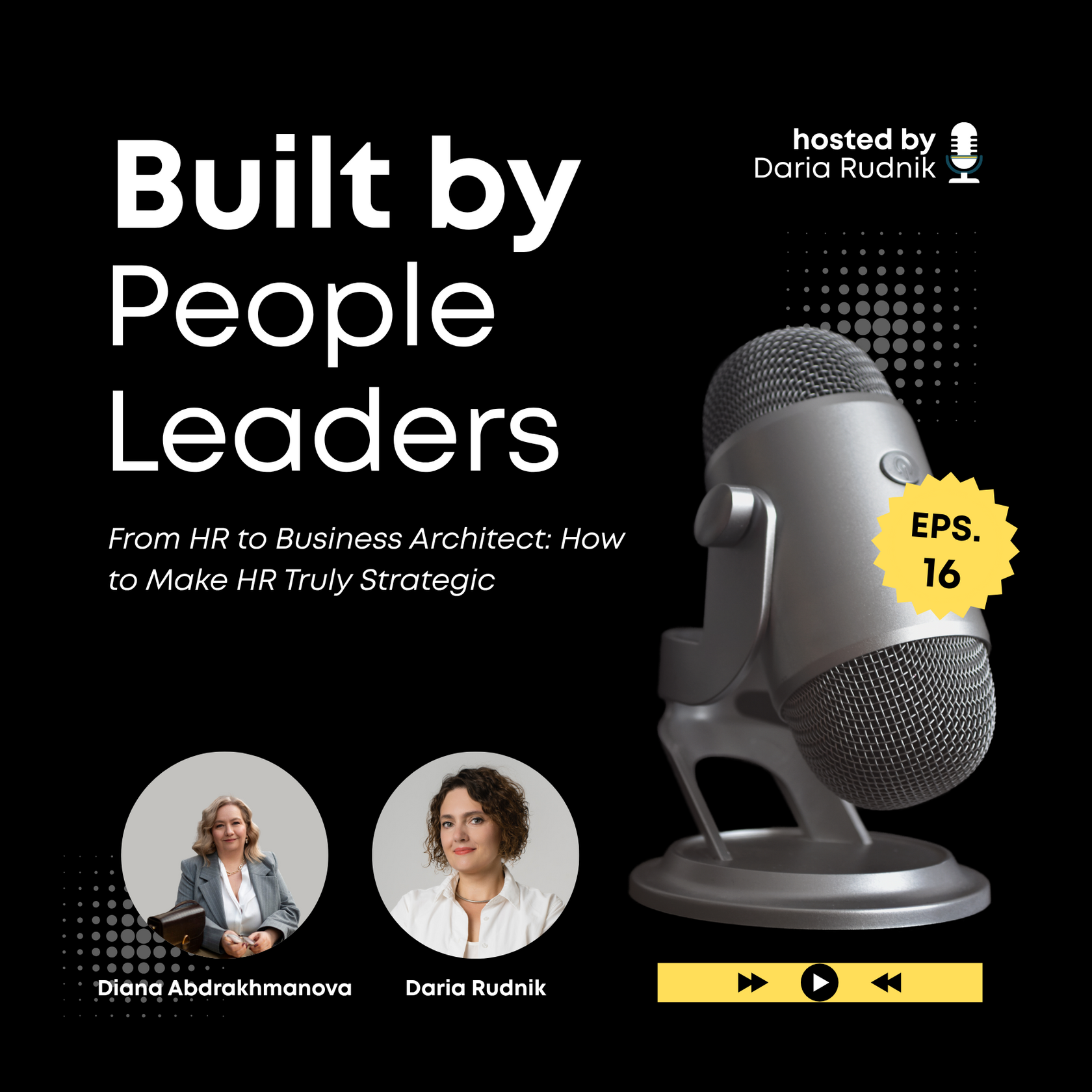
In this episode of the Built by People Leaders podcast, I speak with Diana Abdrahmanova, organizational architect, strategic HR advisor, and former Head of HR, about what it really takes for HR to become a true business driver.
Drawing from her experience leading HR in fast-growing companies and complex M&A environments across regions, Diana shares how the role of HR must evolve from operational support to strategic partnership. She explains why HR professionals need to stop thinking like “HR” and start thinking like business leaders — understanding financial models, market dynamics, and how companies actually make money.
The conversation dives into one of the toughest parts of leadership — managing uncertainty and transformation. Diana shares practical insights on navigating acquisitions, dealing with disengaged teams, and why transparency (even when the truth is uncomfortable) is the most powerful tool leaders have.
We also explore the real impact of AI on HR, shifting the function from administrative execution to organizational architecture, and discuss why many CEOs still don’t see HR as a strategic partner — and how to change that.
Finally, Diana shares a powerful perspective on leadership: how HR can help CEOs become more human, more vulnerable, and ultimately more effective by engaging people instead of trying to lead alone.
Key Takeaways
- HR only becomes strategic when it understands how the business makes money — not just how people work.
- In M&A, the real challenge isn’t integration — it’s negative motivation from people who didn’t choose to join you.
- Honest uncertainty (“we don’t know yet”) builds more trust than polished but empty communication.
- Great HR isn’t about retaining everyone — it’s about creating the right match between people and the system.
- AI doesn’t elevate HR by default — it removes admin work, shifting value to decision-making and execution.
- The biggest barrier between HR and the CEO is not tools, but lack of business thinking.
Chapters
00:00 Introduction to HR and AI in Leadership
02:46 Diana's Journey in HR
05:37 Transformations and Challenges in HR
08:35 Creating Engagement in Acquisitions
11:33 The Value of Transparency in HR
14:25 The Role of HR in Business Success
17:07 AI's Impact on HR
20:05 Bridging the Gap Between HR and CEOs
22:44 Final Thoughts and Surprising Trades in HR
Daria Rudnik (00:10.503)
Welcome to Built by People Leaders podcast brought to you by Aidra AI, your AI-powered coach for leaders in tech. I'm your host, Daria Rudnik, and this show is for HR and L&D leaders for scale-ups and fast-growing companies. Those building impact from within and making creating AI-ready organizations. You can go to dariarudnik.com and download AI-ready team framework to build AI-powered teams ready for the AI-driven future.
And today we have a very special guest with us here today, Diana Abdrahmanova. And I know Diana as an ex head of HR and now she's an organizational architect, strategic HR advisor and executive coach. In her corporate career, she supported global talent transformations and led HR functions in international companies. Now Diana works with founders and CEOs at moments of growth and transition.
helping them scale their companies without losing people, clarity or themselves. Thank you for joining us today, Diana. I'm very excited to have this conversation with you.
Diana (01:21.496)
Thank you Darya for inviting me and I'm also very excited to share my experience and ideas and thoughts with your audience.
Daria Rudnik (01:27.974)
I'm sure it'll be very valuable for our audience. And my first question to you is, well, tell us about your path and your HR career.
Diana (01:38.06)
Yeah, so I started my HR career as many people like from an entry level. After I graduated from the university, my first education is I'm a teacher by my first education. And then I got my certification in HR management and international HR and CIPD qualification. But when I start thinking, okay, so what am I going to do in life? I thought, okay, I'm always curious to be
to know what is behind the scene, know, so how it done, what's not seen from outside. And when I was thinking about companies, I said, okay, maybe HR is that function who actually knows everything. And I never thought at that time that it can also even design how the company may lead to success. So I choose HR as my career to think it would be balanced between papers and people.
But very soon I understand that I'm not the person to stuck with policies and procedures and rules and I feel that there is much more that HR can bring into the organization. And then actually HR can become a value-generated engine of the organization if it's designed properly and if HR really supports business. So that's how I start moving towards my ladder in HR and also move from one company to another and I was lucky to have a great teachers.
and managers at that time who helped me to become a real partner and to start thinking as CEO, as a founder and as CEO of the organization, thus becoming in the chair very strategically, not really operational transaction.
Daria Rudnik (03:13.803)
Well, thanks for sharing that. That's absolutely critical for HR to understand business, to be able to create business impact. Well, how do you do that? I'll go straight to the point. How do you become the strategic partner to the CEO? How do you understand business when you are basically an HR function?
Diana (03:24.942)
You
Diana (03:32.046)
Well, it's just, yeah, that's a good question. And it's simple and not that simple. Well, first of all, you need to take off your head as HR and people pleaser and only think and look at what you can do on one hand to protect the organization. That's what mostly, be honest, they are doing. They're trying to protect the organization from a legal perspective. And again, back at the time when I started in many companies, HR reported either to finance or to legal, which was really a mistake, to be honest.
So the whole focus was on rules. So stop doing and stop thinking as HR. Start looking at what business actually where business lies. Try to understand the business financial model, what your company earns, what they actually do. Do this, know, pastoral analysis of your organization, the industry your company works in. And as David Tuller said, so be outside, inside HR rather than inside, outside the chair. That's I think the crucial mistakes when the chair really stuck in
looking and knowing what's going on inside the company without forgetting, really forgetting to look outside and what are the threats and opportunities awaiting.
Daria Rudnik (04:41.247)
Yeah, that's true. And that helped you grow your career and led multiple transformations. You've been in different industries and different countries. Well, what's the most interesting experience you had while leading HR functions?
Diana (04:58.126)
Well, yeah, as I said, I always was looking for challenges and I always joined companies in the phase of rapid growth, either organically or through M &A. And on one hand, really this high speed of scaling organically might be challenging because yes, 20 people, don't know, and then all of a sudden you 200 and it's really, none of your systems or processes really can support this rapid growth and...
not flexible enough, you need really to think about a lot of aspects to fix or to stay efficient. But when you do &A, especially when you acquire company in different regions, and I've done &A cross AMIA, EPEC and America, so I know all the regions, all these regions and the cultures. So on top of your bringing more people into the organizations, you bring different cultures, not only...
corporate culture, but also national cultures into the organization. And you need to deal with multiple, I would say, with more complex questions. And definitely one size fits all handbook doesn't work here at all. But what I found when I became, well, I turned out to be on the side of the company that has been acquired, I had this experience. So I have like a full cycle of acquisitions. I realized that when you acquired company,
you get people with motivation, I would say rather negative than neutral to join your company. Because when you are growing, when you are hiring more people to grow organically, you more likely have very motivated people on board. They really want to be with you. They want to grow your company, cetera. But when you acquire another team, well, these people do not choose you. Basically, it was not their choice to join your company. And then you start...
you really need to start dealing with this negative motivation, would say, plus on all other, well, would say, obstacles you may have in the face of editing new people or new processes, a new product into the organization. So I would say, even across different regions is the most challenging one.
Daria Rudnik (07:12.681)
Yeah, well, that's a very important lesson like you're sharing that when you acquire a company, those people, they didn't choose you. They kind of happened to be in your organization and probably they had their ambitions of their own. And now some of them will have to lose the job. Some of them will have to move to a different position. Someone who used to be a CTO, CFO manager will go to another role because there is already a CTO, CFO in organization. So it's a big change. So I'm curious, what is the...
Diana (07:20.011)
don't.
Diana (07:37.346)
Yep, exactly.
Daria Rudnik (07:43.995)
What can create this shift from turning those disengaged and maybe unmotivated, maybe resistant employees into supporters of the new organization?
Diana (07:56.687)
Yeah, what I found, would say, too, feature or tip for any transformation on uncertainty is be as much transparent as you can with your people and be honest, do not oversell, do not over promise and honestly say all pros and cons and all possible scenarios of outcome, even if it's a negative one and try to agree on some certain compromise.
that will help people to stay together to a certain point. you like, like, like, for example, it's a good, it's a good one. I'm a CTO in one company. It's an acquisition. And I understand that there is a CTO of another company and more likely I will lose my role because definitely you don't need two CTOs. So be transparent from the beginning. Don't oversell and tell this HR bullshit. We need everyone in the organization. We value everyone because it's not true. like, treat them as an adult and say, Hey, yes.
Your role is under risk, but we need you, we need your skills, we need your expertise, we need your people you are leading to go through. So help us to make this transition and then return we will give you this, this and this. So try this, find this compromise where you both will benefit. Well, after all in modern lives, no one promised to like a long living life in one company. We're all free to choose and we can go to different opportunities. So don't try to keep it.
by all means, by overselling or overpromising. So I would say, and even if you don't know the answers, be honest, say, I don't know what's going on. What will be in one year? What will happen in two years? Because again, maybe this CTO decide to leave. also happens. It also happened one time in my career that, well, the executive team, was not CTO, it was another role, but executive of the acquired company decided to leave the organization. it gave an opportunity to step up for someone who...
who joined us through acquisitions. So it also happened, I would say. So I would give advice to both sides. On the acquiring sides, do not over promise, be transparent, tell people openly about the possible scenarios. Of course, to the extent you can, because sometimes you have very highly confidential and insensitive information you cannot share early in the acquisition.
Diana (10:18.968)
But when you are on the other side, also stay open-minded. Don't cut yourself out yourself. Do not close this door immediately thinking about only the negative scenario. Because very often when you've been acquired, you join a bigger structure. And as a chair, that's true. You have more opportunity to do something. Don't think about your career only like a vertical change.
you may have an amazing horizontal opportunity that will change your life professionally and financially and all other means. So stay open.
Daria Rudnik (10:57.373)
Exactly. Yeah, it's true. And I love that they share about the transparency and clarity. And like what I see leaders a lot, like what they do a lot is, okay, I don't have all the answers. I'm not going to tell anything. Or I don't have...
Diana (11:09.202)
Yes, exactly. They either don't tell anything or they try to invent something to lie basically to people. But again, you're dealing with adult people. People normally sense this bullshit. That's why very often you can say, this is HR bullshit, because it's true.
Daria Rudnik (11:26.653)
Yeah, yeah, yeah. Be very transparent where you can and if you don't, if you can't say anything, just say, I can't say it for now. I will let you know as soon as I can. But kind of the silence that creates a lot of gossipy and...
Diana (11:33.205)
Exactly. Yes. Yes. Because silence means uncertainty, means unknown. And you know yourself as a psychological... Well, I think you have the psychological background as well, that this unknown, this uncertainty creates the stress and tension in our heads. We start building our own reality. And then very often, in many cases, it's negative scenario. I don't know why, but that's...
how human brain in most cases work.
Daria Rudnik (12:04.725)
That's how we work. When we were preparing for this conversation, you wrote that you want to talk about how cool it is to be an HR. And I'm I'm very curious about that because there was a lot of vibe online about bad HR people, people who like HR stands for organization, not for people. HR recruiters don't understand who they are recruiting. HR is more on the legal side, then again, than the people side. HR don't understand business.
So like tell us why is it cool to be HR?
Diana (12:37.209)
Well, I'm a great fan of HR. I'm really passionate about HR and I even created a course for HR professionals to love this professional as I do. Because I think HR is a very powerful function, to be honest, if it's set up properly.
The only thing you need to do is you need to be very open-minded. Don't really try to copy paste, no matter what you experienced this, and learn and look at business again as you're a business owner. So think as an entrepreneur. So HR should be an entrepreneurial mindset, has an interpret mindset, but at the same time, I would say, I always joked and said that good HR is a cynical HR. Yes, sometimes you need to be cynical. I mean, in the way that if you need
Daria Rudnik (13:18.304)
Yeah
Diana (13:21.743)
to a tough decision you should take it to save the organization. You just need to make the reduction redundant for instance professionally or to push someone from the role. That's what I've done in my career that I understand that this person, this individual, has overgrown his role and or he overgrows the organization or organization over you sometimes overgrown.
Yes, right, this is right. Overgrew the person. So, and they both are unhappy together. So why not to help them separate? Maybe it's for a moment, maybe it's for one or two years, but at least that will both benefit. So don't try to be addicted to people and to keep them by all means. Think about the...
Again, this win-win solution, but also think what will benefit the organization and the purpose of your company. Because after all, we're all in business. All business needs to earn money. And again, if the company have money, it normally reinvested back into their people. So if you don't like in the song, no money, no woman, no love. the same. So if companies in the survival mode.
they will always be saving on people as well. But if a is prosperous and confident, of course they will share this confidence and prosperity with the people who help them to build this success. So that's my belief, that's what I believe, and that's why where I see HR plays a crucial role when they look at both sides and the processes, structure.
organization design and business strategy and think, okay, so how people can fix or feed all these to make it a synergy and to really bring organization to the next level of success.
Daria Rudnik (15:20.819)
And I like the perspective that you're bringing. You're just thinking broader. You're not thinking, okay, now we have to let this person go. You're thinking bigger. You're thinking that you're not only just letting this person go, you're helping them find a better place. And if it's done right, if managers gave feedback to this person beforehand, so the person is ready and they know what to expect. And having this conversation with HR, being ready to find a new job, that would better feed their skills, that would better feed their culture, their values.
beneficial for many, for the organization, for this person, for the other company that the person is going to join.
Diana (15:56.143)
Yeah, exactly. But unfortunately, it's a very tough conversation to start conducting. I've done many of them. And of course, it's always difficult in the moment. But after some years, I still receive some feedback from my ex-colleagues or the people I pushed out of the organization. Hey, Diana, thank you very much. Because if it's not for you, I would stuck forever.
or I would stuck for more years, I will lose these years doing the same, being unhappy, but just because I was afraid to make the step. Especially with people who's been with the organization for more than five plus years. They really will lose this ability actually to go to interviews and to sell themselves and they feel scared and they prefer to stay where they are even if they are unhappy. So, and that's where HR really can help them to also open their mind and to look from a different perspective.
within the organization first, of course, I'm not that like pushing everyone out, okay. Think how you can place this, this person better in the organization, but if it's not the case, then help them to look creatively outside the organizations and to find their well-realization, self-realization, so their success outside the organization.
Daria Rudnik (17:10.432)
And now I want to bring a very hot topic, AI. So with AI entering workplaces, how would the role of HR change? How should HR change?
Diana (17:13.935)
Okay, let's do this.
Diana (17:23.235)
Well, I think AI is great really. love AI and especially ChadGPT is my favorite friend to be honest, because what I think AI gives to HR, it really takes all this administrative noise away, all these templates, screenings of descriptions, all the time consuming, but really...
not very much valuable, I would say, the organization, things you need to produce. It also can generate some ideas. And I think that HR now becomes more like an architect.
who can take all these ideas and all that generated by AI things and implement or think how to implement, how to execute basically in their work. So it's really helping HR to shift from operational transactional paper thinking or rule thinking, process thinking functions to more like data driven decision making based on the...
that you can get from AI actually, or AI can generate it for you in the most, the structured, in a better structured way than any human can.
Daria Rudnik (18:29.503)
I read a couple of reports about AI and HR and one of them says that only 1 % of CEOs see HR as someone who can support them with their AI transformation. On the other hand, I see more and more AI tools in HR and HR now is, think, one of the top three areas where AI is used the most, with the other two being
writing code, like developers and engineers. And then second one, I think it was content creation. I'm not sure. And HR is among one of the top three. So I'm curious, why is this disconnect? From what you're seeing, why there's so much disconnect between HR is using AI, but still CEOs don't see HR as a support for AI transformation.
Diana (19:22.775)
I would say it's still the bias that goes from one simple, I would say, weaknesses of HR in general. YCO never see HR as a next to him partner. And with HR in many cases, it's really guilty of this. It's business acumen.
Often HR really, as we saw say in the beginning, think about bringing more tools, even AI tools, bringing more, I don't know, methodologies like, okay, let's have Hogan assessment, let's have CliftonStrengths assessment, let's make an MBTI assessment. So they pick up different really good and trendy things into the organization. But very rarely they can explain why for me as a CEO do I need all this.
And how will it help me to achieve my goals? Because in many cases it sounds like we need it because it will make people feel be happy or it will help us to become an attractive for people or it will help us to, I don't know, to stay updated. That's great, but as for me as a CEO, who's really thinking about taking my...
place in the industry, on the market to earn that, win the market, to be the leading position. It sounds like a noise, nice to have, but not really a priority. So I think this is the only barrier that really breaks this communication. And that's why CEO never think HR is a real driver or champion, change champion in the organization.
Daria Rudnik (21:04.927)
That actually leads me to my next question, which is like, what is the most important message you'd like to share with fellow HR professionals?
Diana (21:14.799)
Stop studying only HR trends. Stop being HR, to be honest. Really, start studying your company's P &L, business metrics, financial models, run this PESTL analysis. Think about how your company makes money and what company's customers really need.
And then learn how to explain what you do or what you are proposing to do. Benefit, all of above mentioned. So really become a co-pilot. But co-pilot on the business, not just...
Yes, you're leading people, again, people will be happy if they get their money, bonuses, benefits, etc. etc. And all this will cost money. So think how to earn more money for your people. I would put it this way.
Daria Rudnik (22:10.333)
I love that. I love that. I know we as HR, we're thinking about people, we know about people, and we tend to focus on people or processes. But there is another very important aspect which how businesses running. It's not just being, let's motivate our people, but it lets motivate people to do what? What they need to be changed? What kind of people do we need to motivate? What kind of people are more important? Again, it might sound cynical, but it's...
Diana (22:29.385)
Yeah.
Diana (22:37.051)
It's not cynical, it's telling the truth, it's be honest to yourself, do not really try to say that we are doing this for the sake of, I don't know, peace, etc. No, we are really doing this for commercial success. Whenever, at the moment, you're honest with yourself, you understand the deepest root, I would say, of the actions you are doing, life becomes easier. And you really can do more, and you can be more gentle, you can be more generous, you can be kinder.
once you understand what you're trying.
where you are and what you are doing. I remember in one of my company, I had a whiteboard in my office and I have only one thing on this board written. It was the question, why? And whenever people come to say, hey, Diana, we need to do this, I said, answer me this question to my place. And once the people answer and I understand that, yes, it will really make sense, said, okay, let's do this. But because very often people never say, never think why they want to do this.
just because they think it's cool or because other companies doing this. It's not the reason for you to copy.
Daria Rudnik (23:44.085)
I agree, I agree.
If you think about it, if you had a magic wand and could solve one of the biggest issues that HR is facing, what would that be?
Diana (23:51.564)
Mm-hmm.
Diana (23:57.572)
Hmm.
Diana (24:01.525)
It would be great to have this magic wand, because in many companies the HR is considered a specialist HRD. They are looked at as a wizard who will come and...
pour a magic powder over people and everyone will be collaborative, open, efficient, motivated, etc. But it's not, it's life. I would say, I very often say, it may be not the direct answer to your question, but I think it also linked to. When people ask me...
what I'm doing actually, because again, sometimes it's hard to explain what HR is doing. And I said that I'm working with the most advanced, but the most complex technology nowadays, people. And we are really so complex that not only one size fits all, not a single tool can be used to solve all the problems. So I would say if I have a magic power, I would say...
try the ability to understand all the complexity at once.
Daria Rudnik (25:12.839)
Yeah, yeah. I have one more question, but I'll keep it till the end. Stay with us and I'll ask Tiana about the surprising trade HR leaders can help their CEOs with. But before we go to that very curious question, I'd love to have some rapid fire quick questions with just very short answers, one word answers.
Diana (25:17.293)
Okay.
Diana (25:37.644)
Okay.
Daria Rudnik (25:40.587)
So are you a tea person or coffee person? Dogs or cats? Are you a morning person or a night owl?
Diana (25:43.343)
See.
dog.
Diana (25:50.945)
Afternoon person.
Daria Rudnik (25:52.317)
After that, would you rather get a phone call or a message?
Diana (25:57.999)
a message, but maybe to follow up with a call.
Daria Rudnik (26:03.209)
What did you want to be when you were a kid?
Diana (26:06.319)
Film producer.
Daria Rudnik (26:08.201)
Wow.
Daria Rudnik (26:12.095)
Where do you go when you need perspective?
Diana (26:14.959)
Outside, always walking or to the sea or to somewhere to the water where you can like see and watch the nature.
Daria Rudnik (26:23.723)
What's one rule you've broken but don't regret?
Diana (26:30.479)
The idea is that a successful career must fall on a linear path.
Daria Rudnik (26:34.998)
I love that.
And what's the one habit or phrase people say it's totally you?
Diana (26:44.837)
Let's look at the system, not the person.
Daria Rudnik (26:46.571)
I can hear that. Yeah, like through all our conversation, we were talking about systems, not just like any specific individual, like systemic perspective, broadened perspective.
Diana (26:56.675)
And this is the magic pill for all the HR. Don't really think much about only people. Really look at this systematical from a system perspective.
Daria Rudnik (27:09.515)
So before we go to our final questions about the surprising trade HR leaders can help their CEO with, how people can connect with you? Where can they find you?
Diana (27:20.353)
Well, I'm on LinkedIn. I have my own website and also for Russian speaking, I have my Instagram and Telegram channel.
Daria Rudnik (27:30.519)
I'll make sure we have all the links in the notes for this episode. You can click, find Diana, ask her questions, keep this conversation going. Well, that was amazing. I really enjoyed that. To finish this conversation, what's one surprising trade HR can help their CEOs with?
Diana (27:52.791)
I will sip of water to keep the intrigue. So as a CliftonStrengths coach, I always recommend people to look at the strengths and to use the strengths to partner on your strengths, not on your weaknesses. and again, based on my experience working, doing this assessment with leaders and CEOs, very often they have a strong...
orange talents on their top, which means influencing, which means they get results through people. So they need people to get results. But they have these three talents on top, self-assurance, significance and competition, which lead them to be very on a high speed, very confident in dealing with uncertainty, unknown, this volatility, et cetera. But what they're missing really to engage people.
into this process. And HR, on the contrary, in many cases, they have a blue, as their leading group, which is relation building domain, and they know more about people and they know what people, how people can be motivated, how people can, what people need or what they may feel. And I would say helping leaders to become more blue, meaning
Asking for help, show their vulnerability, engage people in a design decision process. That will help their teams to come closer to leaders and to understand leaders more. Because when leaders forget to be, because again, if I'm a self-assurance, it means I don't need anyone, I know all the answers. But it's an orange talent and it means that if you are not engaging people, you are doing it by yourself and then you lose your...
talent actually, you lose your strength, it becomes your, not weaknesses, but it's not your strength anymore. in many cases, 99 % of people love to be helpful, like love to help, love to be engaged if you allow them. So I would say that this is one advice I can give to all HR, help your leaders to be engageable by being vulnerable and asking for help.
Daria Rudnik (30:12.329)
I love that. I can so much relate to that. like for me as a former HR leader myself, I remember trying to be there and create this space for the CEO so that they feel they can rely on you. They can be vulnerable with you. They can like ask for advice, support, not like straight at the beginning, obviously, but with time you can create this environment for your leaders so that they come to you for help. And then starting with you.
they can then be more vulnerable and open with their team members and others. So, well, thanks for sharing that. That's an amazing tip. I'm sure it's very helpful for both HR leaders and CEOs, because we are there to build business together.
Diana (30:54.531)
Yeah, we'll basically connect them together.
Daria Rudnik (30:57.777)
Yeah. So thanks for this inspiring conversation. I learned so much. Interesting stories. I love your perspective. And what I hear is it's a lot about being clear and honest, whether you're dealing with employees, whether you're dealing with the CEO, mergers and acquisitions, transformations, change management. It's all about being clear about what people can expect, about being honest, the good, the bad, or if you can't say anything, just be honest. I can't say it at the moment.
And well, thanks for having this conversation with me, Diana. And well, for everyone who listens, subscribe and comment and like, and let's keep this conversation going. Bye.
Diana (31:36.771)
Thank you, Darien. Thank you, everyone. Bye.
Welcome to Built by People Leaders podcast brought to you by Aidra AI, your AI-powered coach for leaders in tech. I'm your host, Daria Rudnik, and this show is for HR and L&D leaders for scale-ups and fast-growing companies. Those building impact from within and making creating AI-ready organizations. You can go to dariarudnik.com and download AI-ready team framework to build AI-powered teams ready for the AI-driven future.
And today we have a very special guest with us here today, Diana Abdrahmanova. And I know Diana as an ex head of HR and now she's an organizational architect, strategic HR advisor and executive coach. In her corporate career, she supported global talent transformations and led HR functions in international companies. Now Diana works with founders and CEOs at moments of growth and transition.
helping them scale their companies without losing people, clarity or themselves. Thank you for joining us today, Diana. I'm very excited to have this conversation with you.
Diana (01:21.496)
Thank you Darya for inviting me and I'm also very excited to share my experience and ideas and thoughts with your audience.
Daria Rudnik (01:27.974)
I'm sure it'll be very valuable for our audience. And my first question to you is, well, tell us about your path and your HR career.
Diana (01:38.06)
Yeah, so I started my HR career as many people like from an entry level. After I graduated from the university, my first education is I'm a teacher by my first education. And then I got my certification in HR management and international HR and CIPD qualification. But when I start thinking, okay, so what am I going to do in life? I thought, okay, I'm always curious to be
to know what is behind the scene, know, so how it done, what's not seen from outside. And when I was thinking about companies, I said, okay, maybe HR is that function who actually knows everything. And I never thought at that time that it can also even design how the company may lead to success. So I choose HR as my career to think it would be balanced between papers and people.
But very soon I understand that I'm not the person to stuck with policies and procedures and rules and I feel that there is much more that HR can bring into the organization. And then actually HR can become a value-generated engine of the organization if it's designed properly and if HR really supports business. So that's how I start moving towards my ladder in HR and also move from one company to another and I was lucky to have a great teachers.
and managers at that time who helped me to become a real partner and to start thinking as CEO, as a founder and as CEO of the organization, thus becoming in the chair very strategically, not really operational transaction.
Daria Rudnik (03:13.803)
Well, thanks for sharing that. That's absolutely critical for HR to understand business, to be able to create business impact. Well, how do you do that? I'll go straight to the point. How do you become the strategic partner to the CEO? How do you understand business when you are basically an HR function?
Diana (03:24.942)
You
Diana (03:32.046)
Well, it's just, yeah, that's a good question. And it's simple and not that simple. Well, first of all, you need to take off your head as HR and people pleaser and only think and look at what you can do on one hand to protect the organization. That's what mostly, be honest, they are doing. They're trying to protect the organization from a legal perspective. And again, back at the time when I started in many companies, HR reported either to finance or to legal, which was really a mistake, to be honest.
So the whole focus was on rules. So stop doing and stop thinking as HR. Start looking at what business actually where business lies. Try to understand the business financial model, what your company earns, what they actually do. Do this, know, pastoral analysis of your organization, the industry your company works in. And as David Tuller said, so be outside, inside HR rather than inside, outside the chair. That's I think the crucial mistakes when the chair really stuck in
looking and knowing what's going on inside the company without forgetting, really forgetting to look outside and what are the threats and opportunities awaiting.
Daria Rudnik (04:41.247)
Yeah, that's true. And that helped you grow your career and led multiple transformations. You've been in different industries and different countries. Well, what's the most interesting experience you had while leading HR functions?
Diana (04:58.126)
Well, yeah, as I said, I always was looking for challenges and I always joined companies in the phase of rapid growth, either organically or through M &A. And on one hand, really this high speed of scaling organically might be challenging because yes, 20 people, don't know, and then all of a sudden you 200 and it's really, none of your systems or processes really can support this rapid growth and...
not flexible enough, you need really to think about a lot of aspects to fix or to stay efficient. But when you do &A, especially when you acquire company in different regions, and I've done &A cross AMIA, EPEC and America, so I know all the regions, all these regions and the cultures. So on top of your bringing more people into the organizations, you bring different cultures, not only...
corporate culture, but also national cultures into the organization. And you need to deal with multiple, I would say, with more complex questions. And definitely one size fits all handbook doesn't work here at all. But what I found when I became, well, I turned out to be on the side of the company that has been acquired, I had this experience. So I have like a full cycle of acquisitions. I realized that when you acquired company,
you get people with motivation, I would say rather negative than neutral to join your company. Because when you are growing, when you are hiring more people to grow organically, you more likely have very motivated people on board. They really want to be with you. They want to grow your company, cetera. But when you acquire another team, well, these people do not choose you. Basically, it was not their choice to join your company. And then you start...
you really need to start dealing with this negative motivation, would say, plus on all other, well, would say, obstacles you may have in the face of editing new people or new processes, a new product into the organization. So I would say, even across different regions is the most challenging one.
Daria Rudnik (07:12.681)
Yeah, well, that's a very important lesson like you're sharing that when you acquire a company, those people, they didn't choose you. They kind of happened to be in your organization and probably they had their ambitions of their own. And now some of them will have to lose the job. Some of them will have to move to a different position. Someone who used to be a CTO, CFO manager will go to another role because there is already a CTO, CFO in organization. So it's a big change. So I'm curious, what is the...
Diana (07:20.011)
don't.
Diana (07:37.346)
Yep, exactly.
Daria Rudnik (07:43.995)
What can create this shift from turning those disengaged and maybe unmotivated, maybe resistant employees into supporters of the new organization?
Diana (07:56.687)
Yeah, what I found, would say, too, feature or tip for any transformation on uncertainty is be as much transparent as you can with your people and be honest, do not oversell, do not over promise and honestly say all pros and cons and all possible scenarios of outcome, even if it's a negative one and try to agree on some certain compromise.
that will help people to stay together to a certain point. you like, like, like, for example, it's a good, it's a good one. I'm a CTO in one company. It's an acquisition. And I understand that there is a CTO of another company and more likely I will lose my role because definitely you don't need two CTOs. So be transparent from the beginning. Don't oversell and tell this HR bullshit. We need everyone in the organization. We value everyone because it's not true. like, treat them as an adult and say, Hey, yes.
Your role is under risk, but we need you, we need your skills, we need your expertise, we need your people you are leading to go through. So help us to make this transition and then return we will give you this, this and this. So try this, find this compromise where you both will benefit. Well, after all in modern lives, no one promised to like a long living life in one company. We're all free to choose and we can go to different opportunities. So don't try to keep it.
by all means, by overselling or overpromising. So I would say, and even if you don't know the answers, be honest, say, I don't know what's going on. What will be in one year? What will happen in two years? Because again, maybe this CTO decide to leave. also happens. It also happened one time in my career that, well, the executive team, was not CTO, it was another role, but executive of the acquired company decided to leave the organization. it gave an opportunity to step up for someone who...
who joined us through acquisitions. So it also happened, I would say. So I would give advice to both sides. On the acquiring sides, do not over promise, be transparent, tell people openly about the possible scenarios. Of course, to the extent you can, because sometimes you have very highly confidential and insensitive information you cannot share early in the acquisition.
Diana (10:18.968)
But when you are on the other side, also stay open-minded. Don't cut yourself out yourself. Do not close this door immediately thinking about only the negative scenario. Because very often when you've been acquired, you join a bigger structure. And as a chair, that's true. You have more opportunity to do something. Don't think about your career only like a vertical change.
you may have an amazing horizontal opportunity that will change your life professionally and financially and all other means. So stay open.
Daria Rudnik (10:57.373)
Exactly. Yeah, it's true. And I love that they share about the transparency and clarity. And like what I see leaders a lot, like what they do a lot is, okay, I don't have all the answers. I'm not going to tell anything. Or I don't have...
Diana (11:09.202)
Yes, exactly. They either don't tell anything or they try to invent something to lie basically to people. But again, you're dealing with adult people. People normally sense this bullshit. That's why very often you can say, this is HR bullshit, because it's true.
Daria Rudnik (11:26.653)
Yeah, yeah, yeah. Be very transparent where you can and if you don't, if you can't say anything, just say, I can't say it for now. I will let you know as soon as I can. But kind of the silence that creates a lot of gossipy and...
Diana (11:33.205)
Exactly. Yes. Yes. Because silence means uncertainty, means unknown. And you know yourself as a psychological... Well, I think you have the psychological background as well, that this unknown, this uncertainty creates the stress and tension in our heads. We start building our own reality. And then very often, in many cases, it's negative scenario. I don't know why, but that's...
how human brain in most cases work.
Daria Rudnik (12:04.725)
That's how we work. When we were preparing for this conversation, you wrote that you want to talk about how cool it is to be an HR. And I'm I'm very curious about that because there was a lot of vibe online about bad HR people, people who like HR stands for organization, not for people. HR recruiters don't understand who they are recruiting. HR is more on the legal side, then again, than the people side. HR don't understand business.
So like tell us why is it cool to be HR?
Diana (12:37.209)
Well, I'm a great fan of HR. I'm really passionate about HR and I even created a course for HR professionals to love this professional as I do. Because I think HR is a very powerful function, to be honest, if it's set up properly.
The only thing you need to do is you need to be very open-minded. Don't really try to copy paste, no matter what you experienced this, and learn and look at business again as you're a business owner. So think as an entrepreneur. So HR should be an entrepreneurial mindset, has an interpret mindset, but at the same time, I would say, I always joked and said that good HR is a cynical HR. Yes, sometimes you need to be cynical. I mean, in the way that if you need
Daria Rudnik (13:18.304)
Yeah
Diana (13:21.743)
to a tough decision you should take it to save the organization. You just need to make the reduction redundant for instance professionally or to push someone from the role. That's what I've done in my career that I understand that this person, this individual, has overgrown his role and or he overgrows the organization or organization over you sometimes overgrown.
Yes, right, this is right. Overgrew the person. So, and they both are unhappy together. So why not to help them separate? Maybe it's for a moment, maybe it's for one or two years, but at least that will both benefit. So don't try to be addicted to people and to keep them by all means. Think about the...
Again, this win-win solution, but also think what will benefit the organization and the purpose of your company. Because after all, we're all in business. All business needs to earn money. And again, if the company have money, it normally reinvested back into their people. So if you don't like in the song, no money, no woman, no love. the same. So if companies in the survival mode.
they will always be saving on people as well. But if a is prosperous and confident, of course they will share this confidence and prosperity with the people who help them to build this success. So that's my belief, that's what I believe, and that's why where I see HR plays a crucial role when they look at both sides and the processes, structure.
organization design and business strategy and think, okay, so how people can fix or feed all these to make it a synergy and to really bring organization to the next level of success.
Daria Rudnik (15:20.819)
And I like the perspective that you're bringing. You're just thinking broader. You're not thinking, okay, now we have to let this person go. You're thinking bigger. You're thinking that you're not only just letting this person go, you're helping them find a better place. And if it's done right, if managers gave feedback to this person beforehand, so the person is ready and they know what to expect. And having this conversation with HR, being ready to find a new job, that would better feed their skills, that would better feed their culture, their values.
beneficial for many, for the organization, for this person, for the other company that the person is going to join.
Diana (15:56.143)
Yeah, exactly. But unfortunately, it's a very tough conversation to start conducting. I've done many of them. And of course, it's always difficult in the moment. But after some years, I still receive some feedback from my ex-colleagues or the people I pushed out of the organization. Hey, Diana, thank you very much. Because if it's not for you, I would stuck forever.
or I would stuck for more years, I will lose these years doing the same, being unhappy, but just because I was afraid to make the step. Especially with people who's been with the organization for more than five plus years. They really will lose this ability actually to go to interviews and to sell themselves and they feel scared and they prefer to stay where they are even if they are unhappy. So, and that's where HR really can help them to also open their mind and to look from a different perspective.
within the organization first, of course, I'm not that like pushing everyone out, okay. Think how you can place this, this person better in the organization, but if it's not the case, then help them to look creatively outside the organizations and to find their well-realization, self-realization, so their success outside the organization.
Daria Rudnik (17:10.432)
And now I want to bring a very hot topic, AI. So with AI entering workplaces, how would the role of HR change? How should HR change?
Diana (17:13.935)
Okay, let's do this.
Diana (17:23.235)
Well, I think AI is great really. love AI and especially ChadGPT is my favorite friend to be honest, because what I think AI gives to HR, it really takes all this administrative noise away, all these templates, screenings of descriptions, all the time consuming, but really...
not very much valuable, I would say, the organization, things you need to produce. It also can generate some ideas. And I think that HR now becomes more like an architect.
who can take all these ideas and all that generated by AI things and implement or think how to implement, how to execute basically in their work. So it's really helping HR to shift from operational transactional paper thinking or rule thinking, process thinking functions to more like data driven decision making based on the...
that you can get from AI actually, or AI can generate it for you in the most, the structured, in a better structured way than any human can.
Daria Rudnik (18:29.503)
I read a couple of reports about AI and HR and one of them says that only 1 % of CEOs see HR as someone who can support them with their AI transformation. On the other hand, I see more and more AI tools in HR and HR now is, think, one of the top three areas where AI is used the most, with the other two being
writing code, like developers and engineers. And then second one, I think it was content creation. I'm not sure. And HR is among one of the top three. So I'm curious, why is this disconnect? From what you're seeing, why there's so much disconnect between HR is using AI, but still CEOs don't see HR as a support for AI transformation.
Diana (19:22.775)
I would say it's still the bias that goes from one simple, I would say, weaknesses of HR in general. YCO never see HR as a next to him partner. And with HR in many cases, it's really guilty of this. It's business acumen.
Often HR really, as we saw say in the beginning, think about bringing more tools, even AI tools, bringing more, I don't know, methodologies like, okay, let's have Hogan assessment, let's have CliftonStrengths assessment, let's make an MBTI assessment. So they pick up different really good and trendy things into the organization. But very rarely they can explain why for me as a CEO do I need all this.
And how will it help me to achieve my goals? Because in many cases it sounds like we need it because it will make people feel be happy or it will help us to become an attractive for people or it will help us to, I don't know, to stay updated. That's great, but as for me as a CEO, who's really thinking about taking my...
place in the industry, on the market to earn that, win the market, to be the leading position. It sounds like a noise, nice to have, but not really a priority. So I think this is the only barrier that really breaks this communication. And that's why CEO never think HR is a real driver or champion, change champion in the organization.
Daria Rudnik (21:04.927)
That actually leads me to my next question, which is like, what is the most important message you'd like to share with fellow HR professionals?
Diana (21:14.799)
Stop studying only HR trends. Stop being HR, to be honest. Really, start studying your company's P &L, business metrics, financial models, run this PESTL analysis. Think about how your company makes money and what company's customers really need.
And then learn how to explain what you do or what you are proposing to do. Benefit, all of above mentioned. So really become a co-pilot. But co-pilot on the business, not just...
Yes, you're leading people, again, people will be happy if they get their money, bonuses, benefits, etc. etc. And all this will cost money. So think how to earn more money for your people. I would put it this way.
Daria Rudnik (22:10.333)
I love that. I love that. I know we as HR, we're thinking about people, we know about people, and we tend to focus on people or processes. But there is another very important aspect which how businesses running. It's not just being, let's motivate our people, but it lets motivate people to do what? What they need to be changed? What kind of people do we need to motivate? What kind of people are more important? Again, it might sound cynical, but it's...
Diana (22:29.385)
Yeah.
Diana (22:37.051)
It's not cynical, it's telling the truth, it's be honest to yourself, do not really try to say that we are doing this for the sake of, I don't know, peace, etc. No, we are really doing this for commercial success. Whenever, at the moment, you're honest with yourself, you understand the deepest root, I would say, of the actions you are doing, life becomes easier. And you really can do more, and you can be more gentle, you can be more generous, you can be kinder.
once you understand what you're trying.
where you are and what you are doing. I remember in one of my company, I had a whiteboard in my office and I have only one thing on this board written. It was the question, why? And whenever people come to say, hey, Diana, we need to do this, I said, answer me this question to my place. And once the people answer and I understand that, yes, it will really make sense, said, okay, let's do this. But because very often people never say, never think why they want to do this.
just because they think it's cool or because other companies doing this. It's not the reason for you to copy.
Daria Rudnik (23:44.085)
I agree, I agree.
If you think about it, if you had a magic wand and could solve one of the biggest issues that HR is facing, what would that be?
Diana (23:51.564)
Mm-hmm.
Diana (23:57.572)
Hmm.
Diana (24:01.525)
It would be great to have this magic wand, because in many companies the HR is considered a specialist HRD. They are looked at as a wizard who will come and...
pour a magic powder over people and everyone will be collaborative, open, efficient, motivated, etc. But it's not, it's life. I would say, I very often say, it may be not the direct answer to your question, but I think it also linked to. When people ask me...
what I'm doing actually, because again, sometimes it's hard to explain what HR is doing. And I said that I'm working with the most advanced, but the most complex technology nowadays, people. And we are really so complex that not only one size fits all, not a single tool can be used to solve all the problems. So I would say if I have a magic power, I would say...
try the ability to understand all the complexity at once.
Daria Rudnik (25:12.839)
Yeah, yeah. I have one more question, but I'll keep it till the end. Stay with us and I'll ask Tiana about the surprising trade HR leaders can help their CEOs with. But before we go to that very curious question, I'd love to have some rapid fire quick questions with just very short answers, one word answers.
Diana (25:17.293)
Okay.
Diana (25:37.644)
Okay.
Daria Rudnik (25:40.587)
So are you a tea person or coffee person? Dogs or cats? Are you a morning person or a night owl?
Diana (25:43.343)
See.
dog.
Diana (25:50.945)
Afternoon person.
Daria Rudnik (25:52.317)
After that, would you rather get a phone call or a message?
Diana (25:57.999)
a message, but maybe to follow up with a call.
Daria Rudnik (26:03.209)
What did you want to be when you were a kid?
Diana (26:06.319)
Film producer.
Daria Rudnik (26:08.201)
Wow.
Daria Rudnik (26:12.095)
Where do you go when you need perspective?
Diana (26:14.959)
Outside, always walking or to the sea or to somewhere to the water where you can like see and watch the nature.
Daria Rudnik (26:23.723)
What's one rule you've broken but don't regret?
Diana (26:30.479)
The idea is that a successful career must fall on a linear path.
Daria Rudnik (26:34.998)
I love that.
And what's the one habit or phrase people say it's totally you?
Diana (26:44.837)
Let's look at the system, not the person.
Daria Rudnik (26:46.571)
I can hear that. Yeah, like through all our conversation, we were talking about systems, not just like any specific individual, like systemic perspective, broadened perspective.
Diana (26:56.675)
And this is the magic pill for all the HR. Don't really think much about only people. Really look at this systematical from a system perspective.
Daria Rudnik (27:09.515)
So before we go to our final questions about the surprising trade HR leaders can help their CEO with, how people can connect with you? Where can they find you?
Diana (27:20.353)
Well, I'm on LinkedIn. I have my own website and also for Russian speaking, I have my Instagram and Telegram channel.
Daria Rudnik (27:30.519)
I'll make sure we have all the links in the notes for this episode. You can click, find Diana, ask her questions, keep this conversation going. Well, that was amazing. I really enjoyed that. To finish this conversation, what's one surprising trade HR can help their CEOs with?
Diana (27:52.791)
I will sip of water to keep the intrigue. So as a CliftonStrengths coach, I always recommend people to look at the strengths and to use the strengths to partner on your strengths, not on your weaknesses. and again, based on my experience working, doing this assessment with leaders and CEOs, very often they have a strong...
orange talents on their top, which means influencing, which means they get results through people. So they need people to get results. But they have these three talents on top, self-assurance, significance and competition, which lead them to be very on a high speed, very confident in dealing with uncertainty, unknown, this volatility, et cetera. But what they're missing really to engage people.
into this process. And HR, on the contrary, in many cases, they have a blue, as their leading group, which is relation building domain, and they know more about people and they know what people, how people can be motivated, how people can, what people need or what they may feel. And I would say helping leaders to become more blue, meaning
Asking for help, show their vulnerability, engage people in a design decision process. That will help their teams to come closer to leaders and to understand leaders more. Because when leaders forget to be, because again, if I'm a self-assurance, it means I don't need anyone, I know all the answers. But it's an orange talent and it means that if you are not engaging people, you are doing it by yourself and then you lose your...
talent actually, you lose your strength, it becomes your, not weaknesses, but it's not your strength anymore. in many cases, 99 % of people love to be helpful, like love to help, love to be engaged if you allow them. So I would say that this is one advice I can give to all HR, help your leaders to be engageable by being vulnerable and asking for help.
Daria Rudnik (30:12.329)
I love that. I can so much relate to that. like for me as a former HR leader myself, I remember trying to be there and create this space for the CEO so that they feel they can rely on you. They can be vulnerable with you. They can like ask for advice, support, not like straight at the beginning, obviously, but with time you can create this environment for your leaders so that they come to you for help. And then starting with you.
they can then be more vulnerable and open with their team members and others. So, well, thanks for sharing that. That's an amazing tip. I'm sure it's very helpful for both HR leaders and CEOs, because we are there to build business together.
Diana (30:54.531)
Yeah, we'll basically connect them together.
Daria Rudnik (30:57.777)
Yeah. So thanks for this inspiring conversation. I learned so much. Interesting stories. I love your perspective. And what I hear is it's a lot about being clear and honest, whether you're dealing with employees, whether you're dealing with the CEO, mergers and acquisitions, transformations, change management. It's all about being clear about what people can expect, about being honest, the good, the bad, or if you can't say anything, just be honest. I can't say it at the moment.
And well, thanks for having this conversation with me, Diana. And well, for everyone who listens, subscribe and comment and like, and let's keep this conversation going. Bye.
Diana (31:36.771)
Thank you, Darien. Thank you, everyone. Bye.