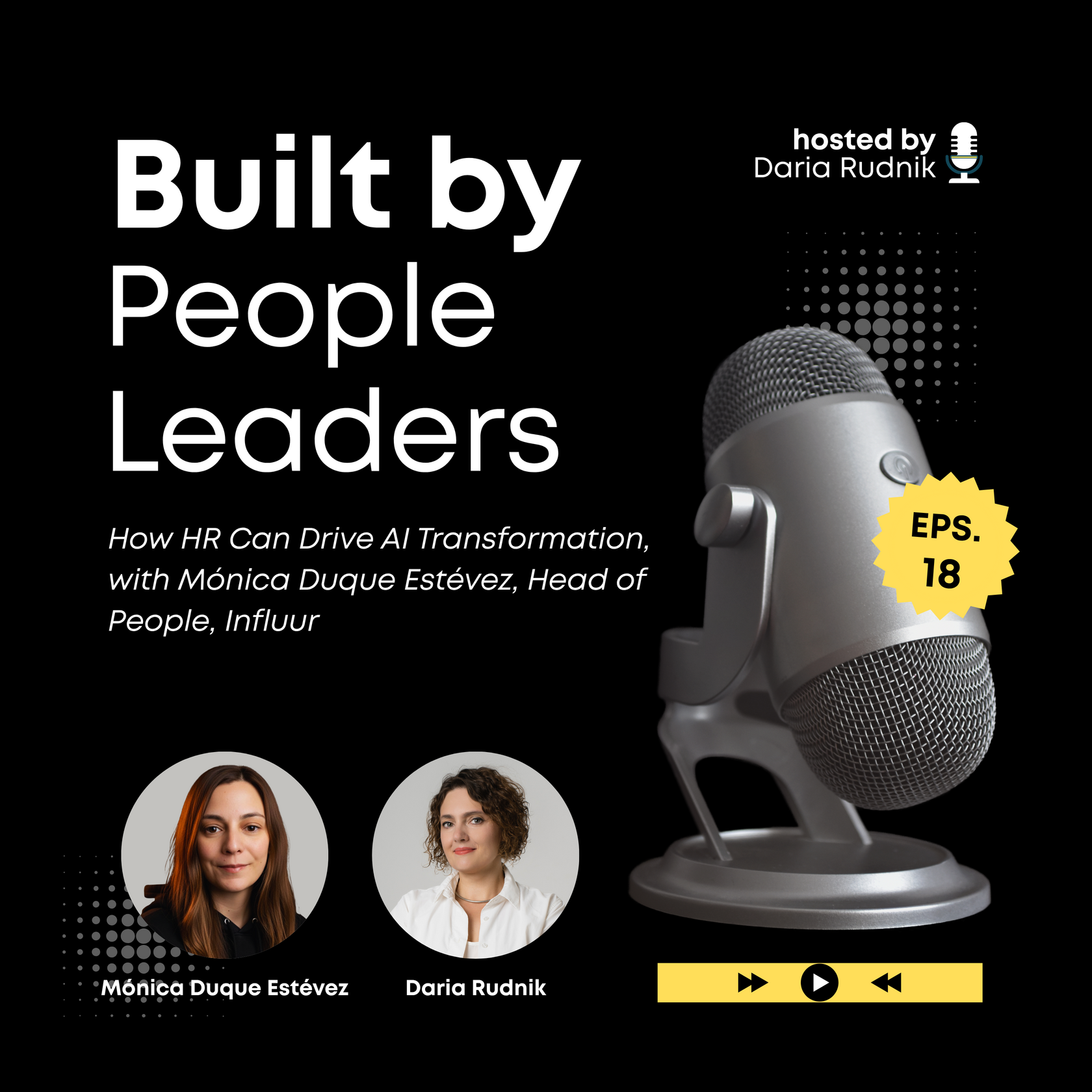
In this episode of the Built by People Leaders podcast, host Daria Rudnik speaks with Monica Duque, senior people leader and AI transformation driver, about what it really takes to build an AI-first organization.
Drawing from her hands-on experience transforming a company through AI, Monica shares how HR can move from a support function to the driver of organizational change. Instead of waiting to be invited to the table, she explains why HR must lead by example — starting with its own processes, automating workflows, and proving impact through measurable results.
The conversation explores how AI is reshaping not just tools, but entire organizational structures. Monica introduces the concept of “blended teams” — combining full-time employees, AI agents, and fractional experts — and explains why this model is becoming essential for modern companies.
They also dive into the practical side of AI adoption: how to train non-technical teams, run internal AI challenges, and create a culture of experimentation that actually delivers ROI.
Finally, Monica shares her “secret recipe” for successful AI transformation — and why the real challenge is not technology, but mindset.
Key Takeaways
- HR becomes a driver of AI transformation only when it builds and proves solutions itself, not when it facilitates or coordinates others.
- AI adoption works only through bottom-up learning — real change happens when teams experiment hands-on, not when leaders mandate it.
- The emerging org model is not just “AI-powered” — it’s blended teams: employees + AI agents + fractional experts working as one system.
- The real ROI of AI is not in tools, but in headcount leverage — the ability to scale output without scaling teams.
- The biggest shift is not technological but behavioral: mindset changes only when leaders actively learn and build alongside their teams.
Chapters
00:00 Introduction to AI-Ready Organizations
07:37 Measuring AI Transformation Success
16:14 Framework for AI Deployment
23:53 Mental Health and Cybersecurity in AI
Daria Rudnik (00:01.504)
Welcome to Built by People Leaders podcast, brought to you by Aidra AI, your AI-powered coach for leaders in tech. I'm your host, Daria Rudnik, and this show is for HR and L&D leaders, those who are building real impact from within and building AI-ready organizations. If you go to DariaRudnik.com, you can download AI-ready team framework, your practical guide to building teams, mature teams, ready for AI era. And today I have a...
very special guest and I'm so excited to have this conversation because this is the person who is building AI ready organizations every day. And it's Monica Duque, a senior people and HR leader with experience scaling people functions in fast growing international organizations. Monica helps founders and leadership teams evolve each HR into a strategic partner during periods of rapid growth.
A key highlight of her work has been transforming an organization into an AI first company by redesigning the org structure, roles, and decision-making models to embed AI into how business operates. So welcome Monika, I'm so happy to have this conversation with you and please tell us a bit about yourself and your journey.
Monica Duque (01:19.032)
Hi, Daria. Thank you so much for the invite. I'm very excited to be here as well. So my name is Monica. I've been in HR for the past seven, eight years of my career. I started my career as a labor unemployment lawyer, and eventually I shifted to the HR world. And for me, it's just fascinating living, being alive in this time where everything is changing with AI. And yeah, I think that the past year we've been
transforming how our teamwork and there's a lot of amazing things I would love to share with you as
Daria Rudnik (01:56.423)
Well, thanks. And I'm super excited. I have so many questions to ask you. But let's start with what statistics and data tells us. It's a lot about that.
Monica Duque (02:00.341)
haha
Daria Rudnik (02:09.326)
A lot of HR, there are a lot of HR tools, recruitment and operations and HR people are using AI. But on the other hand, there is an, I think it was the IBM report that tells us that less than 1 % of CEOs actually see HR as strategic partners in AI transformation. And I'm curious to know what's your opinion on that? Why do you think that is?
Monica Duque (02:35.402)
I love that question. to be honest, one of the things that I think that CEOs don't see HR as a strategic partner is because honestly, we don't own the processes, right? But with AI, we are the ones owning the process. Transformation should come from our people. You need to transform the mindset. You need to transform the culture of organization. Otherwise, the transformation is not going to happen, right? So
Yes, that number is very, low, but we still can do it. I'm doing it today. I'm sitting in the table. sitting with the founders. I'm driving a strategy. And I think that the secret recipe for that, we can keep it until the end and we can share it with you guys. But there's a lot of things that we can do to make sure that we gain like this seat in the table.
Daria Rudnik (03:33.554)
I love that. Yes. Will you please stay with us till the end? We'll share the secret recipe to successful AI transformation. And I totally agree with you that AI should sit at the table while organizations becoming AI ready or AI first organizations. And from the conversations I'm having here on this show with HR leaders, I see that those companies where HR is actually driving or at least like taking very active strategic role in AI transformation, they are showing better
ROI or better implementation in terms of AI. And while the companies that do not invite HR to the table to this conversation are kind of struggling in doing that. And I'm wondering for all HR people out there, what would you recommend? How can they go out proactively and what should they say? Please include me, please invite me to the meeting.
Monica Duque (04:28.424)
Never, never say that. No, no, So to be honest, I think that right now the companies that are having better success, if you see Spotify's case, for example, the department who is leading this transformation is HR. It's not like, invite me. It's like driving the process yourself, right? So the first thing that I would do is learn AI. And by learning AI, it's not like, look at a couple of...
news and that's it. No, no, no. Learn AI yourself. You need to learn how to use N8n and automate your processes in HR. You need to learn how to use a cloud and automate your processes with using cloud, right? So for example, I use a lot of cloud co-work right now. We use a lot of N8n to be honest. We've automated, I think the majority of our processes and that leave us like a lot of time to do other things.
And the curious thing about AI is that people and CEOs and founders, don't believe the potential until they see results, right? Which is accurate. mean, it's a perfect mindset. But then when you start showing those results, that shift, that mindset shifts completely. And for us, I think it is incredible. one of the teams in my current company that
has developed and automated more is the HR team. So we lead by example. That's the only way for you to gain like this, you know, like this opportunity to be included. And then people will come to you, hey, you did that with your team, how can you help me with mine? And then right now we are driving the whole change in the organization. We actually have a beautiful AI tracker in Lovable right now.
Daria Rudnik (06:15.439)
Okay.
Monica Duque (06:19.924)
We're doing a lot of different initiatives and it is amazing because we have the numbers. So remember that when you want to sit in the table with a CEO, when you want to be included, you need to speak the same language. HR usually speaks like current people language and that is a language that no one understands in an organization. So you need to start speaking with numbers. So for me is how are you going to speak with numbers?
Daria Rudnik (06:45.583)
you you
Monica Duque (06:48.748)
And I'm going to give you one example. Currently in my company, we have one QIAR, which is at least one agent per full-time employee. So very straightforward. And every single week, we're tracking how many agents have you built. And it's amazing. People are building agents. So it is incredible.
Daria Rudnik (07:11.823)
I'm curious how you measure success of those AI agents, because again, from what I see on the market, everyone is playing with AI. think 98 % of companies are implementing AI at some stages in some various functions. But to be honest, very few, I think it's less than 5 % actually see ROI on the AI initiatives. How do you measure effectiveness of your AI transformation?
Monica Duque (07:39.202)
That's a great question. So I think we have two different ways to measure it. The first one is, of course, the time that you are saving by building this agent. So this is a crazy way we're measuring it, but we love it because it's very tangible. And actually, the board loves it as well. They're seeing tangible results. for example, this year, we ended up the year with, I think that
Daria Rudnik (07:47.707)
You If.
Monica Duque (08:08.726)
like 10 headcount less than was initially planned for the year. And when we started understanding why we were able to end the year with less headcount, we realized that it was related to the number of hours we've saved with the tools we've created with AI. So that's very tangible and that's a great way to showcase your work as well. So the amount of FTEs, of course, and here by the amount of it,
FTs, I'm not telling everyone like go on, cut your head, not necessarily, but then maybe you were planning to include X amount of new roles and you just can transform your organization internally, transform your orgs and with the AI tools that you're building, then you will see like the amount of hours that you're saving. And it is crazy when you correlate these two metrics because
Daria Rudnik (08:47.375)
you You
Monica Duque (09:07.018)
the correlation at least in my experience is there and it's amazing. It is to be honest one of the best slides I did for the board the past week you know it's crazy so yeah.
Daria Rudnik (09:19.651)
Well, since you mentioned that, like less people in the company, less hiring, does it mean that AI is actually taking people's jobs?
Monica Duque (09:29.474)
Yeah, that's a great question as well. I don't think so. I don't think AI is going to take people's jobs. I don't think so, but things are going to change a lot. And this means that the people, and I think this is a quote that everyone has been saying, the people who don't know how to use AI, they are not going to make it. Like you need to learn how to use AI.
And by use AI is not using chat GPT or creating building one GPT. That's not it. Like a GPT is not even in proper Asia. Like it's not it. You need to learn how to use AI. Like a hundred percent. It doesn't matter if you're in HR. It doesn't matter if you're in finance. It doesn't matter if you're in whatever role you are. Like you need to start to learn how to use AI. So a lot of people...
Daria Rudnik (09:58.913)
You
Monica Duque (10:19.32)
when they see our charts and the amount of hours saved and everything, and they see the amount of hours HR has been saving, it's crazy because we're an HR team. We're not a technical team. Last year, we were a team of two people, two people building, you know, like doing a lot of things. And we managed to automate almost everything in our department. That's crazy. And yeah, it's...
Daria Rudnik (10:44.608)
That's a great example. mean, everyone should... It's amazing,
Monica Duque (10:48.686)
And then when people say no, but I can't do it, I say, well, I'm in HR. What do you mean? If HR can do it, I think you can do it, right? And then you see the response of the person and it's crazy.
Daria Rudnik (11:04.845)
And you're right. mean, we all have a great tool to learn like AI. If you don't know how to use AI, ask AI and help you learn how to use AI. Ask AI how to build your first AI agent. It'll help you. There were a lot of, again, there were a lot of tools, there were a of frameworks and it's just regular chat GPT. Start with it. Start with something. Start trying, experimenting, failing, and then you'll make it. And I agree with what you're saying that AI is not taking our job.
It redesigns because yes, some companies might be hiring less people, but there are other people who are starting their own companies and they need their teams. Teams that again, will be able to use AI and will be able to produce something with less people, more AI, but eventually will have more product, will have more business, will have hopefully growth and economy. I'm an optimist. know, maybe overlay optimistic.
But I do believe there is a great future in how we use AI. But again, you mentioned redesigning and you mentioned changing the structure. How do you think organizations should change or how HR should change organizations when AI is entering the workplace?
Monica Duque (12:23.52)
Yeah, I love that question and it's very linked to your to your past question as well. So there there's one thing and that and this is another secret why I don't think AI is going to take people's jobs. Right now you see all of these young organizations like you see a lovable right a very solid organization with which has a very small team and they're making millions in ARR right that's and it's not only lovable they're
hundreds, thousands of companies like this. But there's one little secret that people don't realize. You need what right now it's been discussed as blended teams. What does this mean? So you're going to have an AI org chart. Your org chart is going to change. So it's going to transform. You will have your full-time employees, the people that you know. However, these full-time employees, they need to be AI architects. All of them, they need to know how to use AI, right?
And then you will have your AI agents. They're going to be like the second bucket of this blended team. And then the third one is going to be what we call like fractional experts. Why do you need them? Because your full-time employees are going to be these AI kids. They're going to be young, very willing to learn. They're going to be these people who will try every single new tool every day. They're going to
a run up and cloud with a thousand Mac minis. And that's the people that you want as your full-time employees, right? But then you need to give them a little bit of strategy and like common sense, right? And that's where more senior people will start to appear. And then you start seeing all of these people who have done it before and that are of course very open with technology and with AI, like coming as fractionals to our teams and
helping them to give them a little bit of perspective on how to turn around different things. Because with AI, yes, you can create a lot, you can build a lot, but then you need the strategy, you need to close the deals if you want to sell something, you need to, and that is something that AI, at least until today, is not able to do. For that, you need the experience. So I would say that...
Monica Duque (14:42.114)
blended teams is the best way of building your org structure right now. And when you start understanding this, you will very easily start understanding why AI is not going to take all of our roles.
Daria Rudnik (14:56.973)
I mean, I couldn't agree more. And I've seen this shift starting probably even before pandemic, when there was a geek economy, there were a lot of freelancers, people working on different projects and kind of joining teams for some specific tasks and some specific projects. with pandemic, people started to feel, okay, I can choose where to work. I can choose how to work. I can choose who to work with.
And we have even more freelancers. now with the, again, with the economy and I see a lot of senior leaders who don't want to be in this constant wheel of chasing some new target, new corporate target, but who want to see some meaning, who want to build something. And they are joining companies as fractional CTOs, CMOs, CHROs, CLOs. They bring strategy, but
on the kind of a specific level, specific timeframe, and then they go and they consult. And with AI, that even amplifies that change. And I think more more companies need to accept that and be more, less conservative about how they build their org charts, how they build their structures, because it's the freelancers, fractional teams, AI agents, and regular team members. Amazing. That's so cool.
You mentioned you have some kind of a framework of how to deploy AI. Do you want to it?
Monica Duque (16:23.771)
Yeah, so I mean it's not like a proper I'm not a I'm not a corporate person. I'm a startup person, right? that's something so it's not like a super proper framework But to be able to do these to be able to drive this transformation Of course one you need to gain your seat at the table and the only way to do that is start showing some results So that's first like the first thing to go
Daria Rudnik (16:31.311)
You
Monica Duque (16:50.54)
And then once you're there and once you are like in charge of driving this like transformation, like you need to start by people learning the way you learn, right? And that's the only way to do it. So again, if the CEO comes and say, Hey, you need to do this transformation because I say so, probably that's not going to happen. Right? So how are you going to make sure that your team have the time, the tools?
and all these support from the company to actually learn AI and make sure that what they're building is accepted and actually encouraged by the organization. So the first thing, a part of gaining your seat and leading these would be like little hackathons. So what we're doing right now is what we call the AI challenges. I think we're in phase number two. We have three phases.
and we divided our organization. This is the second time we do it. So the first one was a year ago. The second one is right now. We divided in three phases. And our team is in one week of learning mode. So they are learning different things. We have a challenge in our lovable web, and it's amazing. You unlock different challenges daily, and then you learn certain things. And you start from scratch. How do you prompt? How do you create a GPT?
How do you build a very small and in-framework? Yeah, like these typical, like very, very basic things. And then after that second week, they are in building mode. And in building mode, they have two days of totally building their challenge. So depending on your role, at the beginning of the challenge,
you're given like a specific challenge for your role. So for example, in HR, you need to build a tool that is going to help us to analyze the EMP score better. That's it, like a small challenge, right? And then day one and day two of the building week, they would be off, 100 % off, and they will be just building their tool. And then on Friday, AI Friday, they present like a small hack at them, but they're non-technical people.
Monica Duque (19:11.214)
Don't get me wrong, I'm not doing this with we're not technical people or technical people are amazing using AI already. They don't need to learn anything. But we do it with the non-technical team and then they present. They have three minutes and they have to present. And it is crazy to see the, like the, the change in mindset of these people. Like before the two weeks, they were like, no, I cannot do it. I'm not able to, this is super hard. I opened it in and I have a headache.
Daria Rudnik (19:13.519)
you Okay.
Monica Duque (19:38.402)
Right now everyone knows what a node is. Everyone knows how to connect an API key. They know things and we see that change very fast, two weeks and you see change. And then we're tracking everything in our tool, the AI tracker. And then people just log in and they start uploading all of the things that they created in their challenge. And you start seeing different names because we do have a ranking of people starting to like a gamification like
Daria Rudnik (20:05.935)
you
Monica Duque (20:06.99)
I need to build more because I want to win this. I need to build more because I want to win this. You know, and it's great. And then you recognize them in the old hands. And of course, this is just the beginning. After that, you need to map what tools you need to give them. Right now, we don't, I mean, we're a startup. We don't have limited money. We don't have limited resources. So what I did was instead of buying swag for 2026, we decided to invest that money in the AI challenge. And we
are granting everyone like $50 for them to invest in the tools they want to use for the challenge and that's it. And after that $50 are completed and are like spent and they are completing a survey and then we need to start working with finance to see how are we going to keep the tools that each person needs, right? And then after that, you're going to start seeing that changing mindset and yeah.
So that's a little bit of how we're doing it.
Daria Rudnik (21:05.519)
That's a great example. Well, first of all, it's learning by doing. You do something and you learn along the way. I love that, like instead of giving the next hoodie or like a mug, people actually invest in that and they're learning while doing something, creating something. And that's the thing when you involve people, all people come together and try and do something, you're doing it together and you have this chart with people who...
do more AI agents or experiment more with AI, kind of creates this spirit that we are in this journey together. We can do things. We can be fast. We can be efficient. We can be great.
Monica Duque (21:46.432)
Yeah and of course here we change one of our values, leaders are presenting as well, it's not just like everyone else, leaders are presenting like the first week, the first phase I presented of course, no one knew I was going to present but at the end I was like hey we need my example I'm presenting today as well and I presented at the end my tool and leaders present.
They have the same challenge, they have the same time, they need to present as well. You lead by example. And then people are very excited because they see how their leaders are also in the same boat trying to learn. I think that there's a big disconnection between leaders who push people to learn AI and leaders who learn how to build AI and with their teams together, they start building.
Daria Rudnik (22:13.903)
Yeah. Yeah.
I'll play a little skeptic and ask you a tough question. Well, I've seen teams and companies being excited with AI and kind of studying, yes, let's go for it. Let's do it. But when people use AI wrong, can overuse AI or don't use it for the right purposes?
Monica Duque (22:44.744)
Of course, go.
Daria Rudnik (23:01.199)
kind of lose engagement and motivation because when we overuse AI, mind goes blank. The brain actually becomes disengaged when we don't use AI in the right way. On the other hand, people using different tools, they're trying to stick to those tools and not use kind of unified approach and unified metrics. How do we measure success? So I'm curious, what's your take on this sustainable and
cautious use of AI, like still being optimistic, but very conscious about how we use it.
Monica Duque (23:36.564)
Yeah, I love that. So to be honest with you, right now we're pushing everyone to use every tool to learn a lot, but you need to be very cautious with certain things like of course, cybersecurity for the company and then for the person who is using the tools, like I would say
Yeah, mental health, but mental health in a different way than the one that we've seen until this point, right? Currently at my company, my company, what it does is that it connects like brands with influencers. So we are very heavy users of all of these tools that affect your mental health, like TikTok, right? A lot of our team, their job is to be on TikTok every single hour of the day, right? And that's crazy because you can like, you cannot imagine how
Daria Rudnik (24:17.743)
So.
Monica Duque (24:29.752)
how a person can sustain this, right? So, I mean, I would say that I don't have an answer for this 100%, but I think that at the end, you need to start seeing for this red flag. So when you start seeing that a lot of people are burning out, if you start seeing a lot of people raising their hand, like this is an experiment, like I wish I had all the answers, I don't. We are all learning how to live with this new reality.
Daria Rudnik (24:43.503)
Mm-hmm.
Monica Duque (24:59.63)
But I do think that mental health needs to be somehow protected by the company for the employee. And then on the other side, the company needs to make sure they have their cybersecurity covered because people, there's a lot of, I mean, there's a lot of tools and a lot of tools that are very insecure. So I think it goes both ways and the company here needs to be very strategic, needs to protect the team and of course need to protect the cybersecurity of the company person.
Daria Rudnik (25:22.991)
Well, thanks for being honest and open answering that question. I know a lot of companies in this experimentation trial and error stage, kind of thinking for their head, okay, we're trying this, but we need to be mindful about what's coming next. And we're watching for the red flags. That's very smart. If you...
Monica Duque (25:33.507)
Yeah.
Daria Rudnik (25:49.639)
If you had a magic wand and you could solve one professional challenge HR has, what would that be?
Monica Duque (25:57.664)
So for me it's reputation and maybe you don't like this answer because it's not like I mean in terms of doing things I think we're capable of doing whatever we want so for me yeah the sky is the limit I don't think that we're limited by anything anything else than reputation when you say that's why I don't have the HR world word in my my role my role is head of people I don't like much the HR word
and I don't like it because it has a bad reputation. we actually in the company make a lot of fun about that. We have one of our agents is called Karen from HR, which is crazy. And people just laugh about it, right? Because it's so Karen, like HR, it's so boring. And people believe you're like, I don't know, doing agreements and paying payroll. And that's what you do. But the thing is that that's not what you do. You are running and driving strategy in the company.
Daria Rudnik (26:38.741)
you
Monica Duque (26:56.33)
So for me that bad reputation, it needs to go away and hopefully with AI we can make this happen.
Daria Rudnik (27:05.02)
Yeah, yeah, I agree and like with like
Talk conversations like this, talking to people who show example and really lead AI transformation. think a lot of HR people can take this approach and that's how we change our reputation. Okay, now I have a few kind of personal rapid fire questions. It's going to be fun. Are you ready? Are you a tea person or a coffee person?
Monica Duque (27:26.54)
I am ready, let's do it.
Monica Duque (27:32.467)
Well, I am from Colombia. My answer should be I love coffee, but I don't. I love tea, so I'm a tea person.
Daria Rudnik (27:39.779)
Dogs or cats?
Monica Duque (27:41.119)
Docs 100 %
Daria Rudnik (27:43.811)
Would you rather take a message or a phone call?
Monica Duque (27:47.434)
message I hate phone calls and I hate voice-outs as well so I have a lot of things to do so I need to constantly you know like be on my on my phone and yeah my agenda is back to back with calls I can never answer my phone I'm sorry for those who call me
Daria Rudnik (27:52.143)
you
Daria Rudnik (28:05.551)
What did you want to be when you were a kid?
Monica Duque (28:11.552)
I wanted to be a veterinarian. So I love animals and that's what I wanted to be. I didn't do it, but I wanted to be.
Daria Rudnik (28:19.951)
What's one rule that you've broken but don't regret?
Monica Duque (28:26.452)
I broke a lot of rules. Like, look at what I've been telling you throughout the whole podcast, right? I am a rule broker. But I would say that I was supposed to be a lawyer and I started my career as a lawyer. I was in a law firm for almost five years and I broke the rule and I just changed my career one day. I woke up and I told my parents.
Daria Rudnik (28:32.473)
yeah, that's it.
you
Monica Duque (28:55.948)
I'm going to do a masters in HR. My dad was... He was... Yeah, he was just very surprised. He didn't like it at all. And yeah, that's what I wanted to do. And here we are. So I broke the biggest rule.
Daria Rudnik (28:56.335)
Well, I'm very glad you did that. You're doing an amazing job in HR and changing the way many HR people operate. So yeah, good job. Well.
Monica Duque (29:23.938)
Thank you.
Daria Rudnik (29:24.835)
Thanks for having this conversation. We still have one kind of tip. It's a secret source to your AI transformation. So stay with us and Monica will shed at the end of this conversation. But before we go to that, before we go to this final secret source, well, how people can reach out to you? How can they find you?
Monica Duque (29:43.68)
Yeah, so they can find me in LinkedIn. I mean, pretty straightforward. Just DM me. I'll try to answer as soon as possible. Maybe you can put in the subject, the name of the podcast and, you know, build by people. And then we can just, I can just filter and make sure I can answer to her.
Daria Rudnik (30:05.953)
All right. Well, the link to to Monica's LinkedIn profile is in notes to this episode. And again, thank you for having this conversation with me. Thanks for sharing your experience, for being open and honest, answering even tough questions, because I know we don't have all the answers, but that's how we learn. We try, we experiment, we learn from that. But please tell us now, what's the secret source to AI, successful AI transformation?
Monica Duque (30:32.18)
Yeah, so my secret recipe, mean, I hope it works for everyone, right? But this has been working for me and for some people I know. And all of this transformation, it's a changing mindset. That's the only way to do it. You need to change the way your team members are thinking, the way they're operating, their way of working. That's the only way. And then to do that,
And I think I mentioned this before, this is not top down. This is not a CEO or leadership team saying, hey, you need to go and do that. You learn AI and you bring all the results to us. That's not how it works. So the transformation needs to be bottom-up. And here is the secret for this to happen. Lead by example, right? I think I mentioned this throughout my whole conversation with you, Daria.
when you lead by example, when your leaders are doers and they are down in the trenches learning with their teams and learning the tools, start changing and you start seeing the changing mindset that you need. Of course, and I'm an HR person, I did change my values by the way. you know, like values are very important in my company.
It goes a little bit beyond, right? So for me, you change your values when the organization is starting to behave in a different way. The culture is your DNA. So you need to change that mindset of your teams. And the only way to do it is leading by example for me.
Daria Rudnik (32:17.168)
Well, thank you so much. That was an amazing conversation about AI and how organizations should change, about fractional roles in AI agents and how HR and non-technical people can build their teams of AI agents and the secret sauce, the secret recipe to successful AI transformation in changing mindset. So thank you, Monica, for sharing this with us. Thank you for all listeners who've been watching and listening to this episode.
If you like it, please give it five-star review on Apple Podcasts or Spotify and subscribe to our YouTube channel and stay tuned for the next episodes. Bye.
Welcome to Built by People Leaders podcast, brought to you by Aidra AI, your AI-powered coach for leaders in tech. I'm your host, Daria Rudnik, and this show is for HR and L&D leaders, those who are building real impact from within and building AI-ready organizations. If you go to DariaRudnik.com, you can download AI-ready team framework, your practical guide to building teams, mature teams, ready for AI era. And today I have a...
very special guest and I'm so excited to have this conversation because this is the person who is building AI ready organizations every day. And it's Monica Duque, a senior people and HR leader with experience scaling people functions in fast growing international organizations. Monica helps founders and leadership teams evolve each HR into a strategic partner during periods of rapid growth.
A key highlight of her work has been transforming an organization into an AI first company by redesigning the org structure, roles, and decision-making models to embed AI into how business operates. So welcome Monika, I'm so happy to have this conversation with you and please tell us a bit about yourself and your journey.
Monica Duque (01:19.032)
Hi, Daria. Thank you so much for the invite. I'm very excited to be here as well. So my name is Monica. I've been in HR for the past seven, eight years of my career. I started my career as a labor unemployment lawyer, and eventually I shifted to the HR world. And for me, it's just fascinating living, being alive in this time where everything is changing with AI. And yeah, I think that the past year we've been
transforming how our teamwork and there's a lot of amazing things I would love to share with you as
Daria Rudnik (01:56.423)
Well, thanks. And I'm super excited. I have so many questions to ask you. But let's start with what statistics and data tells us. It's a lot about that.
Monica Duque (02:00.341)
haha
Daria Rudnik (02:09.326)
A lot of HR, there are a lot of HR tools, recruitment and operations and HR people are using AI. But on the other hand, there is an, I think it was the IBM report that tells us that less than 1 % of CEOs actually see HR as strategic partners in AI transformation. And I'm curious to know what's your opinion on that? Why do you think that is?
Monica Duque (02:35.402)
I love that question. to be honest, one of the things that I think that CEOs don't see HR as a strategic partner is because honestly, we don't own the processes, right? But with AI, we are the ones owning the process. Transformation should come from our people. You need to transform the mindset. You need to transform the culture of organization. Otherwise, the transformation is not going to happen, right? So
Yes, that number is very, low, but we still can do it. I'm doing it today. I'm sitting in the table. sitting with the founders. I'm driving a strategy. And I think that the secret recipe for that, we can keep it until the end and we can share it with you guys. But there's a lot of things that we can do to make sure that we gain like this seat in the table.
Daria Rudnik (03:33.554)
I love that. Yes. Will you please stay with us till the end? We'll share the secret recipe to successful AI transformation. And I totally agree with you that AI should sit at the table while organizations becoming AI ready or AI first organizations. And from the conversations I'm having here on this show with HR leaders, I see that those companies where HR is actually driving or at least like taking very active strategic role in AI transformation, they are showing better
ROI or better implementation in terms of AI. And while the companies that do not invite HR to the table to this conversation are kind of struggling in doing that. And I'm wondering for all HR people out there, what would you recommend? How can they go out proactively and what should they say? Please include me, please invite me to the meeting.
Monica Duque (04:28.424)
Never, never say that. No, no, So to be honest, I think that right now the companies that are having better success, if you see Spotify's case, for example, the department who is leading this transformation is HR. It's not like, invite me. It's like driving the process yourself, right? So the first thing that I would do is learn AI. And by learning AI, it's not like, look at a couple of...
news and that's it. No, no, no. Learn AI yourself. You need to learn how to use N8n and automate your processes in HR. You need to learn how to use a cloud and automate your processes with using cloud, right? So for example, I use a lot of cloud co-work right now. We use a lot of N8n to be honest. We've automated, I think the majority of our processes and that leave us like a lot of time to do other things.
And the curious thing about AI is that people and CEOs and founders, don't believe the potential until they see results, right? Which is accurate. mean, it's a perfect mindset. But then when you start showing those results, that shift, that mindset shifts completely. And for us, I think it is incredible. one of the teams in my current company that
has developed and automated more is the HR team. So we lead by example. That's the only way for you to gain like this, you know, like this opportunity to be included. And then people will come to you, hey, you did that with your team, how can you help me with mine? And then right now we are driving the whole change in the organization. We actually have a beautiful AI tracker in Lovable right now.
Daria Rudnik (06:15.439)
Okay.
Monica Duque (06:19.924)
We're doing a lot of different initiatives and it is amazing because we have the numbers. So remember that when you want to sit in the table with a CEO, when you want to be included, you need to speak the same language. HR usually speaks like current people language and that is a language that no one understands in an organization. So you need to start speaking with numbers. So for me is how are you going to speak with numbers?
Daria Rudnik (06:45.583)
you you
Monica Duque (06:48.748)
And I'm going to give you one example. Currently in my company, we have one QIAR, which is at least one agent per full-time employee. So very straightforward. And every single week, we're tracking how many agents have you built. And it's amazing. People are building agents. So it is incredible.
Daria Rudnik (07:11.823)
I'm curious how you measure success of those AI agents, because again, from what I see on the market, everyone is playing with AI. think 98 % of companies are implementing AI at some stages in some various functions. But to be honest, very few, I think it's less than 5 % actually see ROI on the AI initiatives. How do you measure effectiveness of your AI transformation?
Monica Duque (07:39.202)
That's a great question. So I think we have two different ways to measure it. The first one is, of course, the time that you are saving by building this agent. So this is a crazy way we're measuring it, but we love it because it's very tangible. And actually, the board loves it as well. They're seeing tangible results. for example, this year, we ended up the year with, I think that
Daria Rudnik (07:47.707)
You If.
Monica Duque (08:08.726)
like 10 headcount less than was initially planned for the year. And when we started understanding why we were able to end the year with less headcount, we realized that it was related to the number of hours we've saved with the tools we've created with AI. So that's very tangible and that's a great way to showcase your work as well. So the amount of FTEs, of course, and here by the amount of it,
FTs, I'm not telling everyone like go on, cut your head, not necessarily, but then maybe you were planning to include X amount of new roles and you just can transform your organization internally, transform your orgs and with the AI tools that you're building, then you will see like the amount of hours that you're saving. And it is crazy when you correlate these two metrics because
Daria Rudnik (08:47.375)
you You
Monica Duque (09:07.018)
the correlation at least in my experience is there and it's amazing. It is to be honest one of the best slides I did for the board the past week you know it's crazy so yeah.
Daria Rudnik (09:19.651)
Well, since you mentioned that, like less people in the company, less hiring, does it mean that AI is actually taking people's jobs?
Monica Duque (09:29.474)
Yeah, that's a great question as well. I don't think so. I don't think AI is going to take people's jobs. I don't think so, but things are going to change a lot. And this means that the people, and I think this is a quote that everyone has been saying, the people who don't know how to use AI, they are not going to make it. Like you need to learn how to use AI.
And by use AI is not using chat GPT or creating building one GPT. That's not it. Like a GPT is not even in proper Asia. Like it's not it. You need to learn how to use AI. Like a hundred percent. It doesn't matter if you're in HR. It doesn't matter if you're in finance. It doesn't matter if you're in whatever role you are. Like you need to start to learn how to use AI. So a lot of people...
Daria Rudnik (09:58.913)
You
Monica Duque (10:19.32)
when they see our charts and the amount of hours saved and everything, and they see the amount of hours HR has been saving, it's crazy because we're an HR team. We're not a technical team. Last year, we were a team of two people, two people building, you know, like doing a lot of things. And we managed to automate almost everything in our department. That's crazy. And yeah, it's...
Daria Rudnik (10:44.608)
That's a great example. mean, everyone should... It's amazing,
Monica Duque (10:48.686)
And then when people say no, but I can't do it, I say, well, I'm in HR. What do you mean? If HR can do it, I think you can do it, right? And then you see the response of the person and it's crazy.
Daria Rudnik (11:04.845)
And you're right. mean, we all have a great tool to learn like AI. If you don't know how to use AI, ask AI and help you learn how to use AI. Ask AI how to build your first AI agent. It'll help you. There were a lot of, again, there were a lot of tools, there were a of frameworks and it's just regular chat GPT. Start with it. Start with something. Start trying, experimenting, failing, and then you'll make it. And I agree with what you're saying that AI is not taking our job.
It redesigns because yes, some companies might be hiring less people, but there are other people who are starting their own companies and they need their teams. Teams that again, will be able to use AI and will be able to produce something with less people, more AI, but eventually will have more product, will have more business, will have hopefully growth and economy. I'm an optimist. know, maybe overlay optimistic.
But I do believe there is a great future in how we use AI. But again, you mentioned redesigning and you mentioned changing the structure. How do you think organizations should change or how HR should change organizations when AI is entering the workplace?
Monica Duque (12:23.52)
Yeah, I love that question and it's very linked to your to your past question as well. So there there's one thing and that and this is another secret why I don't think AI is going to take people's jobs. Right now you see all of these young organizations like you see a lovable right a very solid organization with which has a very small team and they're making millions in ARR right that's and it's not only lovable they're
hundreds, thousands of companies like this. But there's one little secret that people don't realize. You need what right now it's been discussed as blended teams. What does this mean? So you're going to have an AI org chart. Your org chart is going to change. So it's going to transform. You will have your full-time employees, the people that you know. However, these full-time employees, they need to be AI architects. All of them, they need to know how to use AI, right?
And then you will have your AI agents. They're going to be like the second bucket of this blended team. And then the third one is going to be what we call like fractional experts. Why do you need them? Because your full-time employees are going to be these AI kids. They're going to be young, very willing to learn. They're going to be these people who will try every single new tool every day. They're going to
a run up and cloud with a thousand Mac minis. And that's the people that you want as your full-time employees, right? But then you need to give them a little bit of strategy and like common sense, right? And that's where more senior people will start to appear. And then you start seeing all of these people who have done it before and that are of course very open with technology and with AI, like coming as fractionals to our teams and
helping them to give them a little bit of perspective on how to turn around different things. Because with AI, yes, you can create a lot, you can build a lot, but then you need the strategy, you need to close the deals if you want to sell something, you need to, and that is something that AI, at least until today, is not able to do. For that, you need the experience. So I would say that...
Monica Duque (14:42.114)
blended teams is the best way of building your org structure right now. And when you start understanding this, you will very easily start understanding why AI is not going to take all of our roles.
Daria Rudnik (14:56.973)
I mean, I couldn't agree more. And I've seen this shift starting probably even before pandemic, when there was a geek economy, there were a lot of freelancers, people working on different projects and kind of joining teams for some specific tasks and some specific projects. with pandemic, people started to feel, okay, I can choose where to work. I can choose how to work. I can choose who to work with.
And we have even more freelancers. now with the, again, with the economy and I see a lot of senior leaders who don't want to be in this constant wheel of chasing some new target, new corporate target, but who want to see some meaning, who want to build something. And they are joining companies as fractional CTOs, CMOs, CHROs, CLOs. They bring strategy, but
on the kind of a specific level, specific timeframe, and then they go and they consult. And with AI, that even amplifies that change. And I think more more companies need to accept that and be more, less conservative about how they build their org charts, how they build their structures, because it's the freelancers, fractional teams, AI agents, and regular team members. Amazing. That's so cool.
You mentioned you have some kind of a framework of how to deploy AI. Do you want to it?
Monica Duque (16:23.771)
Yeah, so I mean it's not like a proper I'm not a I'm not a corporate person. I'm a startup person, right? that's something so it's not like a super proper framework But to be able to do these to be able to drive this transformation Of course one you need to gain your seat at the table and the only way to do that is start showing some results So that's first like the first thing to go
Daria Rudnik (16:31.311)
You
Monica Duque (16:50.54)
And then once you're there and once you are like in charge of driving this like transformation, like you need to start by people learning the way you learn, right? And that's the only way to do it. So again, if the CEO comes and say, Hey, you need to do this transformation because I say so, probably that's not going to happen. Right? So how are you going to make sure that your team have the time, the tools?
and all these support from the company to actually learn AI and make sure that what they're building is accepted and actually encouraged by the organization. So the first thing, a part of gaining your seat and leading these would be like little hackathons. So what we're doing right now is what we call the AI challenges. I think we're in phase number two. We have three phases.
and we divided our organization. This is the second time we do it. So the first one was a year ago. The second one is right now. We divided in three phases. And our team is in one week of learning mode. So they are learning different things. We have a challenge in our lovable web, and it's amazing. You unlock different challenges daily, and then you learn certain things. And you start from scratch. How do you prompt? How do you create a GPT?
How do you build a very small and in-framework? Yeah, like these typical, like very, very basic things. And then after that second week, they are in building mode. And in building mode, they have two days of totally building their challenge. So depending on your role, at the beginning of the challenge,
you're given like a specific challenge for your role. So for example, in HR, you need to build a tool that is going to help us to analyze the EMP score better. That's it, like a small challenge, right? And then day one and day two of the building week, they would be off, 100 % off, and they will be just building their tool. And then on Friday, AI Friday, they present like a small hack at them, but they're non-technical people.
Monica Duque (19:11.214)
Don't get me wrong, I'm not doing this with we're not technical people or technical people are amazing using AI already. They don't need to learn anything. But we do it with the non-technical team and then they present. They have three minutes and they have to present. And it is crazy to see the, like the, the change in mindset of these people. Like before the two weeks, they were like, no, I cannot do it. I'm not able to, this is super hard. I opened it in and I have a headache.
Daria Rudnik (19:13.519)
you Okay.
Monica Duque (19:38.402)
Right now everyone knows what a node is. Everyone knows how to connect an API key. They know things and we see that change very fast, two weeks and you see change. And then we're tracking everything in our tool, the AI tracker. And then people just log in and they start uploading all of the things that they created in their challenge. And you start seeing different names because we do have a ranking of people starting to like a gamification like
Daria Rudnik (20:05.935)
you
Monica Duque (20:06.99)
I need to build more because I want to win this. I need to build more because I want to win this. You know, and it's great. And then you recognize them in the old hands. And of course, this is just the beginning. After that, you need to map what tools you need to give them. Right now, we don't, I mean, we're a startup. We don't have limited money. We don't have limited resources. So what I did was instead of buying swag for 2026, we decided to invest that money in the AI challenge. And we
are granting everyone like $50 for them to invest in the tools they want to use for the challenge and that's it. And after that $50 are completed and are like spent and they are completing a survey and then we need to start working with finance to see how are we going to keep the tools that each person needs, right? And then after that, you're going to start seeing that changing mindset and yeah.
So that's a little bit of how we're doing it.
Daria Rudnik (21:05.519)
That's a great example. Well, first of all, it's learning by doing. You do something and you learn along the way. I love that, like instead of giving the next hoodie or like a mug, people actually invest in that and they're learning while doing something, creating something. And that's the thing when you involve people, all people come together and try and do something, you're doing it together and you have this chart with people who...
do more AI agents or experiment more with AI, kind of creates this spirit that we are in this journey together. We can do things. We can be fast. We can be efficient. We can be great.
Monica Duque (21:46.432)
Yeah and of course here we change one of our values, leaders are presenting as well, it's not just like everyone else, leaders are presenting like the first week, the first phase I presented of course, no one knew I was going to present but at the end I was like hey we need my example I'm presenting today as well and I presented at the end my tool and leaders present.
They have the same challenge, they have the same time, they need to present as well. You lead by example. And then people are very excited because they see how their leaders are also in the same boat trying to learn. I think that there's a big disconnection between leaders who push people to learn AI and leaders who learn how to build AI and with their teams together, they start building.
Daria Rudnik (22:13.903)
Yeah. Yeah.
I'll play a little skeptic and ask you a tough question. Well, I've seen teams and companies being excited with AI and kind of studying, yes, let's go for it. Let's do it. But when people use AI wrong, can overuse AI or don't use it for the right purposes?
Monica Duque (22:44.744)
Of course, go.
Daria Rudnik (23:01.199)
kind of lose engagement and motivation because when we overuse AI, mind goes blank. The brain actually becomes disengaged when we don't use AI in the right way. On the other hand, people using different tools, they're trying to stick to those tools and not use kind of unified approach and unified metrics. How do we measure success? So I'm curious, what's your take on this sustainable and
cautious use of AI, like still being optimistic, but very conscious about how we use it.
Monica Duque (23:36.564)
Yeah, I love that. So to be honest with you, right now we're pushing everyone to use every tool to learn a lot, but you need to be very cautious with certain things like of course, cybersecurity for the company and then for the person who is using the tools, like I would say
Yeah, mental health, but mental health in a different way than the one that we've seen until this point, right? Currently at my company, my company, what it does is that it connects like brands with influencers. So we are very heavy users of all of these tools that affect your mental health, like TikTok, right? A lot of our team, their job is to be on TikTok every single hour of the day, right? And that's crazy because you can like, you cannot imagine how
Daria Rudnik (24:17.743)
So.
Monica Duque (24:29.752)
how a person can sustain this, right? So, I mean, I would say that I don't have an answer for this 100%, but I think that at the end, you need to start seeing for this red flag. So when you start seeing that a lot of people are burning out, if you start seeing a lot of people raising their hand, like this is an experiment, like I wish I had all the answers, I don't. We are all learning how to live with this new reality.
Daria Rudnik (24:43.503)
Mm-hmm.
Monica Duque (24:59.63)
But I do think that mental health needs to be somehow protected by the company for the employee. And then on the other side, the company needs to make sure they have their cybersecurity covered because people, there's a lot of, I mean, there's a lot of tools and a lot of tools that are very insecure. So I think it goes both ways and the company here needs to be very strategic, needs to protect the team and of course need to protect the cybersecurity of the company person.
Daria Rudnik (25:22.991)
Well, thanks for being honest and open answering that question. I know a lot of companies in this experimentation trial and error stage, kind of thinking for their head, okay, we're trying this, but we need to be mindful about what's coming next. And we're watching for the red flags. That's very smart. If you...
Monica Duque (25:33.507)
Yeah.
Daria Rudnik (25:49.639)
If you had a magic wand and you could solve one professional challenge HR has, what would that be?
Monica Duque (25:57.664)
So for me it's reputation and maybe you don't like this answer because it's not like I mean in terms of doing things I think we're capable of doing whatever we want so for me yeah the sky is the limit I don't think that we're limited by anything anything else than reputation when you say that's why I don't have the HR world word in my my role my role is head of people I don't like much the HR word
and I don't like it because it has a bad reputation. we actually in the company make a lot of fun about that. We have one of our agents is called Karen from HR, which is crazy. And people just laugh about it, right? Because it's so Karen, like HR, it's so boring. And people believe you're like, I don't know, doing agreements and paying payroll. And that's what you do. But the thing is that that's not what you do. You are running and driving strategy in the company.
Daria Rudnik (26:38.741)
you
Monica Duque (26:56.33)
So for me that bad reputation, it needs to go away and hopefully with AI we can make this happen.
Daria Rudnik (27:05.02)
Yeah, yeah, I agree and like with like
Talk conversations like this, talking to people who show example and really lead AI transformation. think a lot of HR people can take this approach and that's how we change our reputation. Okay, now I have a few kind of personal rapid fire questions. It's going to be fun. Are you ready? Are you a tea person or a coffee person?
Monica Duque (27:26.54)
I am ready, let's do it.
Monica Duque (27:32.467)
Well, I am from Colombia. My answer should be I love coffee, but I don't. I love tea, so I'm a tea person.
Daria Rudnik (27:39.779)
Dogs or cats?
Monica Duque (27:41.119)
Docs 100 %
Daria Rudnik (27:43.811)
Would you rather take a message or a phone call?
Monica Duque (27:47.434)
message I hate phone calls and I hate voice-outs as well so I have a lot of things to do so I need to constantly you know like be on my on my phone and yeah my agenda is back to back with calls I can never answer my phone I'm sorry for those who call me
Daria Rudnik (27:52.143)
you
Daria Rudnik (28:05.551)
What did you want to be when you were a kid?
Monica Duque (28:11.552)
I wanted to be a veterinarian. So I love animals and that's what I wanted to be. I didn't do it, but I wanted to be.
Daria Rudnik (28:19.951)
What's one rule that you've broken but don't regret?
Monica Duque (28:26.452)
I broke a lot of rules. Like, look at what I've been telling you throughout the whole podcast, right? I am a rule broker. But I would say that I was supposed to be a lawyer and I started my career as a lawyer. I was in a law firm for almost five years and I broke the rule and I just changed my career one day. I woke up and I told my parents.
Daria Rudnik (28:32.473)
yeah, that's it.
you
Monica Duque (28:55.948)
I'm going to do a masters in HR. My dad was... He was... Yeah, he was just very surprised. He didn't like it at all. And yeah, that's what I wanted to do. And here we are. So I broke the biggest rule.
Daria Rudnik (28:56.335)
Well, I'm very glad you did that. You're doing an amazing job in HR and changing the way many HR people operate. So yeah, good job. Well.
Monica Duque (29:23.938)
Thank you.
Daria Rudnik (29:24.835)
Thanks for having this conversation. We still have one kind of tip. It's a secret source to your AI transformation. So stay with us and Monica will shed at the end of this conversation. But before we go to that, before we go to this final secret source, well, how people can reach out to you? How can they find you?
Monica Duque (29:43.68)
Yeah, so they can find me in LinkedIn. I mean, pretty straightforward. Just DM me. I'll try to answer as soon as possible. Maybe you can put in the subject, the name of the podcast and, you know, build by people. And then we can just, I can just filter and make sure I can answer to her.
Daria Rudnik (30:05.953)
All right. Well, the link to to Monica's LinkedIn profile is in notes to this episode. And again, thank you for having this conversation with me. Thanks for sharing your experience, for being open and honest, answering even tough questions, because I know we don't have all the answers, but that's how we learn. We try, we experiment, we learn from that. But please tell us now, what's the secret source to AI, successful AI transformation?
Monica Duque (30:32.18)
Yeah, so my secret recipe, mean, I hope it works for everyone, right? But this has been working for me and for some people I know. And all of this transformation, it's a changing mindset. That's the only way to do it. You need to change the way your team members are thinking, the way they're operating, their way of working. That's the only way. And then to do that,
And I think I mentioned this before, this is not top down. This is not a CEO or leadership team saying, hey, you need to go and do that. You learn AI and you bring all the results to us. That's not how it works. So the transformation needs to be bottom-up. And here is the secret for this to happen. Lead by example, right? I think I mentioned this throughout my whole conversation with you, Daria.
when you lead by example, when your leaders are doers and they are down in the trenches learning with their teams and learning the tools, start changing and you start seeing the changing mindset that you need. Of course, and I'm an HR person, I did change my values by the way. you know, like values are very important in my company.
It goes a little bit beyond, right? So for me, you change your values when the organization is starting to behave in a different way. The culture is your DNA. So you need to change that mindset of your teams. And the only way to do it is leading by example for me.
Daria Rudnik (32:17.168)
Well, thank you so much. That was an amazing conversation about AI and how organizations should change, about fractional roles in AI agents and how HR and non-technical people can build their teams of AI agents and the secret sauce, the secret recipe to successful AI transformation in changing mindset. So thank you, Monica, for sharing this with us. Thank you for all listeners who've been watching and listening to this episode.
If you like it, please give it five-star review on Apple Podcasts or Spotify and subscribe to our YouTube channel and stay tuned for the next episodes. Bye.