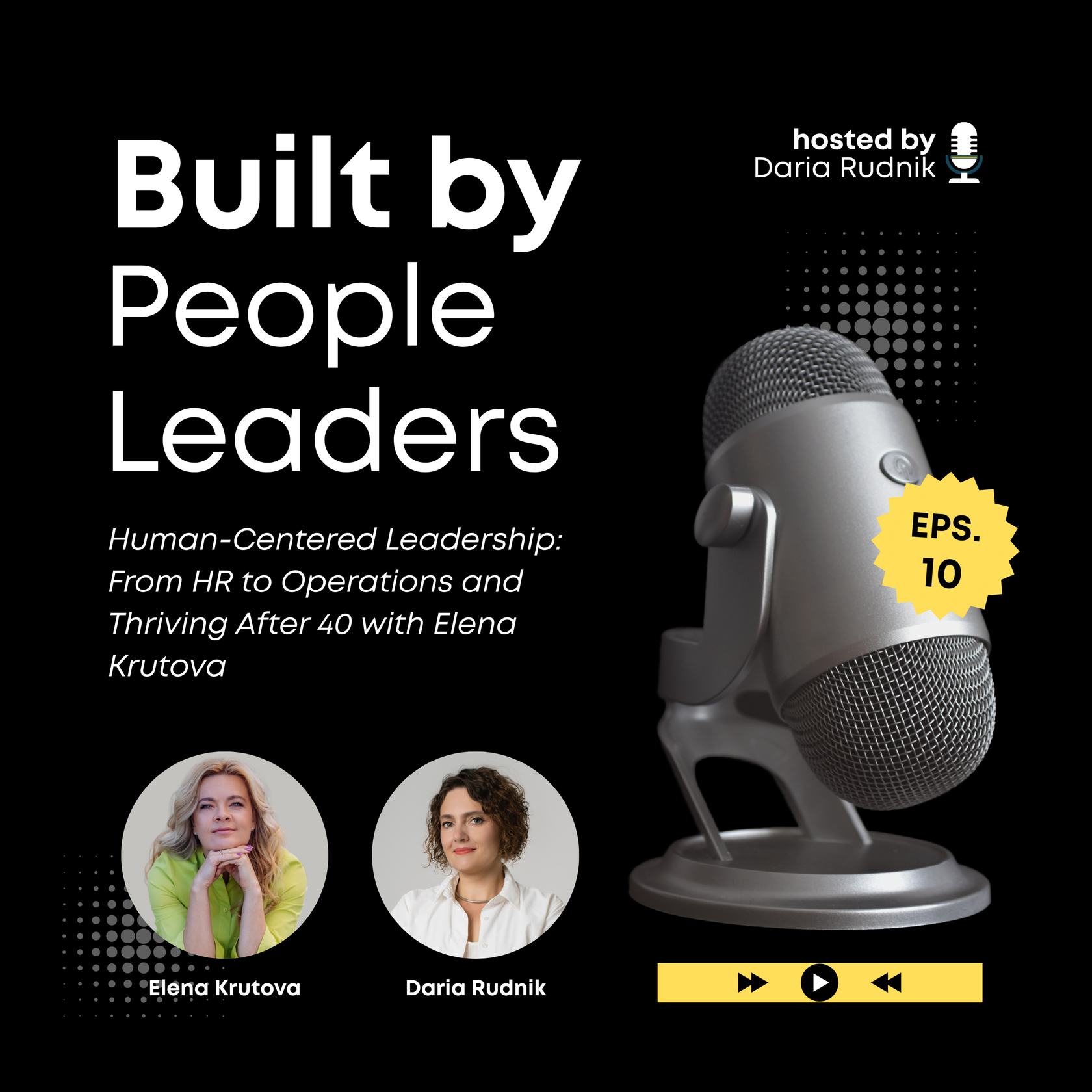
In this episode of the Built by People Leaders podcast, host Daria Rudnik speaks with Elena Krutova, a seasoned HR and operations leader with over 20 years of experience. Elena shares her journey from recruiter to Chief Operations Officer, highlighting the importance of human-centric leadership, integrity, and delivering tangible results. She discusses strategies for HR professionals to be true business partners, the challenges of leading transformations in both fast-growing and struggling organizations, and the role of AI as an efficiency-enhancing tool rather than a replacement for human connection. Elena also shares her advice for sustaining a successful career after 40, emphasizing persistence, confidence, and continuous learning.
Takeaways
Linkedin - https://cy.linkedin.com/in/elenakrutova
Company - www.voiso.com
HR, leadership, business partner, AI in HR, career growth, organizational transformation, employee engagement, human resources, operations, workplace dynamics
Takeaways
- HR earns a real seat at the table by delivering outcomes, not just “the right theory”.
- A sustainable career in fast-growing companies comes from clarity of purpose, strong values, and doing consistent “baby steps”.
- Moving from HR into broader operational leadership is possible when you understand how people work and can connect human, financial, legal, compliance, and process perspectives.
- The hardest transformations aren’t growth—they’re restoring health in struggling organizations, making fair but sometimes unpopular decisions with a “surgeon” mindset.
- AI should boost HR’s efficiency (policies, comms, materials) but never replace human connection.
Linkedin - https://cy.linkedin.com/in/elenakrutova
Company - www.voiso.com
HR, leadership, business partner, AI in HR, career growth, organizational transformation, employee engagement, human resources, operations, workplace dynamics
(00:06-00:25) Daria Rudnik
Welcome to Built by People Leaders podcast, brought to you by Aidra AI, your AI-powered coach for leaders in tech. I'm your host, Daria Rudnik, and this show is for HR and L&D leaders for fast-growing and scale-up companies, those who build real impact from within and shaping AI-ready organization.
(00:25-00:49) Daria Rudnik
If you go to Daria Rudnik.com, you can download AI Ready Teams Framework, a practical guide on how to build mature teams fit for AI-driven world. And today we have a very special guest, Jelena, Jelena Kroutova. I'm so excited to have you here today. Jelena is in business for more than 20 years, leading people functions and operations, and she's here to...
(00:49-01:09) Daria Rudnik
Talk to us about her experience working for fast-growing international companies and how she helps organizations grow without burnout and how they can remain human. Yelena, welcome here. Welcome to the show. I'm so glad to have you here. Do you want to share something about yourself and your path?
(01:09-01:34) Elena Krutova
Sure. Thank you very much, Daria, for the invitation. It's a pleasure for me to talk to the audience and to share my experiences, my philosophy, and the way how I see HR work, leadership work, and dealing with people in general. So for me, it was always fascinating to get deeper into the way how the organizations are working. And although as many of us, I just started as a
(01:34-01:54) Elena Krutova
simple recruiter in a fast-growing business many years ago, then I did not lose the path. So I was moving forward in the HR field, getting additional education, working with different industries, with fast-growing companies in IT sector, with different industries where the growth is not that fast. And
(01:54-02:18) Elena Krutova
For more than 20 years, I'm still here. So I did not burn out. I didn't lose my passion. I shaped my views on the way how the organizations are working, what HR leaders should be doing and should not be doing. And of course, I shaped a lot my own values because the values of the person, the values of the leader at the end of the day form the culture of the company. And I'm really happy to share about all of this today.
(02:19-02:31) Daria Rudnik
Well, thanks for sharing this. And like you mentioned, you have a fascinating career from recruiter, many years in HR, and then moving to process and operation. Do you mind sharing more about that?
(02:32-03:00) Elena Krutova
Yeah. And when I started my career in HR, I couldn't imagine that I would stay for so long. And of course, when we're young, when we are just graduating from the universities, the choices are not always obvious. So for me, it was just the only possible way to start independent life and to start working as soon as I could. And I started as a recruiter in an outsourcing firm called Luxoft. So probably some of the
(03:00-03:30) Elena Krutova
audience know about this company they had quite a bright history on the field and for me it was a great school of being efficient being focused on the results where people are caring about the way how you do your job and how you deliver as fast as you can not about like other things and not about politics not about some other unnecessary hustle in the workplace and then I had a couple of amazing employers in my life
(03:30-03:57) Elena Krutova
One of them was Kaspersky Lab when I was lucky to join the company again at the growing stage. So when I joined, we had 600 people. And when I left five years later, it was 2,500 people. So you could imagine that being responsible for recruitment, I'm on the front line of the organization. So I met many amazing, interesting people. With some of them, I still have good relations and they
(03:57-04:19) Elena Krutova
shaped my views. What is important to mention, I was lucky to have an amazing manager, my mentor, my friend, my close friend till now. For almost 15 years, we have good relations. And she taught me the essence of leadership, the essence of HR work, that HR should and must remain human in whatever we are doing.
(04:19-04:29) Elena Krutova
HR people should see the human nature of things. We should dig deeper into the way why organizations are like that, into the human dynamics and the organizational behavior.
(04:31-04:51) Elena Krutova
I think this experience formed my ethos, my understanding of the way how I should react in different situations. And lately, I had another amazing experience working in one of the fast-growing brokerage firms in Cyprus because when I joined, it was 250 people.
(04:51-05:06) Elena Krutova
When I left, it was 2,500 people and I was the third person in the HR. And when I was leaving, the HR was for more than 140 people and all of them were serving the employees, their families, the community, whatever kind of requests.
(05:06-05:28) Elena Krutova
In the organizational field or the social field, you can imagine all of this was covering by HR. And of course, when you have these like two big laughs of your life, it's hard to predict that you will have a third one one day and you are looking for a change. Like I'm the person who is constantly looking for a change and my energy drives me forward, like whatever happened.
(05:28-05:51) Elena Krutova
And I started to look at other fields and I realized that actually HR can do more. HR can progress through different areas and functions. And now I'm working as a chief operations officer, connecting HR, finance, legal, compliance, business operations, some other internal departments together. And actually my HR experience helps me a lot because I'm
(05:51-06:15) Elena Krutova
I believe and I will not be modest here saying that I know how people function. I know what drives people and I'm capable of making people better, happier, more productive at work, regardless of the role, either chief HR officer or chief operations officer or whatever role I'm handling in the organizational workplace. Well, that's amazing. I have so many questions and it's like,
(06:16-06:42) Daria Rudnik
You see this paradox of HR people knowing a lot about leadership and how organizations are working, how people are working, but still struggling to earn the seat at the table. And you manage not only to be heard as HR leader, but also move to another role or expand your role, expand your function. What would you recommend to
(06:42-07:10) Elena Krutova
What is your biggest learning in how to make this transition? How HRs can be seen as true business partners? It's actually a very good question because even in my experience, in many cases, HR is seen as a theoretical function, which is always saying what is right and what is wrong and criticizing managers or showing the numbers that put the management not in a good position or arguing with managers and all that.
(07:10-07:27) Elena Krutova
thinking that they deliver the strategic views on the way how the leadership should work. But in the reality, all the functions in the company should deliver. The delivery is what you bring to the table, actually, if you are invited. The results that you can bring and they will help the business, this is what is needed.
(07:27-07:44) Elena Krutova
And if you are responsible for recruitment, of course, you can explain why it's impossible to find this person and that it's very costly and the job description is wrong. But if you can have the job done, your value will be significantly higher than any great theoretical HR. And the same with other functions.
(07:44-08:09) Elena Krutova
The common place that we say that engagement is the responsibility of the managers. We all know engagement of our people is the leadership responsibility. But if HR can do things without looking at the managers, without expecting anything from the managers, but just to make their culture better, to make the atmosphere better, to make the life of the employees better, these things that at the end of the day will be valued.
(08:09-08:35) Elena Krutova
So I know that it's really hard and many companies fight with the wrong behavior, to fight with toxicity, to fight with some policies that are not fair to the employees. But you have yourself as a person, as a human being, and you can make someone's life better. You, not HR person, HR director, but you, Elena, you, Daria, someone. And this is what I was always valuing in my work.
(08:35-08:50) Elena Krutova
And I hope that my managers saw that. I make work done and I try to make life of other people a bit better. And more HR I'm working with, with the same philosophy, more I value those people in the profession. Don't criticize anyone.
(08:50-09:19) Elena Krutova
Don't say what is wrong. Don't say what's not working. Do your baby steps every single day. And they will form the path of the better future in any organization. And you will be valuable. You will be seen. And you will definitely have your seat at the table. Because at the end of the day, most of the business leaders are good. They are okay. They just lose some focus. They lose some things. And if HR can show them, I'm here. I'm with you. I'm not against you. And I will do whatever possible to help you.
(09:19-09:44) Daria Rudnik
This will be seen and this will be valued. Exactly. Exactly. Well, they are there because they're smart enough to be the C-suite and we are there as HR people to support them, not to criticize them all the time, even when they make mistakes because everyone makes mistakes. We also make mistakes. And I love this, like the recipe for success, like do your job and bring value to other people, take care of other people, like make sure it's for them. You're doing it for them.
(09:45-10:13) Elena Krutova
Yes, and for example, for HR, the recipe is like that. Now I'm dealing with legal compliance and finance, and I understand that in finance, it will be different agenda. Like you are here as a finance director or manager, not to bring value to the people, sorry, but you are here to save the company funds and to ensure that every month we have money to pay salaries and to pay dividends to the owners or to spend money on the proper things. And the finance people having this agenda, for them, it will be much easier to work.
(10:13-10:26) Elena Krutova
And for each function, I'm sure we can find this simple purpose in the organization, which should be always in the focus. And it shouldn't be lost because otherwise we start doing someone else's job, not our job at the end of the day.
(10:27-10:54) Elena Krutova
So the question for you then, how do you balance? How do you balance being leading finance and legal who are a lot about compliance and kind of numbers and still keep this human side of your work? I always believed that fairness at the end of the day is present in all the organizations. If you are doing your job well, you will be recognized sooner or later. You will get a good compensation sooner or later and you will have certain job security.
(10:54-11:16) Elena Krutova
And this conviction gives me the confidence that if we build the fair processes, if we safeguard the organizational capacity to be like one organism to handle all the pressure, all the troubles, then everything is going to be fine. So for me, regardless of the function, I always keep in mind that the organization has a purpose. We are here to do something.
(11:16-11:36) Elena Krutova
job, to do our job well. There should be boundaries. We should not cross our boundaries, obviously. And if there is a function like HR who is helping people, finance, who is controlling financial health, legal, who is controlling law and all the rest, then the organization will be in a good
(11:36-12:05) Elena Krutova
I'm trying to balance all that. So I'm trying to look at the organization from different perspectives, human, financial, compliance, process related, and just juggling many pieces which are in the air. So this is part of the job. Yeah, it's amazing. You've been through multiple transformations and growing organizations. What's the most impactful transformation or change that you've experienced and you want to share?
(12:05-12:21) Elena Krutova
Usually when people are talking about transformations, they focus on growing companies. They say that in order to grow from startup to a good, well-established organization, you need to establish processes, you need to have good hiring, evaluation, and et cetera, et cetera.
(12:21-12:43) Elena Krutova
And I had experience twice with this kind of organizations. But another complexity appears when you need to help struggling organizations to become better. It means that the processes are in place, but they are not always perfect. It means people are in place, but their motivation is suffering or something does not help them to be performing.
(12:43-13:10) Elena Krutova
And these kind of challenges, I think, they're even more important for any company because we all can imagine that we will be growing all our lives and nothing bad will happen. But bad things happen. Product changes, market changes, ownership structure changes, many things. And these kind of transformations to bring health back to the organization is one of the most important, complicated and difficult topics in the leadership arena.
(13:10-13:25) Elena Krutova
Because here you need the best balance out of all. Finance people will say, cut the cost and you're going to be fine. Sharp people say, we have engagement problems, we cannot do anything. Legal people will say, okay, let's check the contracts and we do to do whatever is according to the contracts.
(13:25-13:51) Elena Krutova
But my role is to look from all the perspectives and to bring health back to the organization, making unpopular decisions in some cases, being a surgeon who is cutting unnecessary and bringing what is necessary. And I'm truly enjoying this kind of work because there in this kind of work, you still remain human. You can still remain fair and focused on people.
(13:51-14:17) Daria Rudnik
You just need to be sharp, crisp, no blah, blah, blah, and focused on what is the best in the long term for the people and the organization itself. I have a surge in analogy because you're right. If you don't delete something that's not working, if you're not fixed, sometimes it's painful, obviously, but it's for better health. It'll create healthier organizations. It'll also help people. I mean, if people work for struggling organizations, if this organization goes down, goes bankrupt, no one is going to be happy.
(14:17-14:32) Elena Krutova
So it's an opportunity. What is important, nobody should be cruel in this kind of cases. Because in some circumstances, we become frustrated, full of fear that something goes wrong and we want to protect our status quo.
(14:32-14:54) Elena Krutova
But look at the surgeon. They are not cruel. They are not focusing on themselves. They are focusing on doing their job right. They have enough education. They have enough knowledge to do their job right. And the same when you do this kind of transformations from like some not much healthier companies or companies with struggles, you need to be the same professional. And then
(14:54-15:19) Daria Rudnik
When you deliver and you see that health is getting back to the company, to the social structure you are dealing with, it's like the best pleasure, I would say, seeing the actual results of your work. And I want to ask you a question, like a very hot topic today is AI. And AI is entering workplaces and influences like workplace dynamics. How do you see HR organizations are evolving when AI is entering that?
(15:20-15:36) Elena Krutova
You know, when ChatGPT appeared in our lives three years ago, I hated it, literally, because every time when I saw the messages from some people written in this Polish nice way, I was like, are you dumb enough not to be able to write it by yourself or what's that?
(15:36-15:55) Elena Krutova
But now I think we got the essence of the tools. So we now understand that they don't replace our capabilities and they should not. But it's a good addition. It's like internet or it's like computers. They cannot do 100% of your job. But if you are educated and you have capabilities to use it, your efficiency can be skyrocketed.
(15:55-16:17) Elena Krutova
For example, unfortunately, the profession of content writers will die soon. Because before, you need to read a couple of articles to think, to write down a text, and the average copywriter could write around two articles per day. Now, 10 minutes, chat GPT, read it, check the facts, and you are there. So you can imagine how fast you can do that.
(16:17-16:47) Elena Krutova
Or I'm not a designer, I have zero capabilities there, but when I need to design something, I use Canva, write a script, whatever you need to be done, change the colors, add the codes, and you are done. And you shouldn't be waiting for a designer for a couple of days when they're ready. So I truly believe that AI tools are perfect tools to be embedded in anyone's profession, in HR especially, when you need to deal with policymaking, communication, some preparation of the materials, but
(16:47-17:14) Elena Krutova
Never, ever replace your human nature with AI. Never, ever reply to the people with AI-polished answers because they see it. And probably it will not harm, but it will not put their respect to you on a higher level. It will not put anything good for you. But as a tool, again, use it as much as you can and learn how to use it because there are many, many interesting tools that are coming every month, every half a year.
(17:14-17:36) Elena Krutova
Yeah, I agree. I mean, it's funny. Someone writes an email with ChatGPT, someone writes a reply to this email with ChatGPT. Yes, exactly. And there's two bots talking to each other. You know what's fascinating, and I'm sure that many HR professionals, their views will resonate with mine, performance reviews are written on ChatGPT. And you are reading amazing reviews. People hate it.
(17:36-17:58) Elena Krutova
People hate it. Managers hate it. People hate it. But everybody's writing it like that and you just don't know where it's truth because you see all these Polish answers and you just don't know. The person has some issues with reality writing this or they truly believe that nobody understands that this was written with AI. I think, I mean, I have my issue with performance reviews and so that...
(17:59-18:24) Daria Rudnik
Everybody has, but never use AI to write performance reviews, please. It's kind of an indicator. Like if people don't use a chat GPT to write something that they think is unimportant, maybe we should do something about it. Yes, yes. We don't have a better solution yet, but it's, yeah, need to figure it out. Like, you know what? There was, again, there was a, I think it was IBM Research.
(18:24-18:44) Daria Rudnik
that shared that only 1% of CEOs actually see HR as their partners in AI transformation. And I'm like, what's your take on it? What do you think? Why is it so? Most likely because HR is seen as the softest function in the organization. And the second, in many companies...
(18:45-18:56) Elena Krutova
Subconsciously, HR is seen as a people advocate. The AI usually is about cutting the roles, cutting people and bringing cost saving to the organization.
(18:57-19:21) Elena Krutova
Probably they are afraid of the resistance that will happen. And having these fears about imaginary resistance, they miss the major point. Sooner you start talking about AI, sooner you start thinking about improving the processes with AI, better for the people it will be. More time they will have to educate themselves.
(19:21-19:46) Elena Krutova
more time you will have to use soft HR power to release this tension and to do proper soft change management practices. So I would say it's probably early stages and she did not get the point that HR is not against the company. HR is not against the people like you are trying to convince. HR will make your job easier if you involve them into the change management from the beginning.
(19:46-20:14) Daria Rudnik
But remember what I said from the first minutes of the conversation. If HR remains human and remains focused, then this question will not appear. It will not exist. I think there's a lot of technical. HR is not technical, and that's why they're not invited. But AI transformation is not so much technical. It's a lot about change management, new capabilities, how we use AI, decision-making, critical thinking, governance, ethics. All of those are HR issues.
(20:14-20:43) Elena Krutova
We can look like always in the past, we can find examples which are similar to the experiences that we have right now. 20 years ago, it was about SAP transformation. HR was never at the table when SAP was implemented, but HR was always at the table when roles should be cut. But now the things are changing. Change management, soft change management in the SAP implementations is one of the core skills and demands during these changes. With AI, we will come to the same.
(20:43-20:54) Daria Rudnik
It's just better to start earlier knowing these experiences. What could be your message that you would like to deliver to HRs who want to be true business partners to their organizations?
(20:55-21:21) Elena Krutova
It's a very deep and important question because I have a big HR community. I read the posts from HR people. I talk to them. HR people have tendency to lose their confidence, especially now. So we are not at the peak of economics. We all know that. So nobody knows what will be in the past. And when HR is losing the confidence and the positive attitude and the energy, then nobody will pick up on the company.
(21:21-21:44) Elena Krutova
This is the one thing that I always tell to my HR people, to my people in other functions. Don't lose the confidence in yourself and in the people. Because even if you deal with something unpredictable, something complicated, toxicity, conflicts, cost reduction, something, somebody should remain human in the company and let it be you. And you can drive others and you can...
(21:44-22:12) Elena Krutova
Ignite others so they are able also to deliver these positive messages. Never ever question yourself as HR. Try to find support from other people. And actually questioning yourself is not a good thing in general, but for HR people, it's just no go in whatever company you're working with now. I get so much support that. Like there are a lot of things coming to HR people that HR is not human enough. They are supporting business or HR is not business enough. They're supporting people.
(22:12-22:28) Daria Rudnik
Being in between of those unhappy employees who have experienced something, maybe unpleasant, okay, who is there to blame? HR is there to blame. But being human for them, being confident that the job you're doing is important is very critical.
(22:29-22:46) Elena Krutova
What is important and for human professions is the integrity. So you should declare only the things that you follow. And if you declare something, you should ensure that in insight you share the same values. Because it's really...
(22:46-23:08) Elena Krutova
I would even say stupid when HR are teaching people about how bad the micromanagement is, but they are doing exactly the same about their teams or checking exactly the same way their teammates every second. Or when they say that a discipline is bad in our company, but HR is always late. Like how you can do that? So use your own integrity and look more often in the mirror.
(23:08-23:32) Elena Krutova
Because whatever you see there, the other people will see as well. So this is, I think, 70% of the success in HR organizations. You have to be a role model. Whatever you declare, you should do it first and you should do it genuinely with honesty and with respect to others. And then, of course, the role will start growing and the perception will be different.
(23:32-23:41) Daria Rudnik
I agree. I mean, 100% agree. Yeah, that's the first thing. Be true to yourself and be true to what you teach and walk the talk.
(23:41-24:11) Elena Krutova
Yes, and I have lots of conversations with different HR people, and some people are saying, yes, it's easier for you. You had good companies. You had good employers. But what for us? Like our management is talking only about money. They're not interested in anything. And I usually say, we are not slaves. We always have choices. And integrity of you as a professional should be at the first place. If you see that nothing can be done or people are not able or not interested in listening to you, just go.
(24:11-24:31) Elena Krutova
And there are no places in the world where you're trapped into your profession and when you are trapped into your company. It means that something stops you. And that means that your integrity, again, is not at that level that you wanted that to be. It happens. Shitty place exists everywhere. But we have our own choices to make our life better.
(24:31-24:58) Daria Rudnik
absolutely i mean you either try and do something about it if you see you can't well find another place like it's no matter like hurting yourself organization maybe they need another person someone not with other values with with other approaches yes somebody is missing you elsewhere and someone is waiting for your job to be empty so they can join this company if you had a magic wand and could solve one professional challenge what would that be it's a
(24:58-25:28) Elena Krutova
A very interesting question, yes. If we're talking in like in the big terms, I would say leadership challenges is a huge one still because the reasons why people grow to the leadership positions are not always connected with humans, are not always connected with leadership itself. They may be connected with greed. They may be connected with being envy or with focusing on money or focusing on something else. And if I have magic wand, I would say that only
(25:28-25:45) Elena Krutova
Truly human oriented people should be at the top. So you check it first. Are you human oriented? Then you go top. If you are not, you go somewhere else, but not there. Because it's like, it's the core of the company. If you're not human oriented at the top, nobody will be below.
(25:46-26:14) Daria Rudnik
It's like Simon Sinek said, like, all your customers are human beings. All your employees are people. All your providers are people. If you don't understand people, you don't understand business. Exactly, exactly. And everybody likes Simon Sinek. But the problem is that not many can implement it, actually, from the first place in their companies. All right. I have one more question. I'll keep it till the end. And it's about how to drive your career after 40. So stay with us. We'll get to this question at the very end of this conversation.
(26:14-26:39) Daria Rudnik
Before we go there, I have a few rapid fire questions to learn more about you as a human. So it's very short, very fast questions, very short answers. Are you ready? Okay. Are you a tea person or a coffee person? Black tea with milk. Nice. Dogs or cats? Dogs. I have two and I would love to have as many as possible.
(26:40-27:07) Elena Krutova
Are you a morning person? Morning person, but I sleep a lot. Would you rather receive a phone call or a message? A message. And calling to other people, for me, it's a torture, real torture. What did you want to be when you were a kid? I wanted to be independent, so I think I fulfilled my goal. Where do you go when you need perspective? I go to the books. Books helps me to see different perspectives. Fiction or non-fiction?
(27:08-27:36) Elena Krutova
Different. I read less business literature now, more like fiction, but all books are good. One rule that you've broken, but don't regret. I don't know. You know, there's a rule, never eat alone. I always eat alone. And I enjoy having my lunches alone. Yeah, we need some, like, me time. Yes, I need personal space, like, and I don't need anyone around. What's one habit or phrase people say that it's totally you? I have a tattoo.
(27:37-28:05) Daria Rudnik
It says never settle. I think this is about me. Cool, cool. I love it. I love it. Well, that was an amazing conversation. I remind you, we still have a question about like driving your career after 40. But before we go there, well, thank you so much, Yelena, for joining us here today. It was so insightful. I learned so much and I love to learn about your career and how that HR, you can grow further. Leading HR function is definitely not the end.
(28:05-28:31) Elena Krutova
and you can be a true business partner to your organization. If people want to connect with you, how can they find you? LinkedIn. So I always have my LinkedIn profile open, so they can always send me a message. And I have a website, which is like mylastname.me, and there is a form there. So I'm always happy to chat to other people if they need any advice, any help, or just a friendly hand to support them during their difficulties in their lives.
(28:31-28:50) Daria Rudnik
Well, thanks, Ian. Those links will be in the comments or notes in the description to this episode. And my final question. So how do you drive your career after 40? It's a really, really good question. You know, LinkedIn algorithms, they work the way once you see some content, you
(28:50-29:18) Elena Krutova
keep on seeing this content again and again. And I constantly see now the content that people, after 45 especially, they lost their hope, they lost their career, they lost the interest. And for me, some time ago, it was also a very good question. Like, should I stay in the career field after 40? Should I change it? Should I do something differently? And this is a hard time, I think, for everyone, especially when you have 20 years, 25 years of experience.
(29:18-29:34) Elena Krutova
And what I see now, the depth of knowledge and the genuinity in you may be the main core driving values when you are continuing doing your career after 40. Of course, it will be hard to build it from scratch, but
(29:34-29:54) Elena Krutova
One of my discoveries during my INSEAD education, during my thesis, was that many people tend to give up too soon. So my main advice, don't give up. If you lost your job at 40, if you lost your true north at 40, if you don't know what you want to do, don't give up.
(29:54-30:17) Elena Krutova
keep on doing things every single day, baby steps, reading books, checking some courses, talking to other people. And this desire to do something bigger will come back. It's really easy to become a victim of disappointment. Disappointment is around the corner for every single step we do. Be stronger than that. Because after 40, you have 20 more
(30:17-30:39) Elena Krutova
years of successful career, believe me, and there are lots of examples like that. It's just about you not giving up and believing that, yes, it's a trouble, it's a hole in the road, but after this, it will be much better. Well, thank you so much, Yelena. It was such an insightful conversation. What I'm taking from it is don't give up, deliver the results, and be human.
(30:39-30:59) Daria Rudnik
Exactly. Thanks for being here with us. It was Built for People Leaders podcast, podcast for HR and L&D leaders in fast-growing companies. Thank you.
Welcome to Built by People Leaders podcast, brought to you by Aidra AI, your AI-powered coach for leaders in tech. I'm your host, Daria Rudnik, and this show is for HR and L&D leaders for fast-growing and scale-up companies, those who build real impact from within and shaping AI-ready organization.
(00:25-00:49) Daria Rudnik
If you go to Daria Rudnik.com, you can download AI Ready Teams Framework, a practical guide on how to build mature teams fit for AI-driven world. And today we have a very special guest, Jelena, Jelena Kroutova. I'm so excited to have you here today. Jelena is in business for more than 20 years, leading people functions and operations, and she's here to...
(00:49-01:09) Daria Rudnik
Talk to us about her experience working for fast-growing international companies and how she helps organizations grow without burnout and how they can remain human. Yelena, welcome here. Welcome to the show. I'm so glad to have you here. Do you want to share something about yourself and your path?
(01:09-01:34) Elena Krutova
Sure. Thank you very much, Daria, for the invitation. It's a pleasure for me to talk to the audience and to share my experiences, my philosophy, and the way how I see HR work, leadership work, and dealing with people in general. So for me, it was always fascinating to get deeper into the way how the organizations are working. And although as many of us, I just started as a
(01:34-01:54) Elena Krutova
simple recruiter in a fast-growing business many years ago, then I did not lose the path. So I was moving forward in the HR field, getting additional education, working with different industries, with fast-growing companies in IT sector, with different industries where the growth is not that fast. And
(01:54-02:18) Elena Krutova
For more than 20 years, I'm still here. So I did not burn out. I didn't lose my passion. I shaped my views on the way how the organizations are working, what HR leaders should be doing and should not be doing. And of course, I shaped a lot my own values because the values of the person, the values of the leader at the end of the day form the culture of the company. And I'm really happy to share about all of this today.
(02:19-02:31) Daria Rudnik
Well, thanks for sharing this. And like you mentioned, you have a fascinating career from recruiter, many years in HR, and then moving to process and operation. Do you mind sharing more about that?
(02:32-03:00) Elena Krutova
Yeah. And when I started my career in HR, I couldn't imagine that I would stay for so long. And of course, when we're young, when we are just graduating from the universities, the choices are not always obvious. So for me, it was just the only possible way to start independent life and to start working as soon as I could. And I started as a recruiter in an outsourcing firm called Luxoft. So probably some of the
(03:00-03:30) Elena Krutova
audience know about this company they had quite a bright history on the field and for me it was a great school of being efficient being focused on the results where people are caring about the way how you do your job and how you deliver as fast as you can not about like other things and not about politics not about some other unnecessary hustle in the workplace and then I had a couple of amazing employers in my life
(03:30-03:57) Elena Krutova
One of them was Kaspersky Lab when I was lucky to join the company again at the growing stage. So when I joined, we had 600 people. And when I left five years later, it was 2,500 people. So you could imagine that being responsible for recruitment, I'm on the front line of the organization. So I met many amazing, interesting people. With some of them, I still have good relations and they
(03:57-04:19) Elena Krutova
shaped my views. What is important to mention, I was lucky to have an amazing manager, my mentor, my friend, my close friend till now. For almost 15 years, we have good relations. And she taught me the essence of leadership, the essence of HR work, that HR should and must remain human in whatever we are doing.
(04:19-04:29) Elena Krutova
HR people should see the human nature of things. We should dig deeper into the way why organizations are like that, into the human dynamics and the organizational behavior.
(04:31-04:51) Elena Krutova
I think this experience formed my ethos, my understanding of the way how I should react in different situations. And lately, I had another amazing experience working in one of the fast-growing brokerage firms in Cyprus because when I joined, it was 250 people.
(04:51-05:06) Elena Krutova
When I left, it was 2,500 people and I was the third person in the HR. And when I was leaving, the HR was for more than 140 people and all of them were serving the employees, their families, the community, whatever kind of requests.
(05:06-05:28) Elena Krutova
In the organizational field or the social field, you can imagine all of this was covering by HR. And of course, when you have these like two big laughs of your life, it's hard to predict that you will have a third one one day and you are looking for a change. Like I'm the person who is constantly looking for a change and my energy drives me forward, like whatever happened.
(05:28-05:51) Elena Krutova
And I started to look at other fields and I realized that actually HR can do more. HR can progress through different areas and functions. And now I'm working as a chief operations officer, connecting HR, finance, legal, compliance, business operations, some other internal departments together. And actually my HR experience helps me a lot because I'm
(05:51-06:15) Elena Krutova
I believe and I will not be modest here saying that I know how people function. I know what drives people and I'm capable of making people better, happier, more productive at work, regardless of the role, either chief HR officer or chief operations officer or whatever role I'm handling in the organizational workplace. Well, that's amazing. I have so many questions and it's like,
(06:16-06:42) Daria Rudnik
You see this paradox of HR people knowing a lot about leadership and how organizations are working, how people are working, but still struggling to earn the seat at the table. And you manage not only to be heard as HR leader, but also move to another role or expand your role, expand your function. What would you recommend to
(06:42-07:10) Elena Krutova
What is your biggest learning in how to make this transition? How HRs can be seen as true business partners? It's actually a very good question because even in my experience, in many cases, HR is seen as a theoretical function, which is always saying what is right and what is wrong and criticizing managers or showing the numbers that put the management not in a good position or arguing with managers and all that.
(07:10-07:27) Elena Krutova
thinking that they deliver the strategic views on the way how the leadership should work. But in the reality, all the functions in the company should deliver. The delivery is what you bring to the table, actually, if you are invited. The results that you can bring and they will help the business, this is what is needed.
(07:27-07:44) Elena Krutova
And if you are responsible for recruitment, of course, you can explain why it's impossible to find this person and that it's very costly and the job description is wrong. But if you can have the job done, your value will be significantly higher than any great theoretical HR. And the same with other functions.
(07:44-08:09) Elena Krutova
The common place that we say that engagement is the responsibility of the managers. We all know engagement of our people is the leadership responsibility. But if HR can do things without looking at the managers, without expecting anything from the managers, but just to make their culture better, to make the atmosphere better, to make the life of the employees better, these things that at the end of the day will be valued.
(08:09-08:35) Elena Krutova
So I know that it's really hard and many companies fight with the wrong behavior, to fight with toxicity, to fight with some policies that are not fair to the employees. But you have yourself as a person, as a human being, and you can make someone's life better. You, not HR person, HR director, but you, Elena, you, Daria, someone. And this is what I was always valuing in my work.
(08:35-08:50) Elena Krutova
And I hope that my managers saw that. I make work done and I try to make life of other people a bit better. And more HR I'm working with, with the same philosophy, more I value those people in the profession. Don't criticize anyone.
(08:50-09:19) Elena Krutova
Don't say what is wrong. Don't say what's not working. Do your baby steps every single day. And they will form the path of the better future in any organization. And you will be valuable. You will be seen. And you will definitely have your seat at the table. Because at the end of the day, most of the business leaders are good. They are okay. They just lose some focus. They lose some things. And if HR can show them, I'm here. I'm with you. I'm not against you. And I will do whatever possible to help you.
(09:19-09:44) Daria Rudnik
This will be seen and this will be valued. Exactly. Exactly. Well, they are there because they're smart enough to be the C-suite and we are there as HR people to support them, not to criticize them all the time, even when they make mistakes because everyone makes mistakes. We also make mistakes. And I love this, like the recipe for success, like do your job and bring value to other people, take care of other people, like make sure it's for them. You're doing it for them.
(09:45-10:13) Elena Krutova
Yes, and for example, for HR, the recipe is like that. Now I'm dealing with legal compliance and finance, and I understand that in finance, it will be different agenda. Like you are here as a finance director or manager, not to bring value to the people, sorry, but you are here to save the company funds and to ensure that every month we have money to pay salaries and to pay dividends to the owners or to spend money on the proper things. And the finance people having this agenda, for them, it will be much easier to work.
(10:13-10:26) Elena Krutova
And for each function, I'm sure we can find this simple purpose in the organization, which should be always in the focus. And it shouldn't be lost because otherwise we start doing someone else's job, not our job at the end of the day.
(10:27-10:54) Elena Krutova
So the question for you then, how do you balance? How do you balance being leading finance and legal who are a lot about compliance and kind of numbers and still keep this human side of your work? I always believed that fairness at the end of the day is present in all the organizations. If you are doing your job well, you will be recognized sooner or later. You will get a good compensation sooner or later and you will have certain job security.
(10:54-11:16) Elena Krutova
And this conviction gives me the confidence that if we build the fair processes, if we safeguard the organizational capacity to be like one organism to handle all the pressure, all the troubles, then everything is going to be fine. So for me, regardless of the function, I always keep in mind that the organization has a purpose. We are here to do something.
(11:16-11:36) Elena Krutova
job, to do our job well. There should be boundaries. We should not cross our boundaries, obviously. And if there is a function like HR who is helping people, finance, who is controlling financial health, legal, who is controlling law and all the rest, then the organization will be in a good
(11:36-12:05) Elena Krutova
I'm trying to balance all that. So I'm trying to look at the organization from different perspectives, human, financial, compliance, process related, and just juggling many pieces which are in the air. So this is part of the job. Yeah, it's amazing. You've been through multiple transformations and growing organizations. What's the most impactful transformation or change that you've experienced and you want to share?
(12:05-12:21) Elena Krutova
Usually when people are talking about transformations, they focus on growing companies. They say that in order to grow from startup to a good, well-established organization, you need to establish processes, you need to have good hiring, evaluation, and et cetera, et cetera.
(12:21-12:43) Elena Krutova
And I had experience twice with this kind of organizations. But another complexity appears when you need to help struggling organizations to become better. It means that the processes are in place, but they are not always perfect. It means people are in place, but their motivation is suffering or something does not help them to be performing.
(12:43-13:10) Elena Krutova
And these kind of challenges, I think, they're even more important for any company because we all can imagine that we will be growing all our lives and nothing bad will happen. But bad things happen. Product changes, market changes, ownership structure changes, many things. And these kind of transformations to bring health back to the organization is one of the most important, complicated and difficult topics in the leadership arena.
(13:10-13:25) Elena Krutova
Because here you need the best balance out of all. Finance people will say, cut the cost and you're going to be fine. Sharp people say, we have engagement problems, we cannot do anything. Legal people will say, okay, let's check the contracts and we do to do whatever is according to the contracts.
(13:25-13:51) Elena Krutova
But my role is to look from all the perspectives and to bring health back to the organization, making unpopular decisions in some cases, being a surgeon who is cutting unnecessary and bringing what is necessary. And I'm truly enjoying this kind of work because there in this kind of work, you still remain human. You can still remain fair and focused on people.
(13:51-14:17) Daria Rudnik
You just need to be sharp, crisp, no blah, blah, blah, and focused on what is the best in the long term for the people and the organization itself. I have a surge in analogy because you're right. If you don't delete something that's not working, if you're not fixed, sometimes it's painful, obviously, but it's for better health. It'll create healthier organizations. It'll also help people. I mean, if people work for struggling organizations, if this organization goes down, goes bankrupt, no one is going to be happy.
(14:17-14:32) Elena Krutova
So it's an opportunity. What is important, nobody should be cruel in this kind of cases. Because in some circumstances, we become frustrated, full of fear that something goes wrong and we want to protect our status quo.
(14:32-14:54) Elena Krutova
But look at the surgeon. They are not cruel. They are not focusing on themselves. They are focusing on doing their job right. They have enough education. They have enough knowledge to do their job right. And the same when you do this kind of transformations from like some not much healthier companies or companies with struggles, you need to be the same professional. And then
(14:54-15:19) Daria Rudnik
When you deliver and you see that health is getting back to the company, to the social structure you are dealing with, it's like the best pleasure, I would say, seeing the actual results of your work. And I want to ask you a question, like a very hot topic today is AI. And AI is entering workplaces and influences like workplace dynamics. How do you see HR organizations are evolving when AI is entering that?
(15:20-15:36) Elena Krutova
You know, when ChatGPT appeared in our lives three years ago, I hated it, literally, because every time when I saw the messages from some people written in this Polish nice way, I was like, are you dumb enough not to be able to write it by yourself or what's that?
(15:36-15:55) Elena Krutova
But now I think we got the essence of the tools. So we now understand that they don't replace our capabilities and they should not. But it's a good addition. It's like internet or it's like computers. They cannot do 100% of your job. But if you are educated and you have capabilities to use it, your efficiency can be skyrocketed.
(15:55-16:17) Elena Krutova
For example, unfortunately, the profession of content writers will die soon. Because before, you need to read a couple of articles to think, to write down a text, and the average copywriter could write around two articles per day. Now, 10 minutes, chat GPT, read it, check the facts, and you are there. So you can imagine how fast you can do that.
(16:17-16:47) Elena Krutova
Or I'm not a designer, I have zero capabilities there, but when I need to design something, I use Canva, write a script, whatever you need to be done, change the colors, add the codes, and you are done. And you shouldn't be waiting for a designer for a couple of days when they're ready. So I truly believe that AI tools are perfect tools to be embedded in anyone's profession, in HR especially, when you need to deal with policymaking, communication, some preparation of the materials, but
(16:47-17:14) Elena Krutova
Never, ever replace your human nature with AI. Never, ever reply to the people with AI-polished answers because they see it. And probably it will not harm, but it will not put their respect to you on a higher level. It will not put anything good for you. But as a tool, again, use it as much as you can and learn how to use it because there are many, many interesting tools that are coming every month, every half a year.
(17:14-17:36) Elena Krutova
Yeah, I agree. I mean, it's funny. Someone writes an email with ChatGPT, someone writes a reply to this email with ChatGPT. Yes, exactly. And there's two bots talking to each other. You know what's fascinating, and I'm sure that many HR professionals, their views will resonate with mine, performance reviews are written on ChatGPT. And you are reading amazing reviews. People hate it.
(17:36-17:58) Elena Krutova
People hate it. Managers hate it. People hate it. But everybody's writing it like that and you just don't know where it's truth because you see all these Polish answers and you just don't know. The person has some issues with reality writing this or they truly believe that nobody understands that this was written with AI. I think, I mean, I have my issue with performance reviews and so that...
(17:59-18:24) Daria Rudnik
Everybody has, but never use AI to write performance reviews, please. It's kind of an indicator. Like if people don't use a chat GPT to write something that they think is unimportant, maybe we should do something about it. Yes, yes. We don't have a better solution yet, but it's, yeah, need to figure it out. Like, you know what? There was, again, there was a, I think it was IBM Research.
(18:24-18:44) Daria Rudnik
that shared that only 1% of CEOs actually see HR as their partners in AI transformation. And I'm like, what's your take on it? What do you think? Why is it so? Most likely because HR is seen as the softest function in the organization. And the second, in many companies...
(18:45-18:56) Elena Krutova
Subconsciously, HR is seen as a people advocate. The AI usually is about cutting the roles, cutting people and bringing cost saving to the organization.
(18:57-19:21) Elena Krutova
Probably they are afraid of the resistance that will happen. And having these fears about imaginary resistance, they miss the major point. Sooner you start talking about AI, sooner you start thinking about improving the processes with AI, better for the people it will be. More time they will have to educate themselves.
(19:21-19:46) Elena Krutova
more time you will have to use soft HR power to release this tension and to do proper soft change management practices. So I would say it's probably early stages and she did not get the point that HR is not against the company. HR is not against the people like you are trying to convince. HR will make your job easier if you involve them into the change management from the beginning.
(19:46-20:14) Daria Rudnik
But remember what I said from the first minutes of the conversation. If HR remains human and remains focused, then this question will not appear. It will not exist. I think there's a lot of technical. HR is not technical, and that's why they're not invited. But AI transformation is not so much technical. It's a lot about change management, new capabilities, how we use AI, decision-making, critical thinking, governance, ethics. All of those are HR issues.
(20:14-20:43) Elena Krutova
We can look like always in the past, we can find examples which are similar to the experiences that we have right now. 20 years ago, it was about SAP transformation. HR was never at the table when SAP was implemented, but HR was always at the table when roles should be cut. But now the things are changing. Change management, soft change management in the SAP implementations is one of the core skills and demands during these changes. With AI, we will come to the same.
(20:43-20:54) Daria Rudnik
It's just better to start earlier knowing these experiences. What could be your message that you would like to deliver to HRs who want to be true business partners to their organizations?
(20:55-21:21) Elena Krutova
It's a very deep and important question because I have a big HR community. I read the posts from HR people. I talk to them. HR people have tendency to lose their confidence, especially now. So we are not at the peak of economics. We all know that. So nobody knows what will be in the past. And when HR is losing the confidence and the positive attitude and the energy, then nobody will pick up on the company.
(21:21-21:44) Elena Krutova
This is the one thing that I always tell to my HR people, to my people in other functions. Don't lose the confidence in yourself and in the people. Because even if you deal with something unpredictable, something complicated, toxicity, conflicts, cost reduction, something, somebody should remain human in the company and let it be you. And you can drive others and you can...
(21:44-22:12) Elena Krutova
Ignite others so they are able also to deliver these positive messages. Never ever question yourself as HR. Try to find support from other people. And actually questioning yourself is not a good thing in general, but for HR people, it's just no go in whatever company you're working with now. I get so much support that. Like there are a lot of things coming to HR people that HR is not human enough. They are supporting business or HR is not business enough. They're supporting people.
(22:12-22:28) Daria Rudnik
Being in between of those unhappy employees who have experienced something, maybe unpleasant, okay, who is there to blame? HR is there to blame. But being human for them, being confident that the job you're doing is important is very critical.
(22:29-22:46) Elena Krutova
What is important and for human professions is the integrity. So you should declare only the things that you follow. And if you declare something, you should ensure that in insight you share the same values. Because it's really...
(22:46-23:08) Elena Krutova
I would even say stupid when HR are teaching people about how bad the micromanagement is, but they are doing exactly the same about their teams or checking exactly the same way their teammates every second. Or when they say that a discipline is bad in our company, but HR is always late. Like how you can do that? So use your own integrity and look more often in the mirror.
(23:08-23:32) Elena Krutova
Because whatever you see there, the other people will see as well. So this is, I think, 70% of the success in HR organizations. You have to be a role model. Whatever you declare, you should do it first and you should do it genuinely with honesty and with respect to others. And then, of course, the role will start growing and the perception will be different.
(23:32-23:41) Daria Rudnik
I agree. I mean, 100% agree. Yeah, that's the first thing. Be true to yourself and be true to what you teach and walk the talk.
(23:41-24:11) Elena Krutova
Yes, and I have lots of conversations with different HR people, and some people are saying, yes, it's easier for you. You had good companies. You had good employers. But what for us? Like our management is talking only about money. They're not interested in anything. And I usually say, we are not slaves. We always have choices. And integrity of you as a professional should be at the first place. If you see that nothing can be done or people are not able or not interested in listening to you, just go.
(24:11-24:31) Elena Krutova
And there are no places in the world where you're trapped into your profession and when you are trapped into your company. It means that something stops you. And that means that your integrity, again, is not at that level that you wanted that to be. It happens. Shitty place exists everywhere. But we have our own choices to make our life better.
(24:31-24:58) Daria Rudnik
absolutely i mean you either try and do something about it if you see you can't well find another place like it's no matter like hurting yourself organization maybe they need another person someone not with other values with with other approaches yes somebody is missing you elsewhere and someone is waiting for your job to be empty so they can join this company if you had a magic wand and could solve one professional challenge what would that be it's a
(24:58-25:28) Elena Krutova
A very interesting question, yes. If we're talking in like in the big terms, I would say leadership challenges is a huge one still because the reasons why people grow to the leadership positions are not always connected with humans, are not always connected with leadership itself. They may be connected with greed. They may be connected with being envy or with focusing on money or focusing on something else. And if I have magic wand, I would say that only
(25:28-25:45) Elena Krutova
Truly human oriented people should be at the top. So you check it first. Are you human oriented? Then you go top. If you are not, you go somewhere else, but not there. Because it's like, it's the core of the company. If you're not human oriented at the top, nobody will be below.
(25:46-26:14) Daria Rudnik
It's like Simon Sinek said, like, all your customers are human beings. All your employees are people. All your providers are people. If you don't understand people, you don't understand business. Exactly, exactly. And everybody likes Simon Sinek. But the problem is that not many can implement it, actually, from the first place in their companies. All right. I have one more question. I'll keep it till the end. And it's about how to drive your career after 40. So stay with us. We'll get to this question at the very end of this conversation.
(26:14-26:39) Daria Rudnik
Before we go there, I have a few rapid fire questions to learn more about you as a human. So it's very short, very fast questions, very short answers. Are you ready? Okay. Are you a tea person or a coffee person? Black tea with milk. Nice. Dogs or cats? Dogs. I have two and I would love to have as many as possible.
(26:40-27:07) Elena Krutova
Are you a morning person? Morning person, but I sleep a lot. Would you rather receive a phone call or a message? A message. And calling to other people, for me, it's a torture, real torture. What did you want to be when you were a kid? I wanted to be independent, so I think I fulfilled my goal. Where do you go when you need perspective? I go to the books. Books helps me to see different perspectives. Fiction or non-fiction?
(27:08-27:36) Elena Krutova
Different. I read less business literature now, more like fiction, but all books are good. One rule that you've broken, but don't regret. I don't know. You know, there's a rule, never eat alone. I always eat alone. And I enjoy having my lunches alone. Yeah, we need some, like, me time. Yes, I need personal space, like, and I don't need anyone around. What's one habit or phrase people say that it's totally you? I have a tattoo.
(27:37-28:05) Daria Rudnik
It says never settle. I think this is about me. Cool, cool. I love it. I love it. Well, that was an amazing conversation. I remind you, we still have a question about like driving your career after 40. But before we go there, well, thank you so much, Yelena, for joining us here today. It was so insightful. I learned so much and I love to learn about your career and how that HR, you can grow further. Leading HR function is definitely not the end.
(28:05-28:31) Elena Krutova
and you can be a true business partner to your organization. If people want to connect with you, how can they find you? LinkedIn. So I always have my LinkedIn profile open, so they can always send me a message. And I have a website, which is like mylastname.me, and there is a form there. So I'm always happy to chat to other people if they need any advice, any help, or just a friendly hand to support them during their difficulties in their lives.
(28:31-28:50) Daria Rudnik
Well, thanks, Ian. Those links will be in the comments or notes in the description to this episode. And my final question. So how do you drive your career after 40? It's a really, really good question. You know, LinkedIn algorithms, they work the way once you see some content, you
(28:50-29:18) Elena Krutova
keep on seeing this content again and again. And I constantly see now the content that people, after 45 especially, they lost their hope, they lost their career, they lost the interest. And for me, some time ago, it was also a very good question. Like, should I stay in the career field after 40? Should I change it? Should I do something differently? And this is a hard time, I think, for everyone, especially when you have 20 years, 25 years of experience.
(29:18-29:34) Elena Krutova
And what I see now, the depth of knowledge and the genuinity in you may be the main core driving values when you are continuing doing your career after 40. Of course, it will be hard to build it from scratch, but
(29:34-29:54) Elena Krutova
One of my discoveries during my INSEAD education, during my thesis, was that many people tend to give up too soon. So my main advice, don't give up. If you lost your job at 40, if you lost your true north at 40, if you don't know what you want to do, don't give up.
(29:54-30:17) Elena Krutova
keep on doing things every single day, baby steps, reading books, checking some courses, talking to other people. And this desire to do something bigger will come back. It's really easy to become a victim of disappointment. Disappointment is around the corner for every single step we do. Be stronger than that. Because after 40, you have 20 more
(30:17-30:39) Elena Krutova
years of successful career, believe me, and there are lots of examples like that. It's just about you not giving up and believing that, yes, it's a trouble, it's a hole in the road, but after this, it will be much better. Well, thank you so much, Yelena. It was such an insightful conversation. What I'm taking from it is don't give up, deliver the results, and be human.
(30:39-30:59) Daria Rudnik
Exactly. Thanks for being here with us. It was Built for People Leaders podcast, podcast for HR and L&D leaders in fast-growing companies. Thank you.