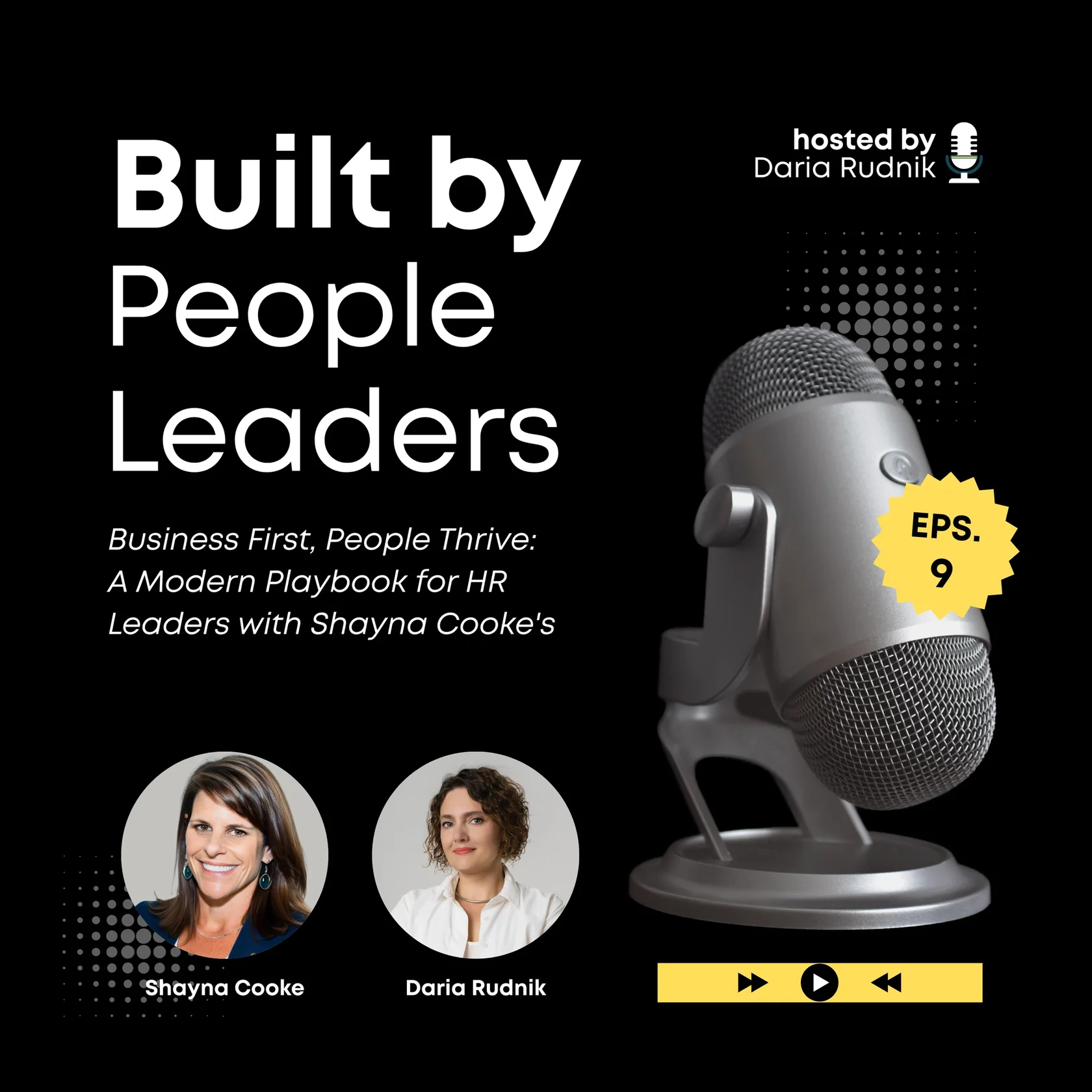
In this episode of Built by People Leaders, Daria Rudnik speaks with Dr. Shayna Cook, Chief People Officer at Dominion Payroll, about what it really takes to build modern organizations where people and performance thrive together.
Shayna shares her nonlinear journey from science teacher to HR executive, why HR must think like a business owner, and how to move from “accidental organizations” to intentionally designed systems. She also walks through her practical AI transformation playbook — including governance, human oversight, and the three pillars guiding adoption — and tells the surprising story of how one employee built internal AI agents that saved the company hundreds of thousands of dollars.
A grounded, practical conversation for HR leaders navigating growth, AI, and real business impact.
Company website: www.dominionpayroll.com
LinkedIn: https://www.linkedin.com/in/shaynacooke/
Takeaways
• From science teacher to Chief People Officer — a nonlinear path that reshaped modern HR leadership.
• Why HR must think like a business owner before advocating for people.
• The 3-pillar AI playbook that turns transformation into measurable impact.
• How building a culture of innovation unlocks unexpected employee growth and engagement.
• Stop running “accidental organizations” — start designing systems where people and performance thrive.
Chapters
00:00 Introduction to HR and AI Transformation
04:50 Shayna's Nonlinear Career Path
09:54 The Role of HR in Organizational Systems
14:44 AI Integration in HR
19:57 Building a Culture of AI Engagement
24:38 Advice for HR Leaders
29:30 Unexpected Outcomes of AI Implementation
Shayna shares her nonlinear journey from science teacher to HR executive, why HR must think like a business owner, and how to move from “accidental organizations” to intentionally designed systems. She also walks through her practical AI transformation playbook — including governance, human oversight, and the three pillars guiding adoption — and tells the surprising story of how one employee built internal AI agents that saved the company hundreds of thousands of dollars.
A grounded, practical conversation for HR leaders navigating growth, AI, and real business impact.
Company website: www.dominionpayroll.com
LinkedIn: https://www.linkedin.com/in/shaynacooke/
Takeaways
• From science teacher to Chief People Officer — a nonlinear path that reshaped modern HR leadership.
• Why HR must think like a business owner before advocating for people.
• The 3-pillar AI playbook that turns transformation into measurable impact.
• How building a culture of innovation unlocks unexpected employee growth and engagement.
• Stop running “accidental organizations” — start designing systems where people and performance thrive.
Chapters
00:00 Introduction to HR and AI Transformation
04:50 Shayna's Nonlinear Career Path
09:54 The Role of HR in Organizational Systems
14:44 AI Integration in HR
19:57 Building a Culture of AI Engagement
24:38 Advice for HR Leaders
29:30 Unexpected Outcomes of AI Implementation
Daria Rudnik (00:02.971)
Welcome to Built by People Leaders podcast brought to you by Aidra AI, AI-powered coach for leaders in tech. This show is for HR in scale-ups and fast-growing organizations, those building real impact from within and creating AI-ready organizations. And today I have a very special guest, Dr. Shaina Cook, a chief people officer and leadership architect focused on building modern organizations where people and performance thrive together.
She helps leaders rethink how work gets done through smarter systems, stronger leadership and intentional culture design. A defining part of her work is helping organizations adopt AI in ways that enhance human impact rather than replace it. And I love that topic and we're going to talk about AI a lot, but welcome Shaina. It's great to have you here. Thanks for joining the podcast.
Shayna Cooke (00:56.034)
Thank you so much for having me. It's great to be here.
Daria Rudnik (00:59.241)
Do you wanna share with the audience your path to HR? I know it wasn't like straight ahead HR, but tell us about it.
Shayna Cooke (01:04.302)
It was definitely not straight ahead. I have had the pleasure of having a very nonlinear career path, which I have really enjoyed every step on that journey. So I would say my professional career began in education. I was a teacher for about 17 years, always in the science department. I started in eighth grade. I taught all the way up through community college. But generally speaking, you know, in the science, in the arena of science, that's kind of where my expertise was. And then
After I had my second child, decided I wanted to maybe to step out of the classroom and more into an administrative position in schools because I just have a very strong feeling about what schools could be and should be for education. And on that journey, and that's kind when I started my doctoral program at VCU to get my degree in leadership and administration of organizations. And in the middle of that, I was presented this awesome opportunity to be a director of professional
learning for this organization that was based out of Boulder, Colorado. And that was really my first step out of education and into more of a business centered opportunity. And I loved it. I thought it was great. I had a coaching team of about 12 that I oversaw. They were based all over the world actually. And we worked in schools everywhere working with teachers on pedagogy and project based learning and bringing that into schools where that was not part of it yet.
And then COVID hit and as with many people that caused me to have to do kind of a pivot, the organization that I worked for because it was consultative in nature, a lot of schools pulled back their funding for that type of work.
And so we were gonna have to furlough for about eight months and that made me very uncomfortable. And so I used that moment to think about, all right, I've been in kind of the education space for about 25 years now, surely these skills are transferable somewhere else in a different kind of industry or maybe over in the business sector fully. And so then I started looking for roles in leadership and development of organizations, which I thought was a very easy transition.
Shayna Cooke (03:17.23)
And so there was a local organization here in Richmond, a payroll company actually, that was looking for a VP of learning and development. And so I reached out to a mutual friend who also had a payroll company, Dominion Payroll, which is where I now work, and asked him, tell me about this other company, tell me about their culture. I'm interested, but I want to understand more about who they are as an organization before I dive in. And...
He was like, well, wait, are you looking? And I was like, I am starting to look. And he was like, well, I have a VP of HR position. And I was like, I don't think you know what I do. I know nothing about HR except for the fact that I have always gotten paychecks and that's where they came from. And he's like, no, no, no, we want it to be different. We want it to be all about people and culture and nurture and growth. And I was like, yes, I can do that. I feel very good about that. And so.
I kind of entered that application process and had many, many interviews and happy to say that this organization took a big risk, if you will, on me because I didn't have that traditional background in HR that a lot of VP levels would have. But they brought me in as their VP of human capital about six years ago. And since then I have really kind of worked to make this organization.
what I think it should be and could be from a people perspective, from a cultural perspective, and then also from an operational and process perspective.
Daria Rudnik (04:44.703)
Oh, I love this story. mean, it resonates so much. Well, first of all, I need to tell you, I have a degree in English and German. I've never worked in school. But I also studied my career in learning and I am a true believer that like when learning grows into kind of more bigger organizational development and human capital and talent management and all of that really helps organizations grow. It's not just a payroll or I don't know.
Shayna Cooke (04:53.364)
yes, I see, yes.
Shayna Cooke (05:13.452)
Yeah. Yeah.
Daria Rudnik (05:14.459)
org charts, which that are very important. But again, like the perspective that you look at the organization and people function from the growth, how you can help people grow, how can you help organizations grow? And I think your background is just an amazing example of how that can benefit organizations. Do you mind sharing how this? Yeah, go ahead.
Shayna Cooke (05:30.924)
Yeah, there's great.
Sorry, I was gonna say there's great synergy between education actually and HR. And I've seen that a number of times where people kind of do that career shifting and primarily it's really just about developing people regardless of how old they are or where they are in their journeys. It's just knowing well how people work and how people learn and using those strengths to help people grow and develop into whatever they're looking for, whether that be in schools or whether that be from a professional perspective. so since I've been,
I've hired a number of teachers out of the classroom, brought them into the business sector to do learning and development in our HR space just because it's such an easy transition to make for sure.
Daria Rudnik (06:16.659)
Yeah, yeah. Well, it's easy on one side, but it's not that easy, I guess. It's not always easy. So tell us about this. Like, what were your failures or learnings that you got from this experience, from this transition?
Shayna Cooke (06:21.038)
Thank
That's fair.
Shayna Cooke (06:34.666)
gosh, you know, I was so excited and so thoughtful about getting the job and going through the interview process. then when I got the job, I just had this moment of panic of I don't know how to do this. Like I've never done this is so outside of what I've ever done. And I was very fearful that that I've been off more than I can chew with this. But to be honest, from the very beginning, I kind of settled in my my first goal was to meet
with every single employee that we had. And so I did. I said one on one with every single one of them. was 177 of them. And I met every one of them. I asked them all the same questions. And I used the information that they provided to me about the organization and about their history at the organization from those questions to build basically a SWOT analysis of where we were doing things well and where things needed to change. And really from those conversations, I built out the next 18 months of my project plan.
in the organization just simply based off of what the employees were seeing and feeling about their work environment. And from then it was just kind of off to the races, one project at a time.
Daria Rudnik (07:45.789)
And I think like you're hitting two goals with one stone while you build relationship with people by having those conversations with them, asking them questions. But you also get a lot of data that you can use to produce some quick wins and long-term results as well. That's a great approach. You mentioned in your bio that you're a leadership architect. And you also talk about designing system, which I love. mean, I think that's the best approach from like
building a system that works. So tell us more about that, how HR leaders, especially in growing companies can build those systems.
Shayna Cooke (08:25.708)
Yeah, so I think when we think about how HR can show up and have be empowered, I guess, to take ownership over, whether it's operational systems or whether it's people systems, I think the challenge in some organizations is showing up as a true partner to the business. And what I mean by that is I think it's important for HR professionals to show up at
as business partners first and people partners second. And I know that I can ruffle some feathers in that thinking, but being people first doesn't necessarily mean being people only. And I think when you have truly strategic HR leaders, they have to be organization first because without a healthy, sustainable organization, there really is no long-term opportunity for people to thrive in those spaces. So from my opinion and my experience, HR's role is really to design the systems and the experiences that allow
employees to do meaningful work, right? So those are going to be systems that engage them, help connect them to their own sense of purpose in the workplace, creating clarity around expectations and then providing real pathways for that growth professionally and financially. And then when those systems are designed well, people don't feel managed, they feel supported. But that's where HR really has to become that true business partner to the business, aligning people and operations so that they reinforce each other rather than compete with each other.
So people first without organizational clarity eventually fails people in the long run, in my opinion.
Daria Rudnik (09:59.359)
I agree. We had a few conversations before like this episode about how important is to you basically create an environment for people where they can thrive. And if you don't do that first, there's no way you can bring the right people in your organization. And if you do, there is no way they can stay because of the mass and poor business metrics. Because if companies not performing, it cannot afford having great people and taking care of those people and growing them.
So absolutely, mean, business comes first because that's where all the people can thrive together and create value for their customers.
Shayna Cooke (10:37.656)
That's exactly right. I would also say that if at all possible, I believe it's critical for CHROs or VPs of HR to actually have real operational ownership of the organization or pieces of the organization if there's an opportunity to do so. So for instance, I oversee two of our client-facing HR service lines. One of them is called DPBoost, and it's basically like a fractional HR person that would come in
The other one is DP assist and this is one where we would have people that do the administrative duties of HR. So organizations that maybe have turnover in their HR space would be able to use these services or if they are just too small to have their own HR teams. And for me, being able to own those pieces of our business, owning the budget, managing a P and L, making the trade offs that need to be made to make sure that those lines are successful. That really builds the financial and operational fluency that I think is required to partner credibly with the rest of the
executive team. And so for me, that was that fundamentally shaped how I think about people strategy about growth and business impact just from being held accountable to that that piece of our business.
Daria Rudnik (11:50.215)
And I love this stretch. mean, I think it's very important for any C-Suite leader basically to have this P &L in their operations, even if it's kind of a back office or something like that. It's not always possible. It might be challenging, but like from my experience again, I used to run a, what is called, kind of a unit, a product unit where we developed engineers into product managers.
And they got business out of it, but they were too young, junior to get business. I was overseeing that and I was responsible for P &L of that unit. Being HR, being like my main job was training them people, training those people to move from engineers to product owners. But still it's a great experience to be able to kind of touch this business, be in contact with customers and finance and stuff.
Shayna Cooke (12:41.965)
Yeah, absolutely. Absolutely.
Daria Rudnik (12:46.185)
Cool. I'd like to talk about my topic that I like talking about, which is AI. Everything is AI now. Usually, well, it happens what I see now is some companies, do implement many, of course, many companies implement AI, but it's kind of here and there. And HR is not always involved. It's either CTO or chief AI officer or someone else or change management, but not HR.
So my first question is, why do you think HR is not being actively involved in this AI transformation?
Shayna Cooke (13:22.991)
it's an interesting question because like for my organization, AI implementation and integration is centered in my space. It's coming out of HR. and I'm, I'm shepherding our organization through it. And to me, I, I see it as that, right? Because I think the evolution of HR, the workforce and the organization is happening simultaneously under the influence of AI. So in my mind, it's inseparable. It's not really just this idea.
of a tool adoption, it's an operating model shift. And to me, HR is a critical role to play in that shift from a people and an operational perspective. HR's responsibility really isn't just about efficiency gains, it's recruiting or in the recruiting and talent process, but it's more about risk. Obviously, there's a lot of risk that comes with AI. It's about governance and teaching, education of the employees. It's about rolling it out inside of the organization and doing so in a manageable way. And
and ultimately the ROI of those tools or that process falls on the shoulders of HR. I think it seems to me like HR and of course in my organization, it's a shepherding of the organization through this transformation. really whenever organizations go through a change management or a transformation such as this, where things touch how work gets done, how decisions are made and how people experience their roles, that's always centered in HR. And so to me, this is no different in this moment with AI.
Daria Rudnik (14:52.231)
Mm-hmm. And you're so right. mean, it's not technical transformation. Any transformation is not just purely technical, but this one specifically because AI influences how we work, how we collaborate, how we think, how we use AI. Do we think what, and I critically evaluate what AI gave us as output or we just use it and send it further? Do we produce any work slope?
Shayna Cooke (15:17.785)
Yeah.
Daria Rudnik (15:21.567)
What's your role as HR? How do you see your role in this AI transformation in your company?
Shayna Cooke (15:29.901)
Yeah, so I am the leader of the transformation actually for our organization. And I can tell you the way that we stepped into this, we did not go slowly, but we did go gently. And what I mean by that is when we knew that we were going to kind of be all in with AI, because really this is the moment, right? I don't see this as a wait and see moment. I think this is the time to intentionally design how AI shows up in our operating systems. Because I think waiting too long a reacting leader is going to not do a service to the
organization. And so we knew we were ready to jump. But I was very my CEO really wanted us to go all in, you know, like, we'll training wheels off, let's just go. And it was my recommendation recommendation that we take a step back and we look at it from a risk and compliance perspective, especially because we're a payroll organization, there's a lot of sensitive information that we deal with. And so I started an AI task force. And I did that just by sending out to the employee base who's using AI, who's excited about it.
Daria Rudnik (16:18.792)
Yeah.
Shayna Cooke (16:29.781)
and who wants to be a part of this movement for demeaning payroll. And we got about 25 employees that were interested in that. And so we really split those into two different groups. We have a risking governance group who helped us build our policy for our internal policy for how we will use AI, be it generative or agentic. And then we have another group that is kind of exploring tools and playing with the different types of AI and kind of coming back and saying this would be great for us or not. And so we started from a risking governance perspective, built the policy,
that out to the employees to talk about, you know, what are those sort of unique identifiers in our clients, in our system from our clients that can never be shared in a generative AI space? Why not? What's the risk with that? What happens if that does? And so we really kind of stepped into it slowly. My L &D team created a training last year for our employees that just said, here's what generative AI is. Here are the tools that we
we will be happy to use at Dominion payroll. Here's what can go in, here's what cannot go in. Here's how you can use it, here's how you cannot use it. Nothing ever goes out to a client that hasn't been proofread by a human first, right? And we really started thinking about how do we continue to push ourselves into this space in a way that is meaningful? And really, it kind of came down to these three pillars, knowing that if it's routine work in the organization, we're going to try to automate it for sure. If it's creative work,
work, we're going to try to augment it with AI and if it's empathetic work that really needs to stay in the human space. And so those are our drivers, right? And what we're looking for is obviously an increase in efficiency across our employee base, because we want to give them capacity back to do important work and remove that automated work from them. We're looking to obviously increase our client satisfaction always. We are looking to decrease errors that happen from the human touch. And then of course, you know, looking to
know, pull back any savings that we can from a financial perspective. But really our three drivers are around employee engagement and client satisfaction, first and foremost.
Daria Rudnik (18:38.719)
Amazing. mean, you just listen to the playbook, how to do AI transformation in your organization. You get the people together, you create policies, you share the policy, you train people, you make sure there's a human check. And I love your three pillars. I don't know if you heard, there was a Stanford research and they identified five steps of human automation scale where one is
Shayna Cooke (18:45.047)
you
Daria Rudnik (19:07.699)
I'm not sure which one is like one, which one is five, but like one is only human, then human, a little bit of AI plus human, then human AI, different types of collaboration. And then five is automation, but still observed by humans. There is no just AI without humans approach. So I love your three pillars, scientifically proven framework from Stanford.
Shayna Cooke (19:28.195)
Yes.
Shayna Cooke (19:32.323)
Yeah. Yes. Great.
Yeah, so far it's been good. So far it's been very good. We also have these we do once a month, we do we call them coffee, tea and AI. And we have anybody that's interested any of the employees that are interested, somebody from the task force will facilitate it each time. But we bring the employees together and we share a tool and we or we ask them to come and you know, what have you been playing with what's working well for you and you're in your work that AI is supporting and it's just kind of like a share and tell time for people to just take a step back and
and spend a little more time in a group setting with these AI tools to help them, you know, to be a little more brave and a little more courageous around this work. So it's been great.
Daria Rudnik (20:20.169)
And I know you have a story that's kind of unexpected outcome of those chairs that we'll be sharing at the end of this episode. So stay close, we'll come to that. Shaina, with your experience learning academia, HR, AI transformation, what would be your advice to HR leaders to be more accepted as business partners for their organizations?
Shayna Cooke (20:47.191)
Yeah, you know, I think.
showing up again, kind of in that organization first perspective. So I think a lot of times when we have one seat at the table, when HR has one seat at the table, if you're on an executive team, you are going to be the only person that's bringing forward some ideas around people benefits. And those things always come at a cost. And so sometimes those opinions are not popular, right? When we're in a cost cutting or cost saving phase or you're focused,
specifically on EBITDA margins and then you've got the HR professional coming forward that says, hey, we need to add this benefit this year because our employees want it and it's only going to cost us $500,000. I think, you know, if being able to understand the goals of the organization, right, and then being able to tie the goals of the organization into the outcomes that HR is trying to put together is very important. Because if you come to the table and you say, need, you know, $500,000, another million
$20 for benefits this year to keep us competitive in the market. But your sales are down, your EBIT is not healthy. That's going to fall on deaf ears. And unfortunately, that HR professional is going to be dismissed as kind of not getting it and not understanding. And so I don't know that the ownership fully falls on HR, but I do know that your HR folks, especially at the executive level, should intimately understand where the business is financially and what the goals of the business of the organization are.
and then help to make the goals around people, employee engagement, benefits, all of that fit into those because they cannot be in conflict with each other. Not to say that I don't sometimes come forward and say, listen, we need to do this. We need to do this for our people. This is what this is going to look like. But I know very deeply to my core what our goals are as an organization. And so because I know that, I know where I can push and where I should not push. And I think that helps.
Shayna Cooke (22:49.103)
us to show up as business partners who understand where you're going as an organization and you are trying to support that fully instead of just blindly saying, well, this is what we need to do for the people first. And I know that that maybe is not a totally popular idea around business first, people second, but I think that that is the way that organizations will thrive. And it is a balance for sure, not to say that you don't make people first.
Daria Rudnik (23:01.833)
Mm-hmm.
Shayna Cooke (23:18.767)
priorities, but they have to align with what's going on in the business or they're just going to fall flat with the decision makers.
Daria Rudnik (23:23.871)
Yeah, absolutely. It's like you said before, go look beyond just HR, go see business, understand financials, items and business KPIs. What is finance doing? What R &D is doing? What other units are doing? What their goals are really on a higher level? What's the strategy? Not just people, like we take care of people, but how that impacts business.
Shayna Cooke (23:45.869)
Yeah.
Shayna Cooke (23:52.215)
Yeah, and partnering closely, I think with the CFO to me is a huge I mean, my CFO is is my right hand person because he is the owner of our budget and our numbers and I have to know exactly where we are so that I can do the work that I'm doing. And even if we're talking about like, you know, merit increases outside of what was already approved for the budget. All of those conversations have to happen in partnership with the CFO. And so having a good relationship with that person, I think is very
Daria Rudnik (23:55.634)
Yeah.
Shayna Cooke (24:22.159)
important and really the skill sets between a CHRO and a CFO are very different but they're very complementary of each other if you have a good partnership between those two folks for sure.
Daria Rudnik (24:32.709)
You're so right. Yeah. I mean, we're so different. We can't be so different. But if you find the synergy, that's going to be an amazing partnership. Jane, if you could solve one professional problem with a magic wand, what would that be?
Shayna Cooke (24:36.821)
Yes.
Shayna Cooke (24:47.983)
I would say if I could have a magic wand, I would eliminate accidental organizations. And what I mean by that is maybe it's because organizations have been operating for decades and the business grew around the people, or maybe because growth happened faster than intentionally designed. So it left these systems and roles and decision making to evolve, but by default, but either way.
I see way too many companies operating by default rather than by design. so they, know, layers are added over time, roles have evolved without clarity, people systems are a mess, and they don't really reflect how work actually happens today. And I think that that creates friction everywhere in terms of unclear accountability, performance processes not measuring up burnt out leaders, employees who feel busy, but they're not impactful. And then HR just ends up managing systems instead of shaping the system itself. So
I think if organizations were forced to design themselves intentionally, thinking about how workflows, how decisions get made, how people grow and are rewarded, we would see much better performance. We'd see much healthier organizations and cultures, far less burnout. In my opinion, the opportunity here for HR is to really be the architect of that intentional design.
Daria Rudnik (26:05.821)
Yeah, I know it might be hard, especially when organizations growing fast and there's no time and you don't know what's going to be the next step. kind of keeping that in mind, okay, we're building a system. We're not just putting patches and kind of trying to solve the now problem. We're building a future ready system. That's true. That's so true.
I have a few rapid fire questions. So just to get to know you as a person. So ready? Okay. Are you a tea person or coffee person? Dogs or cats?
Shayna Cooke (26:28.599)
Okay. Sure. I am ready.
Shayna Cooke (26:37.472)
coffee. No hesitation. Dogs. Also no hesitation.
Daria Rudnik (26:44.691)
Are you a morning person or a night owl?
Shayna Cooke (26:47.183)
Um, can I say both? I really love early mornings when it's quiet, but I also really love late to quiet evenings. I think these are both the periods of the day where no one actually needs anything from me, so I really cherish both of those times. I know it's a trade-off.
Daria Rudnik (27:00.103)
When you sleep.
Would you rather take a message or a phone call?
Shayna Cooke (27:10.081)
message. Unless it's urgent message for sure.
Daria Rudnik (27:15.615)
What did you want to be when you were a kid?
Shayna Cooke (27:18.85)
I'm marine biologist.
Daria Rudnik (27:20.648)
so nice. Where do you go when you need perspective?
Shayna Cooke (27:24.943)
I go to my best friend and I go to my husband. Each of them bring their own perspectives into my life and both are invaluable to me.
Daria Rudnik (27:33.011)
What's one rule that you've broken and you don't regret?
Shayna Cooke (27:37.359)
Waiting for permission. think this is the arc of my leadership story. Early career is really about earning credibility in my mind and then later career is claiming authority and I think I've crossed that line.
Daria Rudnik (27:47.999)
What's one habit or phrase that people say it's totally you?
Shayna Cooke (27:54.831)
tell me more. It's a common habit and phrase that I use all the time. It works in any conversation that you're having, that you're trying to navigate that might be emotional or frustrating or unclear. And I really have found that those three words can get people to drill down further into what's causing the friction every time.
Daria Rudnik (27:56.979)
No.
Daria Rudnik (28:11.564)
Well, thank you so much, Shana. It was an incredible conversation. And we do still have a story to share, so stay with us. We talked about how AI, what were the best approach to implement AI in an organization, how HR can lead it. We talked about how HR can become a true business partner for their organizations and why organizations first are more important than people first, because it's beneficial for all of us. How people can reach out to you, how people can find you.
Shayna Cooke (28:40.365)
Yeah, so you can reach out to me. My email is scook at dominionpayroll.com. And I would love to have a chance to have a virtual coffee with anybody and have a chit chat around any of this stuff that we talked about and do some brainstorming. I do that often, and I enjoy that very much, is working with other folks. You can also find me on LinkedIn. Connect with me on LinkedIn, Shayna Cook, and find me there. I would love to make some connections there as well.
Daria Rudnik (29:08.561)
Okay, well, thanks so much. And we'll have all those links and email and LinkedIn profile in the notes to this episode. And now please tell us the exciting and surprising outcome from engaging employees in this AI transformation.
Shayna Cooke (29:25.591)
Yeah, so I told you that we started this AI task force and I knew we also wanted to start to get into that automation of work looking at agents. And so I have two folks, my director of IT and then one of my implementation specialists who actually is part of our near shore partnership down in Columbia, South America.
His name is Juan and he is wonderful. He's about 24 years old, very, very smart man. And so he came forward and said, I would love to help with this research. And so what I asked for him to do was go out into the marketplace and find these. And I gave him some examples of these AI tech stacks to help us not to get too much into the details, but there's a lot of manual work that happens when a new client comes into a payroll system. There's a lot of manual work that needs to happen from transitioning the client from the old system to the new system.
And that's what our folks down in Columbia are doing. And it's a lot. It takes a long time. So I was like, let's try to find some automation around these tools that can make this much easier and much quicker for you guys. so Juan went into the marketplace and started doing some research and pricing things out for us. And of course, it was to the tune of hundreds of thousands of dollars, which I anticipated. I didn't necessarily was going to spend that, but I wanted to understand what was out there. And then he says, well, I think I'm just going to try to build something.
for us and I was like, okay, Juan, I can't wait to see. And then I was like, okay, we'll give it a shot. Let's see how that goes. And so he went away and he started building these agents in Power BI in our Microsoft environment. And he has built these agents that have fundamentally changed the way the work is happening in the implementation department because of what he's built.
and it was completely seamless and he is brilliant and he definitely is saving us like the ROI of that would be around increased efficiency but he also I mean obviously saved us hundreds of thousands of dollars of investment in AI tools that he was able to build specifically for our environment on his own and I just had no idea and so what's super interesting about that is that
Shayna Cooke (31:35.075)
He also sees himself as an AI architect, and so we're very excited to promote him out of his position in the implementation department. He's gonna move into the IT space with our director of IT and continue to look to be able to build agents in our organization that will increase our efficiencies. Those drivers that we talked about earlier hitting all of those markers, and it was just kind of was happenstance because it was something that he was interested in and he started playing around with it, and here we are, so.
I thought that was a huge win for us and something that was very unexpected for me because I was still in the space of, we have to go buy it. Somebody else built it, so let's go buy it. And it turns out, you know, we just made it inside our own system. It was amazing. Absolutely amazing.
Daria Rudnik (32:15.697)
That is really an incredible story. And it actually proves what you said earlier. Put the organization first and create an environment where people can find and do something meaningful that's beneficial both for organizations and for themselves. We don't need to engage people. We don't need to motivate people. We need to create an environment where they are engaged, motivated, they find what they're passionate about and do that for the benefit of all.
Shayna Cooke (32:38.573)
Yeah, absolutely.
Daria Rudnik (32:41.567)
Well, thank you so much, Shaina. It was a great conversation. I really enjoyed talking to you today and thanks for sharing your experience and insights and your playbook. Please connect with Shaina, reach out to her and ask her questions. She's very open to connections. Thank you.
Shayna Cooke (32:56.515)
Yes, think it was so fun. Great to be with you. Bye.
Welcome to Built by People Leaders podcast brought to you by Aidra AI, AI-powered coach for leaders in tech. This show is for HR in scale-ups and fast-growing organizations, those building real impact from within and creating AI-ready organizations. And today I have a very special guest, Dr. Shaina Cook, a chief people officer and leadership architect focused on building modern organizations where people and performance thrive together.
She helps leaders rethink how work gets done through smarter systems, stronger leadership and intentional culture design. A defining part of her work is helping organizations adopt AI in ways that enhance human impact rather than replace it. And I love that topic and we're going to talk about AI a lot, but welcome Shaina. It's great to have you here. Thanks for joining the podcast.
Shayna Cooke (00:56.034)
Thank you so much for having me. It's great to be here.
Daria Rudnik (00:59.241)
Do you wanna share with the audience your path to HR? I know it wasn't like straight ahead HR, but tell us about it.
Shayna Cooke (01:04.302)
It was definitely not straight ahead. I have had the pleasure of having a very nonlinear career path, which I have really enjoyed every step on that journey. So I would say my professional career began in education. I was a teacher for about 17 years, always in the science department. I started in eighth grade. I taught all the way up through community college. But generally speaking, you know, in the science, in the arena of science, that's kind of where my expertise was. And then
After I had my second child, decided I wanted to maybe to step out of the classroom and more into an administrative position in schools because I just have a very strong feeling about what schools could be and should be for education. And on that journey, and that's kind when I started my doctoral program at VCU to get my degree in leadership and administration of organizations. And in the middle of that, I was presented this awesome opportunity to be a director of professional
learning for this organization that was based out of Boulder, Colorado. And that was really my first step out of education and into more of a business centered opportunity. And I loved it. I thought it was great. I had a coaching team of about 12 that I oversaw. They were based all over the world actually. And we worked in schools everywhere working with teachers on pedagogy and project based learning and bringing that into schools where that was not part of it yet.
And then COVID hit and as with many people that caused me to have to do kind of a pivot, the organization that I worked for because it was consultative in nature, a lot of schools pulled back their funding for that type of work.
And so we were gonna have to furlough for about eight months and that made me very uncomfortable. And so I used that moment to think about, all right, I've been in kind of the education space for about 25 years now, surely these skills are transferable somewhere else in a different kind of industry or maybe over in the business sector fully. And so then I started looking for roles in leadership and development of organizations, which I thought was a very easy transition.
Shayna Cooke (03:17.23)
And so there was a local organization here in Richmond, a payroll company actually, that was looking for a VP of learning and development. And so I reached out to a mutual friend who also had a payroll company, Dominion Payroll, which is where I now work, and asked him, tell me about this other company, tell me about their culture. I'm interested, but I want to understand more about who they are as an organization before I dive in. And...
He was like, well, wait, are you looking? And I was like, I am starting to look. And he was like, well, I have a VP of HR position. And I was like, I don't think you know what I do. I know nothing about HR except for the fact that I have always gotten paychecks and that's where they came from. And he's like, no, no, no, we want it to be different. We want it to be all about people and culture and nurture and growth. And I was like, yes, I can do that. I feel very good about that. And so.
I kind of entered that application process and had many, many interviews and happy to say that this organization took a big risk, if you will, on me because I didn't have that traditional background in HR that a lot of VP levels would have. But they brought me in as their VP of human capital about six years ago. And since then I have really kind of worked to make this organization.
what I think it should be and could be from a people perspective, from a cultural perspective, and then also from an operational and process perspective.
Daria Rudnik (04:44.703)
Oh, I love this story. mean, it resonates so much. Well, first of all, I need to tell you, I have a degree in English and German. I've never worked in school. But I also studied my career in learning and I am a true believer that like when learning grows into kind of more bigger organizational development and human capital and talent management and all of that really helps organizations grow. It's not just a payroll or I don't know.
Shayna Cooke (04:53.364)
yes, I see, yes.
Shayna Cooke (05:13.452)
Yeah. Yeah.
Daria Rudnik (05:14.459)
org charts, which that are very important. But again, like the perspective that you look at the organization and people function from the growth, how you can help people grow, how can you help organizations grow? And I think your background is just an amazing example of how that can benefit organizations. Do you mind sharing how this? Yeah, go ahead.
Shayna Cooke (05:30.924)
Yeah, there's great.
Sorry, I was gonna say there's great synergy between education actually and HR. And I've seen that a number of times where people kind of do that career shifting and primarily it's really just about developing people regardless of how old they are or where they are in their journeys. It's just knowing well how people work and how people learn and using those strengths to help people grow and develop into whatever they're looking for, whether that be in schools or whether that be from a professional perspective. so since I've been,
I've hired a number of teachers out of the classroom, brought them into the business sector to do learning and development in our HR space just because it's such an easy transition to make for sure.
Daria Rudnik (06:16.659)
Yeah, yeah. Well, it's easy on one side, but it's not that easy, I guess. It's not always easy. So tell us about this. Like, what were your failures or learnings that you got from this experience, from this transition?
Shayna Cooke (06:21.038)
Thank
That's fair.
Shayna Cooke (06:34.666)
gosh, you know, I was so excited and so thoughtful about getting the job and going through the interview process. then when I got the job, I just had this moment of panic of I don't know how to do this. Like I've never done this is so outside of what I've ever done. And I was very fearful that that I've been off more than I can chew with this. But to be honest, from the very beginning, I kind of settled in my my first goal was to meet
with every single employee that we had. And so I did. I said one on one with every single one of them. was 177 of them. And I met every one of them. I asked them all the same questions. And I used the information that they provided to me about the organization and about their history at the organization from those questions to build basically a SWOT analysis of where we were doing things well and where things needed to change. And really from those conversations, I built out the next 18 months of my project plan.
in the organization just simply based off of what the employees were seeing and feeling about their work environment. And from then it was just kind of off to the races, one project at a time.
Daria Rudnik (07:45.789)
And I think like you're hitting two goals with one stone while you build relationship with people by having those conversations with them, asking them questions. But you also get a lot of data that you can use to produce some quick wins and long-term results as well. That's a great approach. You mentioned in your bio that you're a leadership architect. And you also talk about designing system, which I love. mean, I think that's the best approach from like
building a system that works. So tell us more about that, how HR leaders, especially in growing companies can build those systems.
Shayna Cooke (08:25.708)
Yeah, so I think when we think about how HR can show up and have be empowered, I guess, to take ownership over, whether it's operational systems or whether it's people systems, I think the challenge in some organizations is showing up as a true partner to the business. And what I mean by that is I think it's important for HR professionals to show up at
as business partners first and people partners second. And I know that I can ruffle some feathers in that thinking, but being people first doesn't necessarily mean being people only. And I think when you have truly strategic HR leaders, they have to be organization first because without a healthy, sustainable organization, there really is no long-term opportunity for people to thrive in those spaces. So from my opinion and my experience, HR's role is really to design the systems and the experiences that allow
employees to do meaningful work, right? So those are going to be systems that engage them, help connect them to their own sense of purpose in the workplace, creating clarity around expectations and then providing real pathways for that growth professionally and financially. And then when those systems are designed well, people don't feel managed, they feel supported. But that's where HR really has to become that true business partner to the business, aligning people and operations so that they reinforce each other rather than compete with each other.
So people first without organizational clarity eventually fails people in the long run, in my opinion.
Daria Rudnik (09:59.359)
I agree. We had a few conversations before like this episode about how important is to you basically create an environment for people where they can thrive. And if you don't do that first, there's no way you can bring the right people in your organization. And if you do, there is no way they can stay because of the mass and poor business metrics. Because if companies not performing, it cannot afford having great people and taking care of those people and growing them.
So absolutely, mean, business comes first because that's where all the people can thrive together and create value for their customers.
Shayna Cooke (10:37.656)
That's exactly right. I would also say that if at all possible, I believe it's critical for CHROs or VPs of HR to actually have real operational ownership of the organization or pieces of the organization if there's an opportunity to do so. So for instance, I oversee two of our client-facing HR service lines. One of them is called DPBoost, and it's basically like a fractional HR person that would come in
The other one is DP assist and this is one where we would have people that do the administrative duties of HR. So organizations that maybe have turnover in their HR space would be able to use these services or if they are just too small to have their own HR teams. And for me, being able to own those pieces of our business, owning the budget, managing a P and L, making the trade offs that need to be made to make sure that those lines are successful. That really builds the financial and operational fluency that I think is required to partner credibly with the rest of the
executive team. And so for me, that was that fundamentally shaped how I think about people strategy about growth and business impact just from being held accountable to that that piece of our business.
Daria Rudnik (11:50.215)
And I love this stretch. mean, I think it's very important for any C-Suite leader basically to have this P &L in their operations, even if it's kind of a back office or something like that. It's not always possible. It might be challenging, but like from my experience again, I used to run a, what is called, kind of a unit, a product unit where we developed engineers into product managers.
And they got business out of it, but they were too young, junior to get business. I was overseeing that and I was responsible for P &L of that unit. Being HR, being like my main job was training them people, training those people to move from engineers to product owners. But still it's a great experience to be able to kind of touch this business, be in contact with customers and finance and stuff.
Shayna Cooke (12:41.965)
Yeah, absolutely. Absolutely.
Daria Rudnik (12:46.185)
Cool. I'd like to talk about my topic that I like talking about, which is AI. Everything is AI now. Usually, well, it happens what I see now is some companies, do implement many, of course, many companies implement AI, but it's kind of here and there. And HR is not always involved. It's either CTO or chief AI officer or someone else or change management, but not HR.
So my first question is, why do you think HR is not being actively involved in this AI transformation?
Shayna Cooke (13:22.991)
it's an interesting question because like for my organization, AI implementation and integration is centered in my space. It's coming out of HR. and I'm, I'm shepherding our organization through it. And to me, I, I see it as that, right? Because I think the evolution of HR, the workforce and the organization is happening simultaneously under the influence of AI. So in my mind, it's inseparable. It's not really just this idea.
of a tool adoption, it's an operating model shift. And to me, HR is a critical role to play in that shift from a people and an operational perspective. HR's responsibility really isn't just about efficiency gains, it's recruiting or in the recruiting and talent process, but it's more about risk. Obviously, there's a lot of risk that comes with AI. It's about governance and teaching, education of the employees. It's about rolling it out inside of the organization and doing so in a manageable way. And
and ultimately the ROI of those tools or that process falls on the shoulders of HR. I think it seems to me like HR and of course in my organization, it's a shepherding of the organization through this transformation. really whenever organizations go through a change management or a transformation such as this, where things touch how work gets done, how decisions are made and how people experience their roles, that's always centered in HR. And so to me, this is no different in this moment with AI.
Daria Rudnik (14:52.231)
Mm-hmm. And you're so right. mean, it's not technical transformation. Any transformation is not just purely technical, but this one specifically because AI influences how we work, how we collaborate, how we think, how we use AI. Do we think what, and I critically evaluate what AI gave us as output or we just use it and send it further? Do we produce any work slope?
Shayna Cooke (15:17.785)
Yeah.
Daria Rudnik (15:21.567)
What's your role as HR? How do you see your role in this AI transformation in your company?
Shayna Cooke (15:29.901)
Yeah, so I am the leader of the transformation actually for our organization. And I can tell you the way that we stepped into this, we did not go slowly, but we did go gently. And what I mean by that is when we knew that we were going to kind of be all in with AI, because really this is the moment, right? I don't see this as a wait and see moment. I think this is the time to intentionally design how AI shows up in our operating systems. Because I think waiting too long a reacting leader is going to not do a service to the
organization. And so we knew we were ready to jump. But I was very my CEO really wanted us to go all in, you know, like, we'll training wheels off, let's just go. And it was my recommendation recommendation that we take a step back and we look at it from a risk and compliance perspective, especially because we're a payroll organization, there's a lot of sensitive information that we deal with. And so I started an AI task force. And I did that just by sending out to the employee base who's using AI, who's excited about it.
Daria Rudnik (16:18.792)
Yeah.
Shayna Cooke (16:29.781)
and who wants to be a part of this movement for demeaning payroll. And we got about 25 employees that were interested in that. And so we really split those into two different groups. We have a risking governance group who helped us build our policy for our internal policy for how we will use AI, be it generative or agentic. And then we have another group that is kind of exploring tools and playing with the different types of AI and kind of coming back and saying this would be great for us or not. And so we started from a risking governance perspective, built the policy,
that out to the employees to talk about, you know, what are those sort of unique identifiers in our clients, in our system from our clients that can never be shared in a generative AI space? Why not? What's the risk with that? What happens if that does? And so we really kind of stepped into it slowly. My L &D team created a training last year for our employees that just said, here's what generative AI is. Here are the tools that we
we will be happy to use at Dominion payroll. Here's what can go in, here's what cannot go in. Here's how you can use it, here's how you cannot use it. Nothing ever goes out to a client that hasn't been proofread by a human first, right? And we really started thinking about how do we continue to push ourselves into this space in a way that is meaningful? And really, it kind of came down to these three pillars, knowing that if it's routine work in the organization, we're going to try to automate it for sure. If it's creative work,
work, we're going to try to augment it with AI and if it's empathetic work that really needs to stay in the human space. And so those are our drivers, right? And what we're looking for is obviously an increase in efficiency across our employee base, because we want to give them capacity back to do important work and remove that automated work from them. We're looking to obviously increase our client satisfaction always. We are looking to decrease errors that happen from the human touch. And then of course, you know, looking to
know, pull back any savings that we can from a financial perspective. But really our three drivers are around employee engagement and client satisfaction, first and foremost.
Daria Rudnik (18:38.719)
Amazing. mean, you just listen to the playbook, how to do AI transformation in your organization. You get the people together, you create policies, you share the policy, you train people, you make sure there's a human check. And I love your three pillars. I don't know if you heard, there was a Stanford research and they identified five steps of human automation scale where one is
Shayna Cooke (18:45.047)
you
Daria Rudnik (19:07.699)
I'm not sure which one is like one, which one is five, but like one is only human, then human, a little bit of AI plus human, then human AI, different types of collaboration. And then five is automation, but still observed by humans. There is no just AI without humans approach. So I love your three pillars, scientifically proven framework from Stanford.
Shayna Cooke (19:28.195)
Yes.
Shayna Cooke (19:32.323)
Yeah. Yes. Great.
Yeah, so far it's been good. So far it's been very good. We also have these we do once a month, we do we call them coffee, tea and AI. And we have anybody that's interested any of the employees that are interested, somebody from the task force will facilitate it each time. But we bring the employees together and we share a tool and we or we ask them to come and you know, what have you been playing with what's working well for you and you're in your work that AI is supporting and it's just kind of like a share and tell time for people to just take a step back and
and spend a little more time in a group setting with these AI tools to help them, you know, to be a little more brave and a little more courageous around this work. So it's been great.
Daria Rudnik (20:20.169)
And I know you have a story that's kind of unexpected outcome of those chairs that we'll be sharing at the end of this episode. So stay close, we'll come to that. Shaina, with your experience learning academia, HR, AI transformation, what would be your advice to HR leaders to be more accepted as business partners for their organizations?
Shayna Cooke (20:47.191)
Yeah, you know, I think.
showing up again, kind of in that organization first perspective. So I think a lot of times when we have one seat at the table, when HR has one seat at the table, if you're on an executive team, you are going to be the only person that's bringing forward some ideas around people benefits. And those things always come at a cost. And so sometimes those opinions are not popular, right? When we're in a cost cutting or cost saving phase or you're focused,
specifically on EBITDA margins and then you've got the HR professional coming forward that says, hey, we need to add this benefit this year because our employees want it and it's only going to cost us $500,000. I think, you know, if being able to understand the goals of the organization, right, and then being able to tie the goals of the organization into the outcomes that HR is trying to put together is very important. Because if you come to the table and you say, need, you know, $500,000, another million
$20 for benefits this year to keep us competitive in the market. But your sales are down, your EBIT is not healthy. That's going to fall on deaf ears. And unfortunately, that HR professional is going to be dismissed as kind of not getting it and not understanding. And so I don't know that the ownership fully falls on HR, but I do know that your HR folks, especially at the executive level, should intimately understand where the business is financially and what the goals of the business of the organization are.
and then help to make the goals around people, employee engagement, benefits, all of that fit into those because they cannot be in conflict with each other. Not to say that I don't sometimes come forward and say, listen, we need to do this. We need to do this for our people. This is what this is going to look like. But I know very deeply to my core what our goals are as an organization. And so because I know that, I know where I can push and where I should not push. And I think that helps.
Shayna Cooke (22:49.103)
us to show up as business partners who understand where you're going as an organization and you are trying to support that fully instead of just blindly saying, well, this is what we need to do for the people first. And I know that that maybe is not a totally popular idea around business first, people second, but I think that that is the way that organizations will thrive. And it is a balance for sure, not to say that you don't make people first.
Daria Rudnik (23:01.833)
Mm-hmm.
Shayna Cooke (23:18.767)
priorities, but they have to align with what's going on in the business or they're just going to fall flat with the decision makers.
Daria Rudnik (23:23.871)
Yeah, absolutely. It's like you said before, go look beyond just HR, go see business, understand financials, items and business KPIs. What is finance doing? What R &D is doing? What other units are doing? What their goals are really on a higher level? What's the strategy? Not just people, like we take care of people, but how that impacts business.
Shayna Cooke (23:45.869)
Yeah.
Shayna Cooke (23:52.215)
Yeah, and partnering closely, I think with the CFO to me is a huge I mean, my CFO is is my right hand person because he is the owner of our budget and our numbers and I have to know exactly where we are so that I can do the work that I'm doing. And even if we're talking about like, you know, merit increases outside of what was already approved for the budget. All of those conversations have to happen in partnership with the CFO. And so having a good relationship with that person, I think is very
Daria Rudnik (23:55.634)
Yeah.
Shayna Cooke (24:22.159)
important and really the skill sets between a CHRO and a CFO are very different but they're very complementary of each other if you have a good partnership between those two folks for sure.
Daria Rudnik (24:32.709)
You're so right. Yeah. I mean, we're so different. We can't be so different. But if you find the synergy, that's going to be an amazing partnership. Jane, if you could solve one professional problem with a magic wand, what would that be?
Shayna Cooke (24:36.821)
Yes.
Shayna Cooke (24:47.983)
I would say if I could have a magic wand, I would eliminate accidental organizations. And what I mean by that is maybe it's because organizations have been operating for decades and the business grew around the people, or maybe because growth happened faster than intentionally designed. So it left these systems and roles and decision making to evolve, but by default, but either way.
I see way too many companies operating by default rather than by design. so they, know, layers are added over time, roles have evolved without clarity, people systems are a mess, and they don't really reflect how work actually happens today. And I think that that creates friction everywhere in terms of unclear accountability, performance processes not measuring up burnt out leaders, employees who feel busy, but they're not impactful. And then HR just ends up managing systems instead of shaping the system itself. So
I think if organizations were forced to design themselves intentionally, thinking about how workflows, how decisions get made, how people grow and are rewarded, we would see much better performance. We'd see much healthier organizations and cultures, far less burnout. In my opinion, the opportunity here for HR is to really be the architect of that intentional design.
Daria Rudnik (26:05.821)
Yeah, I know it might be hard, especially when organizations growing fast and there's no time and you don't know what's going to be the next step. kind of keeping that in mind, okay, we're building a system. We're not just putting patches and kind of trying to solve the now problem. We're building a future ready system. That's true. That's so true.
I have a few rapid fire questions. So just to get to know you as a person. So ready? Okay. Are you a tea person or coffee person? Dogs or cats?
Shayna Cooke (26:28.599)
Okay. Sure. I am ready.
Shayna Cooke (26:37.472)
coffee. No hesitation. Dogs. Also no hesitation.
Daria Rudnik (26:44.691)
Are you a morning person or a night owl?
Shayna Cooke (26:47.183)
Um, can I say both? I really love early mornings when it's quiet, but I also really love late to quiet evenings. I think these are both the periods of the day where no one actually needs anything from me, so I really cherish both of those times. I know it's a trade-off.
Daria Rudnik (27:00.103)
When you sleep.
Would you rather take a message or a phone call?
Shayna Cooke (27:10.081)
message. Unless it's urgent message for sure.
Daria Rudnik (27:15.615)
What did you want to be when you were a kid?
Shayna Cooke (27:18.85)
I'm marine biologist.
Daria Rudnik (27:20.648)
so nice. Where do you go when you need perspective?
Shayna Cooke (27:24.943)
I go to my best friend and I go to my husband. Each of them bring their own perspectives into my life and both are invaluable to me.
Daria Rudnik (27:33.011)
What's one rule that you've broken and you don't regret?
Shayna Cooke (27:37.359)
Waiting for permission. think this is the arc of my leadership story. Early career is really about earning credibility in my mind and then later career is claiming authority and I think I've crossed that line.
Daria Rudnik (27:47.999)
What's one habit or phrase that people say it's totally you?
Shayna Cooke (27:54.831)
tell me more. It's a common habit and phrase that I use all the time. It works in any conversation that you're having, that you're trying to navigate that might be emotional or frustrating or unclear. And I really have found that those three words can get people to drill down further into what's causing the friction every time.
Daria Rudnik (27:56.979)
No.
Daria Rudnik (28:11.564)
Well, thank you so much, Shana. It was an incredible conversation. And we do still have a story to share, so stay with us. We talked about how AI, what were the best approach to implement AI in an organization, how HR can lead it. We talked about how HR can become a true business partner for their organizations and why organizations first are more important than people first, because it's beneficial for all of us. How people can reach out to you, how people can find you.
Shayna Cooke (28:40.365)
Yeah, so you can reach out to me. My email is scook at dominionpayroll.com. And I would love to have a chance to have a virtual coffee with anybody and have a chit chat around any of this stuff that we talked about and do some brainstorming. I do that often, and I enjoy that very much, is working with other folks. You can also find me on LinkedIn. Connect with me on LinkedIn, Shayna Cook, and find me there. I would love to make some connections there as well.
Daria Rudnik (29:08.561)
Okay, well, thanks so much. And we'll have all those links and email and LinkedIn profile in the notes to this episode. And now please tell us the exciting and surprising outcome from engaging employees in this AI transformation.
Shayna Cooke (29:25.591)
Yeah, so I told you that we started this AI task force and I knew we also wanted to start to get into that automation of work looking at agents. And so I have two folks, my director of IT and then one of my implementation specialists who actually is part of our near shore partnership down in Columbia, South America.
His name is Juan and he is wonderful. He's about 24 years old, very, very smart man. And so he came forward and said, I would love to help with this research. And so what I asked for him to do was go out into the marketplace and find these. And I gave him some examples of these AI tech stacks to help us not to get too much into the details, but there's a lot of manual work that happens when a new client comes into a payroll system. There's a lot of manual work that needs to happen from transitioning the client from the old system to the new system.
And that's what our folks down in Columbia are doing. And it's a lot. It takes a long time. So I was like, let's try to find some automation around these tools that can make this much easier and much quicker for you guys. so Juan went into the marketplace and started doing some research and pricing things out for us. And of course, it was to the tune of hundreds of thousands of dollars, which I anticipated. I didn't necessarily was going to spend that, but I wanted to understand what was out there. And then he says, well, I think I'm just going to try to build something.
for us and I was like, okay, Juan, I can't wait to see. And then I was like, okay, we'll give it a shot. Let's see how that goes. And so he went away and he started building these agents in Power BI in our Microsoft environment. And he has built these agents that have fundamentally changed the way the work is happening in the implementation department because of what he's built.
and it was completely seamless and he is brilliant and he definitely is saving us like the ROI of that would be around increased efficiency but he also I mean obviously saved us hundreds of thousands of dollars of investment in AI tools that he was able to build specifically for our environment on his own and I just had no idea and so what's super interesting about that is that
Shayna Cooke (31:35.075)
He also sees himself as an AI architect, and so we're very excited to promote him out of his position in the implementation department. He's gonna move into the IT space with our director of IT and continue to look to be able to build agents in our organization that will increase our efficiencies. Those drivers that we talked about earlier hitting all of those markers, and it was just kind of was happenstance because it was something that he was interested in and he started playing around with it, and here we are, so.
I thought that was a huge win for us and something that was very unexpected for me because I was still in the space of, we have to go buy it. Somebody else built it, so let's go buy it. And it turns out, you know, we just made it inside our own system. It was amazing. Absolutely amazing.
Daria Rudnik (32:15.697)
That is really an incredible story. And it actually proves what you said earlier. Put the organization first and create an environment where people can find and do something meaningful that's beneficial both for organizations and for themselves. We don't need to engage people. We don't need to motivate people. We need to create an environment where they are engaged, motivated, they find what they're passionate about and do that for the benefit of all.
Shayna Cooke (32:38.573)
Yeah, absolutely.
Daria Rudnik (32:41.567)
Well, thank you so much, Shaina. It was a great conversation. I really enjoyed talking to you today and thanks for sharing your experience and insights and your playbook. Please connect with Shaina, reach out to her and ask her questions. She's very open to connections. Thank you.
Shayna Cooke (32:56.515)
Yes, think it was so fun. Great to be with you. Bye.