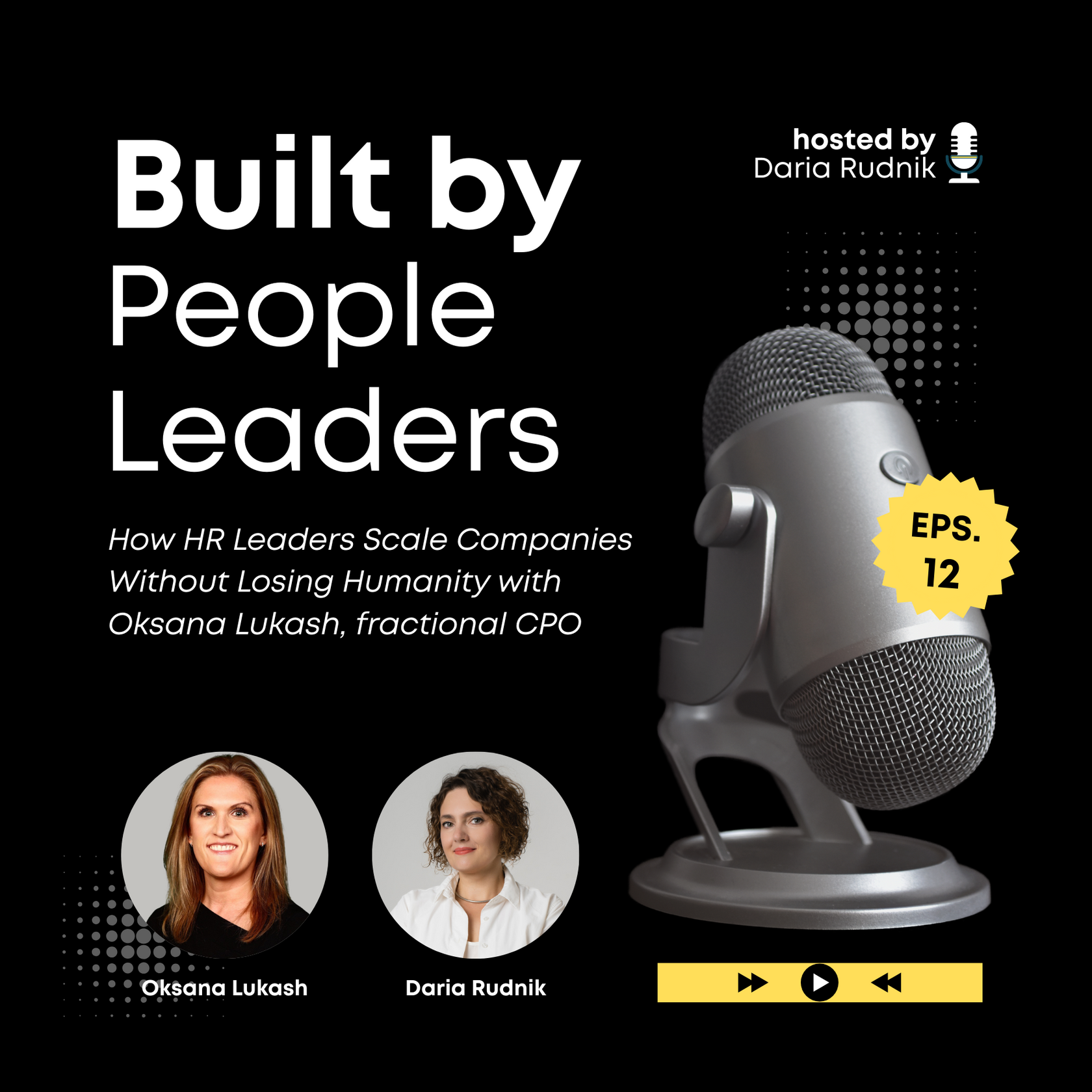
In this episode of the Built by People Leaders podcast, host Daria Rudnik speaks with Oksana Lukash, People & Culture executive and fractional Chief People Officer with over 25 years of experience helping high-growth companies scale sustainably. Oksana shares practical insights on what it really means for HR to understand the business, why culture must be treated as organizational infrastructure, and how leaders can adopt AI and growth strategies without turning their companies into copies of others. The conversation explores how people leaders can balance rapid growth, limited resources, and human-centered leadership in today’s evolving workplace.
Key Takeaways
- Understanding the business means understanding how value is created end-to-end. HR earns credibility when it speaks the operational language of the company—not external frameworks or trends.
- Culture cannot be owned by HR alone. Sustainable culture exists only when every employee takes responsibility for how work gets done.
- AI should create capacity, not just efficiency. The real opportunity of AI is freeing people to focus on collaboration, learning, and human connection.
- The biggest leadership mistake is copying successful companies. Organizations perform better when they design culture, benefits, and ways of working around their own reality—not someone else’s playbook.
Daria Rudnik (00:01.996)
Welcome to Built by People Leaders podcast brought to you by Aidra AI, your AI-powered coach for leaders in tech. I'm your host, Daria Rudnik, and this show is for HR and LMD leaders in fast-growing organizations who are building people function from within and building AI-ready organizations. And today we have a very special guest. I'm so excited about our conversation. Oksana Lukash is a people and culture executive, advisor and founder with more than 25 years of experience.
helping high growth companies scale without losing their humanity. She works with founders, CEOs and boards as a fractional chief people officer, guiding organizations through transformation, leadership development and culture building. A key focus of her work is helping leaders treat culture as infrastructure so that people can thrive and businesses can perform at their best. Well, thank you for being here, Oksana. I'm so excited to have this conversation with you today.
Oksana (00:58.946)
Yeah, thank you, Daria. It's a pleasure.
Daria Rudnik (01:02.228)
And I'm very curious about your career path. You've been Chief People Officer, you're now serving as a fractional Chief People Officer. Tell us about what brought you to HR and why you stayed there.
Oksana (01:13.442)
Yeah, well was completely accidental.
so I moved from Russia when I was 13. I did not get a chance to travel that much when I was a kid, but for some reason I always wanted to. was fascinated by seeing different places, right? And movies and things. So I was convinced that I wanted to go into hospitality because I'm like, better way than right to find a career where I get paid and travel is at the core of the industry. And when I was in high school,
wrapping up my senior year, there was an individual and I wish I remembered their name, but they recommended that I go and actually work in hospitality prior to majoring.
in that as my degree and I cannot think that person enough because I went in, I got a role at a hotel and I hated everything about it a month and a half in. It was not for me, like it's not that I disliked it. I did not like anything about it. So very quickly I realized that I needed a different path.
So I decided to major in business management. And then along the way, as I was interviewing for different roles, I ended up getting a position as an executive assistant to the director of HR.
Oksana (02:32.115)
And during the interview, she promised to keep me busy. told her I'm the type of person I love to learn. I love to again, have more things on my plate than sit and wait for work to show up. And I again, quickly realized that our definitions of busy were very different. So I did not have that much to do. And thankfully, I don't know what it was, but I just, you know, felt that I need to go and talk to her instead of looking for another job. I did. And she started giving me HR projects. And that
was again a big turning point because within a few months I became an HR generalist.
And then at the same time, I decided to do my emphasis in human resources for my degree. So when I graduated, I had both. had a degree and hands-on experience. And then from there, I guess I'm very comfortable with risk because I've been part of more startup small to mid-size companies where you have such a fast pace. You're constantly figuring things out. You're constantly throwing
into situations that you've never been in before. So opportunity to learn is every day. And that's, think, part of what I loved and still love about HR because, again, it changes almost daily. And I just decided to make that my career. And there's just something so beautiful about helping individuals.
realize what it is that their superpowers are and aligning them with opportunities that they can do their best work and unleashing that talent and seeing them thrive. That just got to me and I continue doing it.
Daria Rudnik (04:17.262)
I love that. And I love this identifying what the strength of this person is and how that can contribute to a bigger goal, to organizational goal. Because organizations, at the end, they serve in their customers. by identifying those individual strengths, we're actually building a great product, great communities. And it's a win-win-win situation. I agree so much. Well, tell me, since you've been working in fast-growing companies, startups, what's the...
most challenging part of being an HR in that kind company's organizations.
Oksana (04:52.777)
Ooh, how much time do we have? No, it's definitely the pace, like I mentioned. It's being able to deal with ambiguity. It's also being very comfortable to have very limited resources, both from...
the people's as well as budgets. Because again, I've been hired by a company as early as employee number 17. So we're truly rebuilding every single thing from the ground up. at that time, and we didn't have a product yet. So everything, right, we were spending money, but there was no additional money coming in. So you just have to be very resourceful, very thoughtful, very mindful. You absolutely also need to understand
and the business, what the needs are right now and where the company is going. Because once you're building the infrastructure, it needs to be able to scale and support of the business of where it's going six months, 12 months, three years from now, because you don't want to hit Control-All-Delete and have to redo it all the time. So I think those are some of the challenges that people need to understand.
Daria Rudnik (06:00.43)
Mm-hmm.
Daria Rudnik (06:04.558)
Well, you know what I want to ask you? Maybe an uncomfortable question for some. Almost every HR I know talks about we need to understand business. But when they start talking to business, they say, what are you talking about? mean, we don't have money for that. We don't need all the employees to be happy. Yes, mean, eventually we do understand that happy people produce better results, come to work, do more, more engaged, but we don't have money for that right now.
So when you say speak, like understand business, how do do that?
Oksana (06:39.489)
Yeah.
I mean, it's understanding how does the company make money? What is your product? What is your service? You need to, so for example, I've spent almost 18 years in the life sciences in the biotech space. So it's truly every time, let's say I've been in diagnostic laboratory, I'll use that as an example. It's truly understanding what happens from the time that a customer signs a contract with us to all, like when we receive a patient specimen,
What happens with that patient specimen throughout our lab? How are results reported? What does our customer service department do? Again, how do we make money? Where are potentials for mistakes? What do those mistakes mean? And then how do we, right again, close the loop? So if you don't understand all of that,
That's not understanding the business. my approach is always, you cannot ask people to do things you're not willing to do yourself. And that means you have to understand how every single function fits within each other, where the handoffs are, what their reality is. And then once you're able to speak the language of all the other functions, they do start caring about what the people team does, because you're a lot more mindful and thoughtful of
how you present items and when something is clunky, when it's going to be painful, when it is a necessary evil, you can be again very transparent and honest about it and say that, look, I know your reality is this. I know this is going to be very right clunky. I'm giving you a heads up. Can we just please work through it together? Finish this because it is a requirement and here are the reasons why. And I would love all of your insights on how we can
Daria Rudnik (08:15.875)
Mm-hmm.
Oksana (08:32.949)
this process better for you next time. So that's the reality, right? I think again, if you're, when you're honest with people, you communicate the good, the bad, the ugly and everything in between, and you treat them like adults, most of them respond like adults. But I think we're so used to building processes and environments for the exceptions versus, right, the outcome that most folks have. And I think that's something to think about as well.
Daria Rudnik (09:02.407)
Yeah, that's an interesting thing. And I agree with what you're saying. I you do need to understand another business, like the Gallup Research, or what McKinsey says, or what the next leadership book talks about, or some LinkedIn gurus write about. But you do need to understand exactly what this company does, the industry, the needs and greets of it. And I remember working with Telecom, and I was understanding about the stations, and while working in software development.
I had to understand like Kubernetes and Agile and well, being in cloud computing, I had to understand like something else. I happily forgot all of it when I moved the industry, but once you're there, you just dig in and you know, like, what are they talking about? So that at least you are not lost at the board meeting when they share those words that you're, my gosh, what are they talking about? You need to understand what they're talking about.
Oksana (09:50.358)
Yeah, absolutely. And I think there's also no shame in especially when you're new to be able to write, make the notes, ask the questions, go approach somebody and be like, Hey, I keep, you know, hearing that this
acronym or this keeps getting mentioned, I would love to understand what it is. Can you please help me out or know where I can go? So I think again, always wear that curiosity hat, you know, seek to understand and seek to learn. And most people again, love to talk about what they do. And again, if that's how you approach it, most people would be happy to share.
Daria Rudnik (10:31.404)
Yeah, I agree. like in one of the previous episodes of this show, Andrew Bolton shared that HR, like in his experience, often behaves as if they know everything. And that was kind of frustrating for him. like asking questions, trying to understand, being there, being curious will not only help you understand that, but also help you build those relationships with business leaders.
Oksana (10:58.197)
Yeah, yeah, and I think that's actually a mess.
At least in my view, I think a lot of folks truly go into not just HR, but various positions for the wrong reasons. Right. I think some people go into HR because they love knowing the stuff that nobody else knows and be like, right. I have all the confidential scoop and I have the tea on everybody. some people go in because they truly love to tell people, no, they love being the police and bright and things like that. So I think if those are the reasons you go in,
Yes, the business people that you work with are going to react in the way that you just described
But if you truly go in from a standpoint of that your contribution to the company is to help create environments that are worthy of the talent, where employees can bring all of themselves to work, where their needs are met, where you can help build those relationships between teams, between leaders and their direct reports, where you can unleash people's talents and then give them the resources that
they need, right? Again, obviously within budget constraints and things like that, and then get out of their way and watch them do their best work.
Oksana (12:18.295)
That's why I went into the profession. Do we have hard decisions that we have to make? Absolutely. But so does every other function. But that, again, is where we come in and help folks to remember that just because we have to make a difficult decision, it still should be grounded in integrity, in dignity, with, again, having the people or the person that's going to be impacted by that decision at the forefront.
doing what still is absolutely best for them in the situation. And I think that's where a lot of people get uncomfortable and people in our profession can step up and just do better.
Daria Rudnik (13:01.996)
I'm I'm sure you've experienced that in your career, because I did. What if a CEO, this like a lead executive leader, just tell you, just go, your job is to find me the right people and like, I will do everything else. Just go and do your recruitment stuff. I don't need anything else. What do do?
Oksana (13:22.851)
Well, great question. think it depends. Does the CEO know what great look like?
So in the organizations that have a clearly defined culture of values, way of working that is truly ingrained in the DNA of the company, where that's used as a decision maker and a filter in everything that they do, it could be possible. But I would also say to that CEO, okay, are you definitely then comfortable with me going and finding these people? And in a way, right, like, I don't want to say you don't have a say, but you can just come in
in and doodoo on all of the candidates at the end. So at the end of the day, I think it needs to be first of all, a partnership. Second of all, I don't think it's our job to determine who is the best talent. It's not our job to hire and fire. And I think that's the biggest misconception. The leaders hire and fire because that's their team. Those are their direct reports.
We're there to ensure everything is done again with dignity, with integrity, right within the legal constraints and things like that. And then again, bring in, I think other filters and ask different questions of are we hiring somebody that is going to not only meet the definition of what they do, but how they do it to again, align or add to our culture and values. And I've seen a question pop up.
quite a bit over the last month of what do you do when you have a top performer that's toxic to the culture and I'm honestly even shocked that that question exists because to me it doesn't make sense because you cannot right have a top performer that's toxic to the culture.
Oksana (15:14.232)
Because again, to me, a top performer, again, you focus on the what and the how. So I think again, I would just urge every single leader, every single CEO to be unapologetic of what your company is, what your culture is, what is accepted.
what is tolerated, what is rewarded, and share it with everybody. So again, if the how things get done in your company doesn't matter, be absolutely clear about it, but then you're not going to have conversations about culture. So then again, that question would never come up. So I think again, be clear, then use that as an important aspect to bring people into your organization that will thrive in that type of an environment. And that's where again, how you can help everyone succeed.
Daria Rudnik (16:01.966)
I agree. Again, in one of our previous episodes, we had a conversation with the CEO Pavel Kovsharov, who shared that it's CEO's job to guard the culture, to build the culture. It's not HR's job. It's the CEO's job, the founder's job, because HR can support you in that. HR can create the infrastructure, environment, funnel, whatever you need for you to have the culture that you need for organizations to succeed.
That's true.
Oksana (16:32.152)
Yeah, I would go even a little bit further. And I actually believe that every single individual in a company is responsible for culture. It's not just the CEO, because the CEO cannot be in every single room. The CEO is not in every single interaction. It's not in every single decision. And that's where right having a
great understanding of who you are and who you're not and bringing in people that again are aligned with that type of an environment that again want to take it to that next level and rewarding things that are done with alignment with that.
definition and then right having appropriate conversations when it's not that's what makes the culture live and the ownership should be on every single individual because then it becomes too easy well first of all it's not sustainable if one or two people own it and then the second part is right it's just it's not sustainable but when every single individual is responsible for it you openly talk about it right you use that again and
disagreements in who you decide to work with as a client who you don't, it just becomes part of the process, right? Same to me as DI, it's not a check the box. If it's truly integrated in who you are.
It's impossible, right, when political times shift, it's impossible to just pull it out because it's truly in the infrastructure of who you are. And we've seen that, again, with plenty of organizations that said the right things to get the accolades in the moment, right? They could stop doing certain things they did. And other companies like Costco, right? It is so ingrained in who they are.
Oksana (18:20.086)
It doesn't matter what's going on, it's impossible for them to just stop doing it.
Daria Rudnik (18:26.85)
kind of alignment with an organization on all levels. Well, I have a question, which is, I I have to ask that because everyone is talking about that AI. And when AI is entering workplace, it changes workplace dynamics. It changes how teams work. It changes how we think. It changes how we work and collaborate. What's your take on how AI would influence workplace dynamics?
Oksana (18:29.732)
Yeah.
Sure.
Oksana (18:55.916)
Yeah, well, one thing for sure, AI is here to stay, right? We can fight it. We can like it. We can dislike it. We can do all the things that's here to stay. Same way as a calculator, right? A computer, internet, all the things that we were scared of as well. I think the major things that I'm seeing is, well, first of all, too, is I think AI is going to make work more human.
I absolutely do believe in that. So even what you and I are doing, right? We didn't know each other until we got on this call and the ability to have a conversation with somebody to build that rapport and relationship. That's what I think EI is going to allow us to do more of. I think a lot of companies are focused on creating more efficiency and I think they should be focusing on creating more capacity. We've already, I think, squeezed
everything plus some from all of our people, right? During COVID, post COVID and all the things in between, people are stretched to their max. So you cannot really make them more efficient because they're just beyond overworked.
We should be focusing, another thing actually, sorry, lots of opinions on this one. The thing that I've always noticed, and I'm sure you can agree from your experience, the two most understaffed, under budgeted functions almost with any organization, especially when we talk startup small to mid, are usually the people team and the IT team. We never have enough people.
Our data is always right. We're playing catch up with it being clean. Our systems are outdated and old where again, we're trying to make them all connect with each other and integrate them. And we can't because again, just those capabilities are not there and we need to update the systems and what's happening now. Those two teams that have been screaming from the rooftops and asking for resources and new systems are now all of a sudden are being asked.
Daria Rudnik (20:58.702)
Yeah.
Oksana (21:06.104)
to implement AI and make everything wonderful and magical in a matter of months with the same resources and the same people. So there is a huge problem right there, number one. Number two is if we're honest, most of the processes and how companies function were built for people.
by people for a world that no longer really exists. So in my opinion, we're continuing to put duct tape on processes that are outdated, that absolutely served us as much as they did, got us to where we came. But the world is very different. People are very different. Our needs are very different. The way that we work is very different. So why are we continuing to again, like shove square pegs into round holes? I
think we need to, again, thank all the outdated processes, leave them where they need to be, and start building new ways of working and new structures and processes within organizations. And at that point, bring in the systems that are updated and layer in AI.
I think another thing is we're shoving AI down the throat of everybody versus making them be part of the decision. And I don't know if you know Emma, always butcher her last name. I think it's Gredet. She's the founder of Good American. She's involved in Skims and a lot of other things. The reason I bring her up is in one of her podcasts, she mentioned that she...
had an all hands meeting with her entire organization and again said, AI is here to stay. We can fight it. We can do whatever. I can tell you how to use it. But she goes, I don't know every single role within the company. So she's like, look, I want to make this fun.
Oksana (22:52.854)
Here's the tool we're going to use. And she asked every single function to figure out how to incorporate AI into what they're doing to solve the issues that they've been dealing with that they've not been able to solve any other way. And then the entire company was going to present what each function did. And the entire company was going to vote on who the winner is.
So out of, again, standard functions within a company, who do you think would be a winner when it comes to implementing AI? Just take a wild guess.
Daria Rudnik (23:25.588)
R &D.
Oksana (23:28.449)
Accounting One.
Daria Rudnik (23:30.222)
Wow, why?
Oksana (23:31.64)
And the reason for that is she created a completely open space for everyone to use the tool the way that they saw fit. And they had, again, an issue that wasn't able to get solved, that actually a lot of customers were upset about. It was costing the company hundreds of thousands of dollars. And in a matter of whatever, think it was weeks or a month, that that contest was going on.
They were able to find a solution that now took minutes instead of hours and was saving company extraordinary amounts of money. So that's how I think that's a beautiful example that instead of us continuing to do things to people and at the end of the day, the higher we go in the organization, the less we understand how every single role actually works and what they're doing.
So give the people the tools and have them incorporated into what they're doing to create capacity for them to learn other skills that they're excited about for them to continue to grow and develop. So I think that's what needs to change.
Daria Rudnik (24:38.038)
I love this story. Yeah, it's a great, amazing story. From what I'm seeing, the most successful organizations implementing AI are those who actually do that. They invite all the people to be part of the process because no one knows how it's going to work. No one knows what's right or wrong, what's the best tool because today is one tool and tomorrow is another tool. But the tool is not the most important thing. It's the most important thing is what problem are we solving with AI today?
And thanks for sharing this story. That's really brilliant. All right. Well, that's an amazing conversation. We have a few rapid fire questions and we have a very interesting conversation left for the end of this episode. So stay with us. We'll talking about Frankensteining the company and how not to do that and why not to do that. So like don't make your company a Frankenstein. So are you ready to some rapid fire questions?
Oksana (25:09.604)
Yeah.
Oksana (25:26.359)
Yeah.
Oksana (25:35.321)
Let's do it.
Daria Rudnik (25:36.606)
Okay, so are you a tea person or coffee person?
Oksana (25:40.025)
coffee.
Daria Rudnik (25:41.868)
Dogs or cats?
Oksana (25:43.669)
dogs. I have three myself. One is in my lap right now.
Daria Rudnik (25:47.918)
Cool. Are you morning person or night owl?
Oksana (25:52.213)
can I pick a midday auction?
Daria Rudnik (25:57.391)
Would you rather call someone or text? Send a message. Well, it's the majority people prefer text nowadays. What did you want to be when you were a kid?
Oksana (25:58.916)
I love my sleeves, so.
Oksana (26:04.815)
text.
Oksana (26:14.033)
Like I mentioned, I wanted to go into hospitality just so I can travel. That was kind of the main goal.
Daria Rudnik (26:20.482)
Where do you go when you need perspective?
Oksana (26:23.557)
actually the beach. So I love the ocean and just being close to the ocean completely resets me and helps me just clear my mind and really like find myself.
Daria Rudnik (26:39.182)
Yeah, I can imagine. What's one rule you've broken but don't regret?
Oksana (26:47.575)
Not shitting into a box, always being an outlier.
going against kind of, I think on this one you can relate, right, having been born and raised in communist Russia, especially as a girl, it was very much right. I was told that my worth as a human was kind of defined by me getting married and being a mom and everything else is not as important. And I just again, even though I did do all of that, I'm very proud of it. I've always just wanted more.
And I again kind of chased my own path from the very beginning and I'm very proud of it because then again I get to live the life I want versus continuing to try to please everybody else.
Daria Rudnik (27:33.388)
I never learned how to cook borscht.
Okay, what's one habit or phrase that people say it's totally you?
Oksana (27:50.266)
Honestly, again, that, well, I really love people and I build very authentic relationships. And I've, again, just nurtured them and I'm very proud of them. And other people notice that too. Like I'm always there for them in a meaningful way.
Daria Rudnik (28:12.248)
Well, thanks, Oksana. It was an amazing conversation. We still have one story about what not to do as a company or a human being while chasing your dream, but we'll keep it to the end. And again, thank you so much for being here. How people can reach out to you, how can they connect with you?
Oksana (28:28.998)
Sure, no thank you so much. My website is currently being updated, but it should be up and running hopefully by the end of the month, beginning of March. It's aksanolukas.com. And also I'm very active on LinkedIn. Always appreciate making new connections and having conversations with folks. So the listeners are welcome to reach out to me there and connect and continue this conversation further.
Daria Rudnik (28:55.074)
Well, thank you, Oksana. All the links are in the notes to this episode. reach out to Oksana, send her message, connect with her on LinkedIn, and keep this conversation going. And now, what's the story? What is it that the companies or people shouldn't be doing while chasing their dreams?
Oksana (29:10.82)
Yeah.
I think it's both for people and companies. We live in a world of constant consumption of access to so much information and we cannot help the comparison game. But while we're chasing, right, the comparison and trying to take pieces of what everybody else is willing to share with us and show us how many of us have stopped and thought again that this is just a tiny little portion of what somebody is willing to show us, both personally as individuals and
companies, right? We automatically just believe that, okay, because the same seven logos, right, the matter, the Googles, the invidias of the world are offering or doing something, we should copy that too. And I think instead, we should be looking internally, both at ourselves as individuals and ourselves as companies and deciding what makes us different.
Why do, again, our clients choose to work with us, especially if we are in a space where there are other options? And instead of, again, chasing and copying what everyone else is doing, start building things that only work for you. Offer benefits that, again, meet your employees where they are right now today and what their needs are of them and their families, and evaluate that every single year. Don't go chasing, again, what everyone else is doing. And I think, again, we're spending so much time, energy,
and resources doing that. And if we focus internally, it would be a fraction of what we're already doing with significantly better results because we become again very unique and individual in ourselves versus right a washed up copy of somebody else.
Daria Rudnik (30:55.306)
I agree. so much agree. And again, when the leader comes to you and say, hey, we want to hire people as like the same people as a matter has or Google has, the question is like, why? What kind of people do you need to reach your goals, not their goals? What kind of culture you are building in your company, not somewhere else? That's a great point.
Oksana (31:09.871)
Exactly.
Oksana (31:14.566)
Yeah.
But as we touched on earlier, too, I think here's another part that everyone needs to go on this journey and figure out. It's very easy to go and follow somebody else's plan, because again, when a mistake happens, when there was a detour, right, when things do not go according to plan, you kind of can point the finger at somebody else or just say, hey, right, that was not my plan. just following. I'm just executing what I was told. And some people are very comfortable with that.
nothing wrong with it. And other people, they're just not built that way. And that's not the world that they want to be in. So they want to go and build something new. And if that's your thing, then why are you copying again, portions of what somebody else is doing that they're doing for themselves? Go on your path on your own. Are there going to be detours and failures and things? Yes. But those are the moments I think that define us and where we have the greatest learnings anyway as well.
Daria Rudnik (32:17.23)
Well, thank you so much, Oksana, for being here with us today. And to all the listeners, well, if you like this episode, please leave a review on Apple Podcasts or Spotify or YouTube, whatever you're listening to us, and stay tuned for the next episodes. Bye.
Oksana (32:32.176)
Thank you.
Welcome to Built by People Leaders podcast brought to you by Aidra AI, your AI-powered coach for leaders in tech. I'm your host, Daria Rudnik, and this show is for HR and LMD leaders in fast-growing organizations who are building people function from within and building AI-ready organizations. And today we have a very special guest. I'm so excited about our conversation. Oksana Lukash is a people and culture executive, advisor and founder with more than 25 years of experience.
helping high growth companies scale without losing their humanity. She works with founders, CEOs and boards as a fractional chief people officer, guiding organizations through transformation, leadership development and culture building. A key focus of her work is helping leaders treat culture as infrastructure so that people can thrive and businesses can perform at their best. Well, thank you for being here, Oksana. I'm so excited to have this conversation with you today.
Oksana (00:58.946)
Yeah, thank you, Daria. It's a pleasure.
Daria Rudnik (01:02.228)
And I'm very curious about your career path. You've been Chief People Officer, you're now serving as a fractional Chief People Officer. Tell us about what brought you to HR and why you stayed there.
Oksana (01:13.442)
Yeah, well was completely accidental.
so I moved from Russia when I was 13. I did not get a chance to travel that much when I was a kid, but for some reason I always wanted to. was fascinated by seeing different places, right? And movies and things. So I was convinced that I wanted to go into hospitality because I'm like, better way than right to find a career where I get paid and travel is at the core of the industry. And when I was in high school,
wrapping up my senior year, there was an individual and I wish I remembered their name, but they recommended that I go and actually work in hospitality prior to majoring.
in that as my degree and I cannot think that person enough because I went in, I got a role at a hotel and I hated everything about it a month and a half in. It was not for me, like it's not that I disliked it. I did not like anything about it. So very quickly I realized that I needed a different path.
So I decided to major in business management. And then along the way, as I was interviewing for different roles, I ended up getting a position as an executive assistant to the director of HR.
Oksana (02:32.115)
And during the interview, she promised to keep me busy. told her I'm the type of person I love to learn. I love to again, have more things on my plate than sit and wait for work to show up. And I again, quickly realized that our definitions of busy were very different. So I did not have that much to do. And thankfully, I don't know what it was, but I just, you know, felt that I need to go and talk to her instead of looking for another job. I did. And she started giving me HR projects. And that
was again a big turning point because within a few months I became an HR generalist.
And then at the same time, I decided to do my emphasis in human resources for my degree. So when I graduated, I had both. had a degree and hands-on experience. And then from there, I guess I'm very comfortable with risk because I've been part of more startup small to mid-size companies where you have such a fast pace. You're constantly figuring things out. You're constantly throwing
into situations that you've never been in before. So opportunity to learn is every day. And that's, think, part of what I loved and still love about HR because, again, it changes almost daily. And I just decided to make that my career. And there's just something so beautiful about helping individuals.
realize what it is that their superpowers are and aligning them with opportunities that they can do their best work and unleashing that talent and seeing them thrive. That just got to me and I continue doing it.
Daria Rudnik (04:17.262)
I love that. And I love this identifying what the strength of this person is and how that can contribute to a bigger goal, to organizational goal. Because organizations, at the end, they serve in their customers. by identifying those individual strengths, we're actually building a great product, great communities. And it's a win-win-win situation. I agree so much. Well, tell me, since you've been working in fast-growing companies, startups, what's the...
most challenging part of being an HR in that kind company's organizations.
Oksana (04:52.777)
Ooh, how much time do we have? No, it's definitely the pace, like I mentioned. It's being able to deal with ambiguity. It's also being very comfortable to have very limited resources, both from...
the people's as well as budgets. Because again, I've been hired by a company as early as employee number 17. So we're truly rebuilding every single thing from the ground up. at that time, and we didn't have a product yet. So everything, right, we were spending money, but there was no additional money coming in. So you just have to be very resourceful, very thoughtful, very mindful. You absolutely also need to understand
and the business, what the needs are right now and where the company is going. Because once you're building the infrastructure, it needs to be able to scale and support of the business of where it's going six months, 12 months, three years from now, because you don't want to hit Control-All-Delete and have to redo it all the time. So I think those are some of the challenges that people need to understand.
Daria Rudnik (06:00.43)
Mm-hmm.
Daria Rudnik (06:04.558)
Well, you know what I want to ask you? Maybe an uncomfortable question for some. Almost every HR I know talks about we need to understand business. But when they start talking to business, they say, what are you talking about? mean, we don't have money for that. We don't need all the employees to be happy. Yes, mean, eventually we do understand that happy people produce better results, come to work, do more, more engaged, but we don't have money for that right now.
So when you say speak, like understand business, how do do that?
Oksana (06:39.489)
Yeah.
I mean, it's understanding how does the company make money? What is your product? What is your service? You need to, so for example, I've spent almost 18 years in the life sciences in the biotech space. So it's truly every time, let's say I've been in diagnostic laboratory, I'll use that as an example. It's truly understanding what happens from the time that a customer signs a contract with us to all, like when we receive a patient specimen,
What happens with that patient specimen throughout our lab? How are results reported? What does our customer service department do? Again, how do we make money? Where are potentials for mistakes? What do those mistakes mean? And then how do we, right again, close the loop? So if you don't understand all of that,
That's not understanding the business. my approach is always, you cannot ask people to do things you're not willing to do yourself. And that means you have to understand how every single function fits within each other, where the handoffs are, what their reality is. And then once you're able to speak the language of all the other functions, they do start caring about what the people team does, because you're a lot more mindful and thoughtful of
how you present items and when something is clunky, when it's going to be painful, when it is a necessary evil, you can be again very transparent and honest about it and say that, look, I know your reality is this. I know this is going to be very right clunky. I'm giving you a heads up. Can we just please work through it together? Finish this because it is a requirement and here are the reasons why. And I would love all of your insights on how we can
Daria Rudnik (08:15.875)
Mm-hmm.
Oksana (08:32.949)
this process better for you next time. So that's the reality, right? I think again, if you're, when you're honest with people, you communicate the good, the bad, the ugly and everything in between, and you treat them like adults, most of them respond like adults. But I think we're so used to building processes and environments for the exceptions versus, right, the outcome that most folks have. And I think that's something to think about as well.
Daria Rudnik (09:02.407)
Yeah, that's an interesting thing. And I agree with what you're saying. I you do need to understand another business, like the Gallup Research, or what McKinsey says, or what the next leadership book talks about, or some LinkedIn gurus write about. But you do need to understand exactly what this company does, the industry, the needs and greets of it. And I remember working with Telecom, and I was understanding about the stations, and while working in software development.
I had to understand like Kubernetes and Agile and well, being in cloud computing, I had to understand like something else. I happily forgot all of it when I moved the industry, but once you're there, you just dig in and you know, like, what are they talking about? So that at least you are not lost at the board meeting when they share those words that you're, my gosh, what are they talking about? You need to understand what they're talking about.
Oksana (09:50.358)
Yeah, absolutely. And I think there's also no shame in especially when you're new to be able to write, make the notes, ask the questions, go approach somebody and be like, Hey, I keep, you know, hearing that this
acronym or this keeps getting mentioned, I would love to understand what it is. Can you please help me out or know where I can go? So I think again, always wear that curiosity hat, you know, seek to understand and seek to learn. And most people again, love to talk about what they do. And again, if that's how you approach it, most people would be happy to share.
Daria Rudnik (10:31.404)
Yeah, I agree. like in one of the previous episodes of this show, Andrew Bolton shared that HR, like in his experience, often behaves as if they know everything. And that was kind of frustrating for him. like asking questions, trying to understand, being there, being curious will not only help you understand that, but also help you build those relationships with business leaders.
Oksana (10:58.197)
Yeah, yeah, and I think that's actually a mess.
At least in my view, I think a lot of folks truly go into not just HR, but various positions for the wrong reasons. Right. I think some people go into HR because they love knowing the stuff that nobody else knows and be like, right. I have all the confidential scoop and I have the tea on everybody. some people go in because they truly love to tell people, no, they love being the police and bright and things like that. So I think if those are the reasons you go in,
Yes, the business people that you work with are going to react in the way that you just described
But if you truly go in from a standpoint of that your contribution to the company is to help create environments that are worthy of the talent, where employees can bring all of themselves to work, where their needs are met, where you can help build those relationships between teams, between leaders and their direct reports, where you can unleash people's talents and then give them the resources that
they need, right? Again, obviously within budget constraints and things like that, and then get out of their way and watch them do their best work.
Oksana (12:18.295)
That's why I went into the profession. Do we have hard decisions that we have to make? Absolutely. But so does every other function. But that, again, is where we come in and help folks to remember that just because we have to make a difficult decision, it still should be grounded in integrity, in dignity, with, again, having the people or the person that's going to be impacted by that decision at the forefront.
doing what still is absolutely best for them in the situation. And I think that's where a lot of people get uncomfortable and people in our profession can step up and just do better.
Daria Rudnik (13:01.996)
I'm I'm sure you've experienced that in your career, because I did. What if a CEO, this like a lead executive leader, just tell you, just go, your job is to find me the right people and like, I will do everything else. Just go and do your recruitment stuff. I don't need anything else. What do do?
Oksana (13:22.851)
Well, great question. think it depends. Does the CEO know what great look like?
So in the organizations that have a clearly defined culture of values, way of working that is truly ingrained in the DNA of the company, where that's used as a decision maker and a filter in everything that they do, it could be possible. But I would also say to that CEO, okay, are you definitely then comfortable with me going and finding these people? And in a way, right, like, I don't want to say you don't have a say, but you can just come in
in and doodoo on all of the candidates at the end. So at the end of the day, I think it needs to be first of all, a partnership. Second of all, I don't think it's our job to determine who is the best talent. It's not our job to hire and fire. And I think that's the biggest misconception. The leaders hire and fire because that's their team. Those are their direct reports.
We're there to ensure everything is done again with dignity, with integrity, right within the legal constraints and things like that. And then again, bring in, I think other filters and ask different questions of are we hiring somebody that is going to not only meet the definition of what they do, but how they do it to again, align or add to our culture and values. And I've seen a question pop up.
quite a bit over the last month of what do you do when you have a top performer that's toxic to the culture and I'm honestly even shocked that that question exists because to me it doesn't make sense because you cannot right have a top performer that's toxic to the culture.
Oksana (15:14.232)
Because again, to me, a top performer, again, you focus on the what and the how. So I think again, I would just urge every single leader, every single CEO to be unapologetic of what your company is, what your culture is, what is accepted.
what is tolerated, what is rewarded, and share it with everybody. So again, if the how things get done in your company doesn't matter, be absolutely clear about it, but then you're not going to have conversations about culture. So then again, that question would never come up. So I think again, be clear, then use that as an important aspect to bring people into your organization that will thrive in that type of an environment. And that's where again, how you can help everyone succeed.
Daria Rudnik (16:01.966)
I agree. Again, in one of our previous episodes, we had a conversation with the CEO Pavel Kovsharov, who shared that it's CEO's job to guard the culture, to build the culture. It's not HR's job. It's the CEO's job, the founder's job, because HR can support you in that. HR can create the infrastructure, environment, funnel, whatever you need for you to have the culture that you need for organizations to succeed.
That's true.
Oksana (16:32.152)
Yeah, I would go even a little bit further. And I actually believe that every single individual in a company is responsible for culture. It's not just the CEO, because the CEO cannot be in every single room. The CEO is not in every single interaction. It's not in every single decision. And that's where right having a
great understanding of who you are and who you're not and bringing in people that again are aligned with that type of an environment that again want to take it to that next level and rewarding things that are done with alignment with that.
definition and then right having appropriate conversations when it's not that's what makes the culture live and the ownership should be on every single individual because then it becomes too easy well first of all it's not sustainable if one or two people own it and then the second part is right it's just it's not sustainable but when every single individual is responsible for it you openly talk about it right you use that again and
disagreements in who you decide to work with as a client who you don't, it just becomes part of the process, right? Same to me as DI, it's not a check the box. If it's truly integrated in who you are.
It's impossible, right, when political times shift, it's impossible to just pull it out because it's truly in the infrastructure of who you are. And we've seen that, again, with plenty of organizations that said the right things to get the accolades in the moment, right? They could stop doing certain things they did. And other companies like Costco, right? It is so ingrained in who they are.
Oksana (18:20.086)
It doesn't matter what's going on, it's impossible for them to just stop doing it.
Daria Rudnik (18:26.85)
kind of alignment with an organization on all levels. Well, I have a question, which is, I I have to ask that because everyone is talking about that AI. And when AI is entering workplace, it changes workplace dynamics. It changes how teams work. It changes how we think. It changes how we work and collaborate. What's your take on how AI would influence workplace dynamics?
Oksana (18:29.732)
Yeah.
Sure.
Oksana (18:55.916)
Yeah, well, one thing for sure, AI is here to stay, right? We can fight it. We can like it. We can dislike it. We can do all the things that's here to stay. Same way as a calculator, right? A computer, internet, all the things that we were scared of as well. I think the major things that I'm seeing is, well, first of all, too, is I think AI is going to make work more human.
I absolutely do believe in that. So even what you and I are doing, right? We didn't know each other until we got on this call and the ability to have a conversation with somebody to build that rapport and relationship. That's what I think EI is going to allow us to do more of. I think a lot of companies are focused on creating more efficiency and I think they should be focusing on creating more capacity. We've already, I think, squeezed
everything plus some from all of our people, right? During COVID, post COVID and all the things in between, people are stretched to their max. So you cannot really make them more efficient because they're just beyond overworked.
We should be focusing, another thing actually, sorry, lots of opinions on this one. The thing that I've always noticed, and I'm sure you can agree from your experience, the two most understaffed, under budgeted functions almost with any organization, especially when we talk startup small to mid, are usually the people team and the IT team. We never have enough people.
Our data is always right. We're playing catch up with it being clean. Our systems are outdated and old where again, we're trying to make them all connect with each other and integrate them. And we can't because again, just those capabilities are not there and we need to update the systems and what's happening now. Those two teams that have been screaming from the rooftops and asking for resources and new systems are now all of a sudden are being asked.
Daria Rudnik (20:58.702)
Yeah.
Oksana (21:06.104)
to implement AI and make everything wonderful and magical in a matter of months with the same resources and the same people. So there is a huge problem right there, number one. Number two is if we're honest, most of the processes and how companies function were built for people.
by people for a world that no longer really exists. So in my opinion, we're continuing to put duct tape on processes that are outdated, that absolutely served us as much as they did, got us to where we came. But the world is very different. People are very different. Our needs are very different. The way that we work is very different. So why are we continuing to again, like shove square pegs into round holes? I
think we need to, again, thank all the outdated processes, leave them where they need to be, and start building new ways of working and new structures and processes within organizations. And at that point, bring in the systems that are updated and layer in AI.
I think another thing is we're shoving AI down the throat of everybody versus making them be part of the decision. And I don't know if you know Emma, always butcher her last name. I think it's Gredet. She's the founder of Good American. She's involved in Skims and a lot of other things. The reason I bring her up is in one of her podcasts, she mentioned that she...
had an all hands meeting with her entire organization and again said, AI is here to stay. We can fight it. We can do whatever. I can tell you how to use it. But she goes, I don't know every single role within the company. So she's like, look, I want to make this fun.
Oksana (22:52.854)
Here's the tool we're going to use. And she asked every single function to figure out how to incorporate AI into what they're doing to solve the issues that they've been dealing with that they've not been able to solve any other way. And then the entire company was going to present what each function did. And the entire company was going to vote on who the winner is.
So out of, again, standard functions within a company, who do you think would be a winner when it comes to implementing AI? Just take a wild guess.
Daria Rudnik (23:25.588)
R &D.
Oksana (23:28.449)
Accounting One.
Daria Rudnik (23:30.222)
Wow, why?
Oksana (23:31.64)
And the reason for that is she created a completely open space for everyone to use the tool the way that they saw fit. And they had, again, an issue that wasn't able to get solved, that actually a lot of customers were upset about. It was costing the company hundreds of thousands of dollars. And in a matter of whatever, think it was weeks or a month, that that contest was going on.
They were able to find a solution that now took minutes instead of hours and was saving company extraordinary amounts of money. So that's how I think that's a beautiful example that instead of us continuing to do things to people and at the end of the day, the higher we go in the organization, the less we understand how every single role actually works and what they're doing.
So give the people the tools and have them incorporated into what they're doing to create capacity for them to learn other skills that they're excited about for them to continue to grow and develop. So I think that's what needs to change.
Daria Rudnik (24:38.038)
I love this story. Yeah, it's a great, amazing story. From what I'm seeing, the most successful organizations implementing AI are those who actually do that. They invite all the people to be part of the process because no one knows how it's going to work. No one knows what's right or wrong, what's the best tool because today is one tool and tomorrow is another tool. But the tool is not the most important thing. It's the most important thing is what problem are we solving with AI today?
And thanks for sharing this story. That's really brilliant. All right. Well, that's an amazing conversation. We have a few rapid fire questions and we have a very interesting conversation left for the end of this episode. So stay with us. We'll talking about Frankensteining the company and how not to do that and why not to do that. So like don't make your company a Frankenstein. So are you ready to some rapid fire questions?
Oksana (25:09.604)
Yeah.
Oksana (25:26.359)
Yeah.
Oksana (25:35.321)
Let's do it.
Daria Rudnik (25:36.606)
Okay, so are you a tea person or coffee person?
Oksana (25:40.025)
coffee.
Daria Rudnik (25:41.868)
Dogs or cats?
Oksana (25:43.669)
dogs. I have three myself. One is in my lap right now.
Daria Rudnik (25:47.918)
Cool. Are you morning person or night owl?
Oksana (25:52.213)
can I pick a midday auction?
Daria Rudnik (25:57.391)
Would you rather call someone or text? Send a message. Well, it's the majority people prefer text nowadays. What did you want to be when you were a kid?
Oksana (25:58.916)
I love my sleeves, so.
Oksana (26:04.815)
text.
Oksana (26:14.033)
Like I mentioned, I wanted to go into hospitality just so I can travel. That was kind of the main goal.
Daria Rudnik (26:20.482)
Where do you go when you need perspective?
Oksana (26:23.557)
actually the beach. So I love the ocean and just being close to the ocean completely resets me and helps me just clear my mind and really like find myself.
Daria Rudnik (26:39.182)
Yeah, I can imagine. What's one rule you've broken but don't regret?
Oksana (26:47.575)
Not shitting into a box, always being an outlier.
going against kind of, I think on this one you can relate, right, having been born and raised in communist Russia, especially as a girl, it was very much right. I was told that my worth as a human was kind of defined by me getting married and being a mom and everything else is not as important. And I just again, even though I did do all of that, I'm very proud of it. I've always just wanted more.
And I again kind of chased my own path from the very beginning and I'm very proud of it because then again I get to live the life I want versus continuing to try to please everybody else.
Daria Rudnik (27:33.388)
I never learned how to cook borscht.
Okay, what's one habit or phrase that people say it's totally you?
Oksana (27:50.266)
Honestly, again, that, well, I really love people and I build very authentic relationships. And I've, again, just nurtured them and I'm very proud of them. And other people notice that too. Like I'm always there for them in a meaningful way.
Daria Rudnik (28:12.248)
Well, thanks, Oksana. It was an amazing conversation. We still have one story about what not to do as a company or a human being while chasing your dream, but we'll keep it to the end. And again, thank you so much for being here. How people can reach out to you, how can they connect with you?
Oksana (28:28.998)
Sure, no thank you so much. My website is currently being updated, but it should be up and running hopefully by the end of the month, beginning of March. It's aksanolukas.com. And also I'm very active on LinkedIn. Always appreciate making new connections and having conversations with folks. So the listeners are welcome to reach out to me there and connect and continue this conversation further.
Daria Rudnik (28:55.074)
Well, thank you, Oksana. All the links are in the notes to this episode. reach out to Oksana, send her message, connect with her on LinkedIn, and keep this conversation going. And now, what's the story? What is it that the companies or people shouldn't be doing while chasing their dreams?
Oksana (29:10.82)
Yeah.
I think it's both for people and companies. We live in a world of constant consumption of access to so much information and we cannot help the comparison game. But while we're chasing, right, the comparison and trying to take pieces of what everybody else is willing to share with us and show us how many of us have stopped and thought again that this is just a tiny little portion of what somebody is willing to show us, both personally as individuals and
companies, right? We automatically just believe that, okay, because the same seven logos, right, the matter, the Googles, the invidias of the world are offering or doing something, we should copy that too. And I think instead, we should be looking internally, both at ourselves as individuals and ourselves as companies and deciding what makes us different.
Why do, again, our clients choose to work with us, especially if we are in a space where there are other options? And instead of, again, chasing and copying what everyone else is doing, start building things that only work for you. Offer benefits that, again, meet your employees where they are right now today and what their needs are of them and their families, and evaluate that every single year. Don't go chasing, again, what everyone else is doing. And I think, again, we're spending so much time, energy,
and resources doing that. And if we focus internally, it would be a fraction of what we're already doing with significantly better results because we become again very unique and individual in ourselves versus right a washed up copy of somebody else.
Daria Rudnik (30:55.306)
I agree. so much agree. And again, when the leader comes to you and say, hey, we want to hire people as like the same people as a matter has or Google has, the question is like, why? What kind of people do you need to reach your goals, not their goals? What kind of culture you are building in your company, not somewhere else? That's a great point.
Oksana (31:09.871)
Exactly.
Oksana (31:14.566)
Yeah.
But as we touched on earlier, too, I think here's another part that everyone needs to go on this journey and figure out. It's very easy to go and follow somebody else's plan, because again, when a mistake happens, when there was a detour, right, when things do not go according to plan, you kind of can point the finger at somebody else or just say, hey, right, that was not my plan. just following. I'm just executing what I was told. And some people are very comfortable with that.
nothing wrong with it. And other people, they're just not built that way. And that's not the world that they want to be in. So they want to go and build something new. And if that's your thing, then why are you copying again, portions of what somebody else is doing that they're doing for themselves? Go on your path on your own. Are there going to be detours and failures and things? Yes. But those are the moments I think that define us and where we have the greatest learnings anyway as well.
Daria Rudnik (32:17.23)
Well, thank you so much, Oksana, for being here with us today. And to all the listeners, well, if you like this episode, please leave a review on Apple Podcasts or Spotify or YouTube, whatever you're listening to us, and stay tuned for the next episodes. Bye.
Oksana (32:32.176)
Thank you.