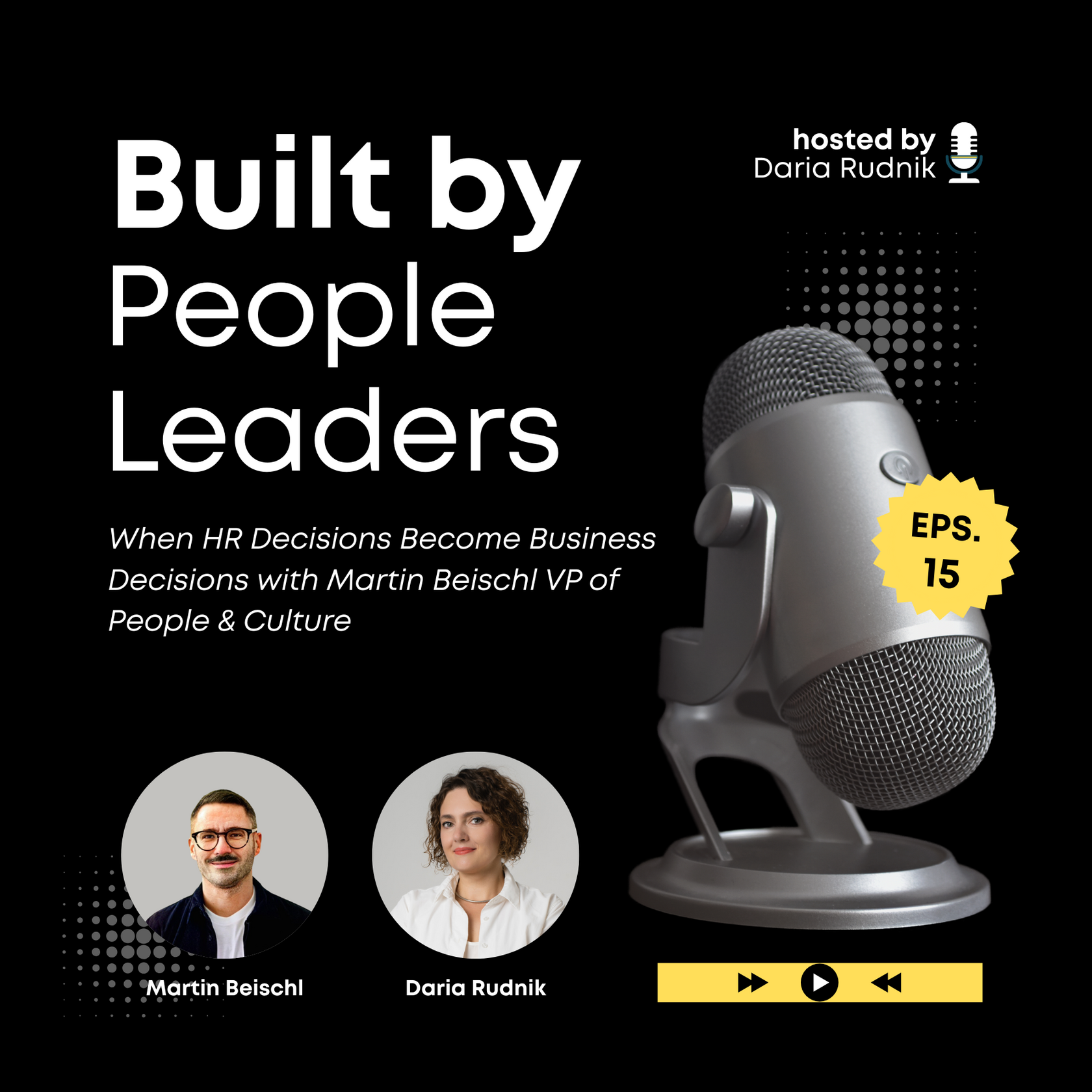
In this episode of the Built by People Leaders podcast, host Daria Rudnik speaks with Martin Beischl, VP of People & Culture, about how the role of HR evolves as startups grow into complex organizations. Drawing from his experience scaling B2B tech companies from early growth to successful exit, Martin shares how people leaders must shift from intuitive decision-making to structured, business-aligned people strategy.
The conversation explores how HR can become a true strategic partner by speaking the language of the business, simplifying processes instead of overengineering them, and protecting organizational clarity during rapid growth. Martin also shares practical insights on hiring leadership in early-stage companies, designing career paths that go beyond people management, and why many companies might be better off eliminating bonus systems entirely.
The episode also dives into the role of HR in the age of AI — not just adopting new tools, but protecting employees’ cognitive bandwidth and ensuring technology actually creates value rather than noise.
Takeaways
- Process doesn’t slow companies down — bad hierarchy does. Simple, well-designed processes actually speed up decisions, while unnecessary organizational layers are what truly create bottlenecks.
- HR becomes strategic when it starts solving revenue problems. Talking with leaders about ramp times, quotas, and pipeline makes HR part of business outcomes, not just people operations.
- AI in HR should reduce cognitive load, not create more content. The real responsibility of HR is filtering and implementing AI tools that meaningfully simplify work.
- Many bonus systems don’t drive behavior at all. When goals constantly change in scaling companies, bonuses often create confusion and stress instead of motivation.
LinkedIn https://www.linkedin.com/in/dr-martin-beischl-71058594/
Chapters
00:00 Introduction to People Leadership in Tech
03:01 The Evolution of HR in Scaling Companies
05:58 Balancing Speed and Structure in HR
08:53 Hiring Strategies in Uncertain Times
11:45 The Role of HR as Business Partners
14:49 Navigating AI in the Workplace
19:37 The Case Against Bonuses in Organizations
The conversation explores how HR can become a true strategic partner by speaking the language of the business, simplifying processes instead of overengineering them, and protecting organizational clarity during rapid growth. Martin also shares practical insights on hiring leadership in early-stage companies, designing career paths that go beyond people management, and why many companies might be better off eliminating bonus systems entirely.
The episode also dives into the role of HR in the age of AI — not just adopting new tools, but protecting employees’ cognitive bandwidth and ensuring technology actually creates value rather than noise.
Takeaways
- Process doesn’t slow companies down — bad hierarchy does. Simple, well-designed processes actually speed up decisions, while unnecessary organizational layers are what truly create bottlenecks.
- HR becomes strategic when it starts solving revenue problems. Talking with leaders about ramp times, quotas, and pipeline makes HR part of business outcomes, not just people operations.
- AI in HR should reduce cognitive load, not create more content. The real responsibility of HR is filtering and implementing AI tools that meaningfully simplify work.
- Many bonus systems don’t drive behavior at all. When goals constantly change in scaling companies, bonuses often create confusion and stress instead of motivation.
LinkedIn https://www.linkedin.com/in/dr-martin-beischl-71058594/
Chapters
00:00 Introduction to People Leadership in Tech
03:01 The Evolution of HR in Scaling Companies
05:58 Balancing Speed and Structure in HR
08:53 Hiring Strategies in Uncertain Times
11:45 The Role of HR as Business Partners
14:49 Navigating AI in the Workplace
19:37 The Case Against Bonuses in Organizations
Daria Rudnik (00:02.698)
Welcome to Built by People Leaders podcast, a show brought to you by Aidra AI, your AI-powered coach for leaders in tech. I'm your host, Daria Rudnik, and this show is for HR and L &D leaders in fast-growing scale-ups and fast-growing companies, those who building real impact from within and shaping AI-ready organizations. If you go to dariarudnik.com, you can download AI-ready team framework.
a practical guide to help you build team maturity in the age of AI. And today we have a very special guest and I'm so excited about the conversation that we're going to have. Martin Weischel, VP of People and Culture with background in scaling international B2B technology companies through critical transition phases from rapid growth to exit readiness. He worked closely with founders, executive teams and investors across Europe and the US.
including supporting a successful exit. His focus today is on how people leadership needs to evolve when decisions start to carry real irreversible business consequences. Consequences. That's a tricky word. Well, anyway, welcome, Martin. I'm so excited to have you on this show.
Martin Beischl (01:11.715)
No.
Thank you.
Thank you very much and the pleasure is mine. Really excited.
Daria Rudnik (01:22.302)
Okay, well, do you want to share something about your path to HR and leadership? What brought you there and why did you stay?
Martin Beischl (01:31.825)
That's a great question. throughout my studies, throughout my career, I've always been fascinated by one topic and that is how can you shape organizations with long lasting impact? How can you bring this cultural, this psychological, this organizational and this business lens, of course the legal lens as well, together? So I...
always find it fascinating because actually my background is in political science and sometimes I get asked the question, okay, after political science, why do you choose a career in HR? And I sometimes say, it's not that different. I mean, if you think about political organizations and societies and about business organizations, companies in a context, it's always about a couple of commonalities, right? How do you shape
a bigger something that people perceive as legitimate, as powerful, where decisions are accepted, where everybody feels they belong. So in that sense, I've always, as a people leader, really built on the approach that the best people decisions are taken when you take them from a broad context, right? You take the psychological angle, you take the sociological angle, you take...
the very cultural angle, the business angle and the legal angle together and then you take a holistic decision. yeah, I have always had the pleasure of finding an environment where I could put these things into practice. And that's also the answer to the question what keeps me there, right? I find that fascinating, Daria.
Daria Rudnik (03:06.001)
Well, thanks. And I so much agree because we as HR people, we need to understand the legal side of business. We need to understand how money are coming to our organization. We need to understand psychology of people and those people who work like employees and leadership as well. Okay, well, how do they make decisions? How can we influence those decisions? So there's lots of huge different areas that we need to be comfortable with. Thanks for sharing that.
Martin Beischl (03:32.867)
Absolutely.
Daria Rudnik (03:33.846)
Well, I'd like to dive deeper into your experience with scale-ups and how HR should change when companies are growing.
Martin Beischl (03:45.204)
That's a good question. speaking from my experience, mean, like when I was at Risk Methods, I had really the privilege of seeing the full journey of a B2B scale up. So I joined in the earlier series A days and was able to see the entire growth journey, scaling journey until a successful exit, which we accomplished in late 22. And I think in a nutshell, early growth,
the days or early growth days are the times when everything feels intuitive, almost a little bit family-like, right? In hindsight, you think, scaling is always going to be easy and we can stay like a family, like friends. And then there comes the time of accelerated scaling. You have to switch gears from, let's say, building and hiring fast. That's definitely primary focus of the earlier days to, OK, let's take a step back.
Let's think about structure. Let's think about processes. Let's think about refining the things that we have already built. Refining hiring also is one of the things. Simplifying, reducing complexity when needed, that's definitely the second thing. And of course, the second phase is also very much about taking hard decisions and change management as well. And I would say that's the second.
scaling stage that I would see. And then for me, the last stage that I observed in this journey was the pre-exit stage when stakes, of course, become higher. And you protect the organization, you protect the processes, you minimize exceptions, and you also protect the culture. And of course, here also the reporting requirements, the data that you have to work on, and also the predictability of the decisions that becomes
much more top of the agenda throughout the journey. And that requires also a very different approach to how you do HR. And the bad thing is nobody explicitly tells you when is the point in time to switch gears and when the new stage or the new phase sets in. Yeah, but I would say there are a couple of rules of thumb that you can apply to that.
Daria Rudnik (05:42.552)
Mm-hmm.
Daria Rudnik (06:03.886)
Well, that was exactly my next question. How do you know? How do you know? Because again, we're rushing. I've been in the startup company and we're rushing into doing things without, we don't have just time to think. But at some point we need to step back and think. how do you keep that balance?
Martin Beischl (06:05.913)
Okay.
Martin Beischl (06:11.801)
Mm.
Martin Beischl (06:22.519)
Yeah, so I think the first law of thumb that I see is at latest six months after you complete this first accelerated phase of hiring, right, you conclude a funding round. You rush into hiring and you of course have to bring in the critical talent fast. Then you figure out
maybe not all of the things with this first batch of hires works out the way you hoped and expected it to be. So six months for, I would say, a reasonable central European based labor law that's good approximation of what the probation period can look like is then the point in time we need to figure out, OK, some of the hires might not work out. And some of the things that you build around these processes just are not the right processes. And then I would say is the point in time
to set in the next stage and to think of course also in longer terms, in taking a step back and also investing the necessary time in the processes. So you have to push yourself very, very hard to do that. You also have to advocate with the founders and with the CEOs for that specific approach. And always the narrative needs to be, our goal should not be
to bring in the hires now or tomorrow, our goal needs to be that we bring in hires that are with us six months, 12 months, 18 months from here. And that, from my experience, typically changes the perspective and also enhances the quality of the decision-making process.
Daria Rudnik (08:02.658)
Yeah, I agree. And when you share the perspective and you kind of focus people on the goal, that really helps having more meaningful conversations. I do agree. And how do you actually respond to that question? Like from what I've heard a lot is, when leaders say, hey, we're in a kind of early stage, we don't need all those processes, we don't need that structure. Let's just do things and then we'll figure it out. So how do you deal with those kinds of comments?
Martin Beischl (08:29.753)
Well, I think it's important to point out that structure and processes are not a contradiction to speed. It's actually quite the opposite because good decisions, quality and speed of decision making gets improved when you have structure and meaningful processes in place. I mean, one of my anchor sentences in HR always is keep it simple. You have to take away the fear of the business leaders that when HR creates a process, it's going to be a super lengthy
Handbook, it's gonna be a super I don't know sophisticated over engineered process that HR falls in love with but the business leaders don't have the time to even read and to digest so I mean Take a step back. Keep it simple reduce complexity and build a process around that and I'm sure that this will land well and Also people will see the positive outcomes of a meaningful
lean process for faster decision making.
Daria Rudnik (09:32.814)
I love it. And I so much agree. mean, again, it's a simple process. Making simple is a great kind of motto. And when you build a process or a structure, you don't build an org structure for the enterprise. You just need some points that you can rely on that will help you make decisions. Anything that is not helping you make decisions just goes to the trash. Not now, later when you need it.
Martin Beischl (09:37.23)
Yep.
Martin Beischl (09:57.134)
Yeah, I love that point also because it's also about org structure and about hierarchy. Sometimes we build a hierarchy, sometimes we build org structures and layers, but it's not clearly scoped. OK, what is the expected outcome? What is the expected value of such layer? Question that, protect the health of the organization, protect the health of your org chart at that point in time because many people overestimate.
how decisions are slowed down by process. Most of the time they aren't, but decisions really are slowed down by hierarchies, in my opinion.
Daria Rudnik (10:33.066)
So much true, yeah.
So tell me about hiring in the times of uncertainty. So let's say you need a CTO. Okay, you need someone who will be in charge of that function. And you find a person and you want them to join your startup or scale up, but you don't have enough money and you need to kind of persuade them. So what do do? You give them a title. But also at some point, know that later on,
the company might overgrown, the company might overgrow and they will not fit this seniority. And they would have to like, that's got to be another leader about them. How do you manage those kinds of decisions, conversations where you on one hand need to bring people to the company on the other hand, you don't know what's going to happen next.
Martin Beischl (11:14.681)
Mm-hmm.
Martin Beischl (11:24.078)
Mm-hmm.
Yeah, I think that's a great point. Definitely a very concrete example also from the past. then what you shared there doesn't sound unfamiliar. So my learning, my learning really is even in the early days, protect as much as you can the title structure. mean, like the C title really is an extreme title. And I do think that you would still be able to attract great talent aspiring
aspiring individuals with the exact right mindset by offering a little bit more of a more flexible title. Why not a head of engineering instead of a CTO? So I do think that's definitely one of the rules of thumb that I would always give to HR people when making this first critical batch of hires, number one. And the second thing is you have to start early on, at latest, I would say, when you do when you conclude the series B.
think about career frameworks that offer upward but also lateral mobility. Not necessarily people who are the right fit for a leadership role, meaning with team responsibility, are really the right fit, let's say in the earlier stage, and then they might not be the right fit for the later accelerated stage, and that's even not on them.
because maybe they don't even want that. Most of the cases, they don't want even that. They don't even want that. And they are far more intrigued and far more fascinated by tech leadership. So you have to early on think about technical career path and make it very clear in the narrative towards the entire team. Not only, say, an engineering team, but also within the entire company that this is actually not a...
Martin Beischl (13:15.531)
an emotion, but it's just a natural move and it has still impact. And I give you a concrete example. We both at IP Fabric and also in the past at Risk Methods, we made it very, very clear that we expect also from people who don't have hard HR leadership responsibilities, let's say an architect or a tech lead, we still expect leadership.
competencies in terms of project management, in terms of stakeholder management from them. leadership isn't defined only in the hard HR dimension of things, but also in the company-wide impact dimension and in the scope of the tech decisions that they take. So I think this is really a powerful thing that I would encourage.
Daria Rudnik (13:59.864)
Mm-hmm.
And thanks for saying that because we kind of tend to think that career growth means that you have more and more people that report to you, which is not true. Your career growth means the impact you are creating for the organization. And it's not always people, sometimes it's your expertise. And to be honest, with now, with a bunch of AI agents, you can do so much more than with a few human beings.
You can truly be an expert in your field and grow and both leaders, HR and people need to be ready for that.
Martin Beischl (14:39.617)
Absolutely, absolutely. And I definitely think it also helps to retain critical talent in the organization and to reduce the attrition rate. So I'm a big fan of that.
Daria Rudnik (14:48.942)
Tell me please, how can HR be better business partners for their organizations, for their leaders?
Martin Beischl (14:58.201)
I think it's always a very, very interesting topic because definitely HR, think in my opinion, definitely has to have a seat at the table. But let's be honest, HR doesn't get a seat at the table just by asking for it. I think it's important that HR speaks the language of the business, the language of value creation, the language of scalability, also the language of risk. So I mean,
Speak with your sales leaders about ramp times of the account executives. Speak about sales playbooks. What you do to enable the account executives get up to speed. Think about quota planning as well. Engage in these conversations. It just doesn't fall from the sky that you get this voice and the seat at the table. It comes as a natural result of you providing value to the business by
also addressing a couple of maybe unpleasant elephants in the room, even sales leaders, marketing leaders. At the end of the day, they are dependent on their teams, on their engagement. So you can, everything that I just said, speak about sales, playbooks, and ramp times, et cetera, you can do that without losing your people-centric perspective, because that's the genuine value that you bring to the business. And I always keep on
repeating the narrative, which I firmly believe in. In a B2B SaaS company, people are the single most important asset that we have. So the HR leaders, they sit on such an important resource. They are a critical enabler of every business goal. So in a nutshell, it might sound a little bit provocative, but in a B2B SaaS company, every problem, quote unquote, is a people-related problem.
But at the same time, also every solution and every solution that a business thinks of needs to be a people-centric solution, I think.
Daria Rudnik (17:02.926)
What do you say, like you join your company, you go to a sales leader or a marketing leader, what do you tell them or what do ask them?
Martin Beischl (17:11.044)
What keeps you up at night? I think this is always the most important question. also, when I talk about sales leaders, marketing, not about with them, with marketing leaders, with sales leaders, I think, hey, what do you think about your goals? What do you think about your pipeline generation goals for this year? What do you think about?
about your quotas, your team quotas for this year. How realistic is that? And what can I do to help you make that happen? I think that's as easy as that. And also, I would tell them, OK, these are the risks that I see from a people perspective when it comes to that. I might want to discuss with them a couple of insights from
and pretty engagement surveys, some of the data that we might see could become a risk for the attainment of business goals going forward. that's what I would approach it. But at the end of the day, I think it's important also, marketing and sales leaders are also people, right? I mean, like there are people that HR is there to support. So we are also there to support them, to understand them, what drives them, what motivates them.
the pressure under which they are and to show empathy towards them because I do think that's the best way that we can leverage our impact in the organization.
Daria Rudnik (18:47.466)
Yeah, yeah. I mean, if not HR, who will share empathy with all of those overloaded, little stretch thing between all the multiple demands? And I agree. I I love what you're saying that you go to them and ask about their goals and you speak the language about their pipeline. You don't say, hey, what kind of training do you need? You don't ask them, hey, what kind of competences do we need to develop in your organization? You ask them about their goals and then you kind of match your HR tools.
Martin Beischl (19:10.777)
Mm.
Daria Rudnik (19:16.824)
with their goals and then provide them solution. So I love that. Thanks.
Martin Beischl (19:23.298)
And one thing, particularly because you asked about sales and marketing leaders, but it's not only about sales and marketing leaders, but all of the leaders are of course under time pressure. mean, our business, for example, has a heavy peak time in Q4. So I know that the sales leader and his time is quite limited in Q4. So I also think it's extremely important that HR defines processes, playbooks, policies.
that the leaders can understand at first glance in one or two minutes. I think this is super important. Yeah, I mean, we can't expect the business leaders to dedicate, I don't know, 60 % of their weekly working time in digging into HR policies and playbooks. I mean, that's not what we expect them to do. And I think that's also what I mean by showing empathy to the business leaders.
Daria Rudnik (20:17.742)
Yeah, like I said, make it simple. Well, Martin, these are great. I I love the conversation, but we haven't touched one topic that is a hot topic everywhere, which is AI is entering workplace and it changes work dynamics. It changes how we think, how we collaborate, how team work together, the results we produce in a good and a bad way as well. So what's your take on that? What do you think?
Martin Beischl (20:20.482)
Yeah, exactly.
Martin Beischl (20:27.386)
Mm-hmm.
Martin Beischl (20:41.978)
Mm-hmm.
Martin Beischl (20:45.862)
I mean, it's hard to not have an opinion on AI nowadays, I think. So AI, needless to say, is super powerful, I mean, especially in HR. But I don't think it's universally valuable everywhere, especially in scaling organizations. I don't think the question is, can we use AI? But it's more about, does it help us achieve what we want to achieve? Does it help?
reduce complexity or does it just increase noise? So I think HR has a responsibility nowadays to also protect the cognitive bandwidth of the employees by putting in place AI solutions that make sense, that actually are a lever for the business.
Because AI, would say, implemented in a bad way, just creates a lot of noise. In the best case, it's beautiful noise, irrelevant, that lies just somewhere and nobody ever reads. But in the best sense, it's, of course, an additional lever for HR teams that helps them free up their time to do more of what they actually should be doing. And it is partnering with the business to achieve exactly that.
seat at the table. But I do think the important question here is make a solid judgment on where it provides value. Because if you are just as an HR team, somebody who forwards AI generated reports and scripts, it completely damages and undermines your credibility towards the business and towards the people. And this is a very thin line to walk, I think.
Daria Rudnik (22:34.254)
I love how you said that the role of HR is to reduce complexity and protect cognitive bandwidth. That's so true and so important. Again, there a lot of people and leaders who are rushing into this new shiny thing. mean, HR as well, we want that. We want to try it. We want to experiment with that. But someone needs to take a step back and say, hey, what is it we're trying to achieve? What is the goal?
Martin Beischl (22:51.3)
Yeah.
Daria Rudnik (23:00.98)
will it help us reach our goals? Or if not, then okay, maybe some other time. That's really great. All right. Well, that's an incredible conversation. I know we still have one story to share at the end about how to radically reduce bonuses and why you don't need bonuses in the organization. We'll talk about that later. So stay with us. And for now, I have some rapid fire questions to get to know more about you. Are you ready?
Martin Beischl (23:29.152)
Absolutely, looking forward.
Daria Rudnik (23:30.43)
All right. So are you a tea person or a coffee person?
Martin Beischl (23:36.282)
Unfortunately both. I can't cut on either. Which is very bad I know. Definitely cats. Every time I can do cat setting for my neighbors, greetings go out to them. I take that pleasure.
Daria Rudnik (23:42.496)
Okay, dogs or cats?
Daria Rudnik (23:54.146)
Are you a morning person or a night owl?
Martin Beischl (23:57.154)
More of an idol, I have to say, which helps when you work with the US.
Daria Rudnik (24:01.693)
yeah. Would you rather take a message or a phone call?
Martin Beischl (24:06.714)
Absolutely. Absolutely.
Daria Rudnik (24:07.694)
It's a trend. mean, everyone wants messages. No one wants to do phone calls anymore.
Martin Beischl (24:14.008)
Yeah, indeed. it's I think it's like warn me when you do a phone call warn me before so that I'm ready. But if I take if I'm expecting to take a phone call just like that. my goodness, I would be overwhelmed.
Daria Rudnik (24:29.25)
What did you want to be when you were a kid?
Martin Beischl (24:31.842)
A metro driver? Yeah, yeah. Unfortunately, it wasn't meant to be.
Daria Rudnik (24:38.062)
Where do you go when you need perspective?
Martin Beischl (24:42.586)
The good thing is I'm based in Munich so the Alps are closed. No, not closed. The Alps are closed by. They're never closed. They don't close down. So the Alps are really closed. So climbing the top of a mountain and getting perspective, it's always an option there.
Daria Rudnik (24:56.0)
Wow. What's one rule that you've broken but don't regret?
Martin Beischl (25:01.774)
Well, I initially had the rule of no coffee after 5 PM. And I broke that several times in the exit process when we were managing this exit process with the at-risk methods and the acquisition by Sphere, which included, of course, a lot of heavy night shifts. Agile diligence is not fun in that regard, but I would have said I would probably not have
made it through that phase without heavy coffee consumption after 5 PM. But yeah, it all turned out fine at the end.
Daria Rudnik (25:33.326)
Totally understand. I get it.
Daria Rudnik (25:41.122)
What's one habit or phrase that people say it's totally you?
Martin Beischl (25:46.286)
Yeah, I have a phrase. I'm not proud of that phrase, but I think it's important for HR leaders because it has some equity and transparency and or to it. If it's not written, it didn't happen. I believe that the best decisions are made when you document them in a written way.
Daria Rudnik (26:03.646)
I support that very much because again, like we might think we understand each other, but unless we really read it, there's no confirmation that we both understand the same thing. Even if we read it, it's not always the same, but at least there's more clarity.
Martin Beischl (26:16.289)
Exactly. Exactly. That's exactly. And people have a harder time, let's say, writing irrelevant things that are not really related to the decision making process. In a written document on the top track, it gets lost or we get off track quite fast. So I also think it's good for the discipline of decision making.
Daria Rudnik (26:40.846)
Okay. All right. So thanks for sharing your experience, Martin. We talked about the role of HR bringing, like making life more simple and sharing empathy with leaders and organizations. That the role of HR is to reduce complexity and focus on the goal. We don't go to business leaders offering HR solutions. We go there asking questions about their goals, their needs, what keeps them up at night.
Martin Beischl (26:46.691)
Nice.
Daria Rudnik (27:10.37)
And we're also mindful about, how we protect the C level when we hire people, even when it's like rapid hiring processes, we always need to protect the C level so that we have a move in terms of like changing our org structure. Well, we still have a story about bonuses, so stay with us. again, thank you so much, Martin. Where people can find you, how can they reach out?
Martin Beischl (27:36.449)
LinkedIn is definitely the best option. So you will find my link to my profile there. And I'm definitely happy to engage, to answer questions, to engage in direct messages. yeah, always great to engage in knowledge sharing and networking.
Daria Rudnik (27:53.24)
Sure, and obviously, yes, the link to the LinkedIn profile is in the notes to this episode. Reach out to Martin and keep this conversation going. And now please tell us, how come you radically reduced bonuses or removed bonuses from organizations?
Martin Beischl (28:11.364)
Yeah, so this goes back to how the angle of HR changes in the scaling phase. So I'd say after accelerated growth and accelerated hiring in the early growth stage, you figure out that soon it becomes about what you said before, complexity reduction, and making sure that what you do is impactful and also people understand it. And at the end of the day,
it reduces noise and friction. So it's about streamlining. what we did, At Risk Methods actually was in 2021, first year after the pandemic. It's actually related to the pandemic, that story. We abolished bonuses for all individual contributors except for sales. I have to say that. So sales kept their commissions and I'm not an advocate for abolishing commissions at all. So I think that goes without saying.
No, but we figured out that at the beginning of the year when you want to determine specific goals for people and make them relevant or tie them to bonus agreements, it's always a hard thing to pre-define for the entire year the KPIs or the goals that at the end of the year would then determine the percentage of bonus to be paid out. So 2020 hit.
months into the year we all went into a pandemic that fundamentally changed, I mean like who would have thought really, that fundamentally changed the way that our business would operate for the following three years essentially. So people were stuck with a bonus plan at the beginning of 2020 and for us back then COVID was good, it was an accelerator of growth, an accelerator of the business but still we had to do more and we had to do different things.
because at the end of the day, you still have to steer the business and steer the departments with the goals that reflect the business reality. You do that anyway. That's managerial day to day. So what we had was people stuck with bonus agreements. And you also couldn't easily update these bonus agreements because the whole world was too volatile. Right. I mean, we couldn't reliably predict, this is going to be your quarterly goal that we would tie a bonus to.
Martin Beischl (30:35.833)
And this was one angle and the other angle was actually the real business goals, a little bit more flexible, a little bit more agile goal setting. So people were really confronted with two, maybe not contradictory, but definitely two different goal systems. One, let's say relevant for the bonus payout and the other one actually relevant for their day to day. And it created a lot of frustration. It created a lot of confusion. So at the end of the day, we said to ourselves,
OK, let's just reduce the bonus, top up people's fixed salary. And we didn't even do in all of the cases a very radical or very, very complete conversion. We just took a look at a couple of historical achievements as well. And it was actually very well received. And we got feedback from the teams that it reduced stress levels in the team. created
much more clarity, also much more flexibility to work on meaningful goals. Because a goal is always much more complex to change when you have a monetary component to it. It immediately becomes more controversial. So you could actually give the business the freedom to define business goals for the teams for performance management, but without bonuses tied to it. And it actually
was well received and we kept this system until the very end, the acquisition.
Daria Rudnik (32:07.31)
Great. I that's an amazing story. I totally support this. I mean, of course, you can calculate bonuses for salespeople because you know you have the numbers, you have the formula. Everyone knows they know the bonus that they're going to get. For other people, they have no idea what the bonus they're going to get. They have almost no control on how they would perform because, again, goals are changing. Leadership perception of those goals is changing.
And it's like creates, it removes friction and frustration when you just get your like base salary and you know what you get and you give yourself in and you share everything you want to share with the company without thinking, okay, am I going to get a bonus for that?
Martin Beischl (32:50.945)
Indeed, yeah. I would definitely say bonus schemes, they definitely make sense in very specific environments and very specific situations. But more often than not, you really have exactly the situation that you described. A scheme that people feel, okay, I have no control of this. I don't even know what it actually means that I'm signing. in these specific cases, of course, it's very unlikely that these bonuses drive any behavior.
And then what it really does is these schemes create a lot of overhead, a lot of even sources of errors for HR teams and finance teams that have to work with that and don't really drive any behavior with the people that are supposed to be motivated by these schemes. So I think that's a good conclusion.
Daria Rudnik (33:40.856)
Yeah. Well, that's great. Thanks for sharing this story. I hope that was helpful for everyone struggling with bonus systems. Just get rid of that. If they don't bring any value, get rid. If they do, you know how to do that. Well, yeah, yeah. Because it's clear. I you have the formula. You know how to calculate that. Yeah. Well, thank you, Martin. Thanks for being here with us. Thanks for sharing your experience. Thanks for sharing those stories. And for those who listened till the end, thanks for being here with us. If you like the show,
Martin Beischl (33:52.983)
Outside of sales.
Martin Beischl (33:58.392)
Exactly.
Daria Rudnik (34:09.902)
please rate it on Apple Podcasts, PodiWi, subscribe to our YouTube channel and stay tuned for the next episodes. Bye.
Martin Beischl (34:18.595)
Bye bye.
Welcome to Built by People Leaders podcast, a show brought to you by Aidra AI, your AI-powered coach for leaders in tech. I'm your host, Daria Rudnik, and this show is for HR and L &D leaders in fast-growing scale-ups and fast-growing companies, those who building real impact from within and shaping AI-ready organizations. If you go to dariarudnik.com, you can download AI-ready team framework.
a practical guide to help you build team maturity in the age of AI. And today we have a very special guest and I'm so excited about the conversation that we're going to have. Martin Weischel, VP of People and Culture with background in scaling international B2B technology companies through critical transition phases from rapid growth to exit readiness. He worked closely with founders, executive teams and investors across Europe and the US.
including supporting a successful exit. His focus today is on how people leadership needs to evolve when decisions start to carry real irreversible business consequences. Consequences. That's a tricky word. Well, anyway, welcome, Martin. I'm so excited to have you on this show.
Martin Beischl (01:11.715)
No.
Thank you.
Thank you very much and the pleasure is mine. Really excited.
Daria Rudnik (01:22.302)
Okay, well, do you want to share something about your path to HR and leadership? What brought you there and why did you stay?
Martin Beischl (01:31.825)
That's a great question. throughout my studies, throughout my career, I've always been fascinated by one topic and that is how can you shape organizations with long lasting impact? How can you bring this cultural, this psychological, this organizational and this business lens, of course the legal lens as well, together? So I...
always find it fascinating because actually my background is in political science and sometimes I get asked the question, okay, after political science, why do you choose a career in HR? And I sometimes say, it's not that different. I mean, if you think about political organizations and societies and about business organizations, companies in a context, it's always about a couple of commonalities, right? How do you shape
a bigger something that people perceive as legitimate, as powerful, where decisions are accepted, where everybody feels they belong. So in that sense, I've always, as a people leader, really built on the approach that the best people decisions are taken when you take them from a broad context, right? You take the psychological angle, you take the sociological angle, you take...
the very cultural angle, the business angle and the legal angle together and then you take a holistic decision. yeah, I have always had the pleasure of finding an environment where I could put these things into practice. And that's also the answer to the question what keeps me there, right? I find that fascinating, Daria.
Daria Rudnik (03:06.001)
Well, thanks. And I so much agree because we as HR people, we need to understand the legal side of business. We need to understand how money are coming to our organization. We need to understand psychology of people and those people who work like employees and leadership as well. Okay, well, how do they make decisions? How can we influence those decisions? So there's lots of huge different areas that we need to be comfortable with. Thanks for sharing that.
Martin Beischl (03:32.867)
Absolutely.
Daria Rudnik (03:33.846)
Well, I'd like to dive deeper into your experience with scale-ups and how HR should change when companies are growing.
Martin Beischl (03:45.204)
That's a good question. speaking from my experience, mean, like when I was at Risk Methods, I had really the privilege of seeing the full journey of a B2B scale up. So I joined in the earlier series A days and was able to see the entire growth journey, scaling journey until a successful exit, which we accomplished in late 22. And I think in a nutshell, early growth,
the days or early growth days are the times when everything feels intuitive, almost a little bit family-like, right? In hindsight, you think, scaling is always going to be easy and we can stay like a family, like friends. And then there comes the time of accelerated scaling. You have to switch gears from, let's say, building and hiring fast. That's definitely primary focus of the earlier days to, OK, let's take a step back.
Let's think about structure. Let's think about processes. Let's think about refining the things that we have already built. Refining hiring also is one of the things. Simplifying, reducing complexity when needed, that's definitely the second thing. And of course, the second phase is also very much about taking hard decisions and change management as well. And I would say that's the second.
scaling stage that I would see. And then for me, the last stage that I observed in this journey was the pre-exit stage when stakes, of course, become higher. And you protect the organization, you protect the processes, you minimize exceptions, and you also protect the culture. And of course, here also the reporting requirements, the data that you have to work on, and also the predictability of the decisions that becomes
much more top of the agenda throughout the journey. And that requires also a very different approach to how you do HR. And the bad thing is nobody explicitly tells you when is the point in time to switch gears and when the new stage or the new phase sets in. Yeah, but I would say there are a couple of rules of thumb that you can apply to that.
Daria Rudnik (05:42.552)
Mm-hmm.
Daria Rudnik (06:03.886)
Well, that was exactly my next question. How do you know? How do you know? Because again, we're rushing. I've been in the startup company and we're rushing into doing things without, we don't have just time to think. But at some point we need to step back and think. how do you keep that balance?
Martin Beischl (06:05.913)
Okay.
Martin Beischl (06:11.801)
Mm.
Martin Beischl (06:22.519)
Yeah, so I think the first law of thumb that I see is at latest six months after you complete this first accelerated phase of hiring, right, you conclude a funding round. You rush into hiring and you of course have to bring in the critical talent fast. Then you figure out
maybe not all of the things with this first batch of hires works out the way you hoped and expected it to be. So six months for, I would say, a reasonable central European based labor law that's good approximation of what the probation period can look like is then the point in time we need to figure out, OK, some of the hires might not work out. And some of the things that you build around these processes just are not the right processes. And then I would say is the point in time
to set in the next stage and to think of course also in longer terms, in taking a step back and also investing the necessary time in the processes. So you have to push yourself very, very hard to do that. You also have to advocate with the founders and with the CEOs for that specific approach. And always the narrative needs to be, our goal should not be
to bring in the hires now or tomorrow, our goal needs to be that we bring in hires that are with us six months, 12 months, 18 months from here. And that, from my experience, typically changes the perspective and also enhances the quality of the decision-making process.
Daria Rudnik (08:02.658)
Yeah, I agree. And when you share the perspective and you kind of focus people on the goal, that really helps having more meaningful conversations. I do agree. And how do you actually respond to that question? Like from what I've heard a lot is, when leaders say, hey, we're in a kind of early stage, we don't need all those processes, we don't need that structure. Let's just do things and then we'll figure it out. So how do you deal with those kinds of comments?
Martin Beischl (08:29.753)
Well, I think it's important to point out that structure and processes are not a contradiction to speed. It's actually quite the opposite because good decisions, quality and speed of decision making gets improved when you have structure and meaningful processes in place. I mean, one of my anchor sentences in HR always is keep it simple. You have to take away the fear of the business leaders that when HR creates a process, it's going to be a super lengthy
Handbook, it's gonna be a super I don't know sophisticated over engineered process that HR falls in love with but the business leaders don't have the time to even read and to digest so I mean Take a step back. Keep it simple reduce complexity and build a process around that and I'm sure that this will land well and Also people will see the positive outcomes of a meaningful
lean process for faster decision making.
Daria Rudnik (09:32.814)
I love it. And I so much agree. mean, again, it's a simple process. Making simple is a great kind of motto. And when you build a process or a structure, you don't build an org structure for the enterprise. You just need some points that you can rely on that will help you make decisions. Anything that is not helping you make decisions just goes to the trash. Not now, later when you need it.
Martin Beischl (09:37.23)
Yep.
Martin Beischl (09:57.134)
Yeah, I love that point also because it's also about org structure and about hierarchy. Sometimes we build a hierarchy, sometimes we build org structures and layers, but it's not clearly scoped. OK, what is the expected outcome? What is the expected value of such layer? Question that, protect the health of the organization, protect the health of your org chart at that point in time because many people overestimate.
how decisions are slowed down by process. Most of the time they aren't, but decisions really are slowed down by hierarchies, in my opinion.
Daria Rudnik (10:33.066)
So much true, yeah.
So tell me about hiring in the times of uncertainty. So let's say you need a CTO. Okay, you need someone who will be in charge of that function. And you find a person and you want them to join your startup or scale up, but you don't have enough money and you need to kind of persuade them. So what do do? You give them a title. But also at some point, know that later on,
the company might overgrown, the company might overgrow and they will not fit this seniority. And they would have to like, that's got to be another leader about them. How do you manage those kinds of decisions, conversations where you on one hand need to bring people to the company on the other hand, you don't know what's going to happen next.
Martin Beischl (11:14.681)
Mm-hmm.
Martin Beischl (11:24.078)
Mm-hmm.
Yeah, I think that's a great point. Definitely a very concrete example also from the past. then what you shared there doesn't sound unfamiliar. So my learning, my learning really is even in the early days, protect as much as you can the title structure. mean, like the C title really is an extreme title. And I do think that you would still be able to attract great talent aspiring
aspiring individuals with the exact right mindset by offering a little bit more of a more flexible title. Why not a head of engineering instead of a CTO? So I do think that's definitely one of the rules of thumb that I would always give to HR people when making this first critical batch of hires, number one. And the second thing is you have to start early on, at latest, I would say, when you do when you conclude the series B.
think about career frameworks that offer upward but also lateral mobility. Not necessarily people who are the right fit for a leadership role, meaning with team responsibility, are really the right fit, let's say in the earlier stage, and then they might not be the right fit for the later accelerated stage, and that's even not on them.
because maybe they don't even want that. Most of the cases, they don't want even that. They don't even want that. And they are far more intrigued and far more fascinated by tech leadership. So you have to early on think about technical career path and make it very clear in the narrative towards the entire team. Not only, say, an engineering team, but also within the entire company that this is actually not a...
Martin Beischl (13:15.531)
an emotion, but it's just a natural move and it has still impact. And I give you a concrete example. We both at IP Fabric and also in the past at Risk Methods, we made it very, very clear that we expect also from people who don't have hard HR leadership responsibilities, let's say an architect or a tech lead, we still expect leadership.
competencies in terms of project management, in terms of stakeholder management from them. leadership isn't defined only in the hard HR dimension of things, but also in the company-wide impact dimension and in the scope of the tech decisions that they take. So I think this is really a powerful thing that I would encourage.
Daria Rudnik (13:59.864)
Mm-hmm.
And thanks for saying that because we kind of tend to think that career growth means that you have more and more people that report to you, which is not true. Your career growth means the impact you are creating for the organization. And it's not always people, sometimes it's your expertise. And to be honest, with now, with a bunch of AI agents, you can do so much more than with a few human beings.
You can truly be an expert in your field and grow and both leaders, HR and people need to be ready for that.
Martin Beischl (14:39.617)
Absolutely, absolutely. And I definitely think it also helps to retain critical talent in the organization and to reduce the attrition rate. So I'm a big fan of that.
Daria Rudnik (14:48.942)
Tell me please, how can HR be better business partners for their organizations, for their leaders?
Martin Beischl (14:58.201)
I think it's always a very, very interesting topic because definitely HR, think in my opinion, definitely has to have a seat at the table. But let's be honest, HR doesn't get a seat at the table just by asking for it. I think it's important that HR speaks the language of the business, the language of value creation, the language of scalability, also the language of risk. So I mean,
Speak with your sales leaders about ramp times of the account executives. Speak about sales playbooks. What you do to enable the account executives get up to speed. Think about quota planning as well. Engage in these conversations. It just doesn't fall from the sky that you get this voice and the seat at the table. It comes as a natural result of you providing value to the business by
also addressing a couple of maybe unpleasant elephants in the room, even sales leaders, marketing leaders. At the end of the day, they are dependent on their teams, on their engagement. So you can, everything that I just said, speak about sales, playbooks, and ramp times, et cetera, you can do that without losing your people-centric perspective, because that's the genuine value that you bring to the business. And I always keep on
repeating the narrative, which I firmly believe in. In a B2B SaaS company, people are the single most important asset that we have. So the HR leaders, they sit on such an important resource. They are a critical enabler of every business goal. So in a nutshell, it might sound a little bit provocative, but in a B2B SaaS company, every problem, quote unquote, is a people-related problem.
But at the same time, also every solution and every solution that a business thinks of needs to be a people-centric solution, I think.
Daria Rudnik (17:02.926)
What do you say, like you join your company, you go to a sales leader or a marketing leader, what do you tell them or what do ask them?
Martin Beischl (17:11.044)
What keeps you up at night? I think this is always the most important question. also, when I talk about sales leaders, marketing, not about with them, with marketing leaders, with sales leaders, I think, hey, what do you think about your goals? What do you think about your pipeline generation goals for this year? What do you think about?
about your quotas, your team quotas for this year. How realistic is that? And what can I do to help you make that happen? I think that's as easy as that. And also, I would tell them, OK, these are the risks that I see from a people perspective when it comes to that. I might want to discuss with them a couple of insights from
and pretty engagement surveys, some of the data that we might see could become a risk for the attainment of business goals going forward. that's what I would approach it. But at the end of the day, I think it's important also, marketing and sales leaders are also people, right? I mean, like there are people that HR is there to support. So we are also there to support them, to understand them, what drives them, what motivates them.
the pressure under which they are and to show empathy towards them because I do think that's the best way that we can leverage our impact in the organization.
Daria Rudnik (18:47.466)
Yeah, yeah. I mean, if not HR, who will share empathy with all of those overloaded, little stretch thing between all the multiple demands? And I agree. I I love what you're saying that you go to them and ask about their goals and you speak the language about their pipeline. You don't say, hey, what kind of training do you need? You don't ask them, hey, what kind of competences do we need to develop in your organization? You ask them about their goals and then you kind of match your HR tools.
Martin Beischl (19:10.777)
Mm.
Daria Rudnik (19:16.824)
with their goals and then provide them solution. So I love that. Thanks.
Martin Beischl (19:23.298)
And one thing, particularly because you asked about sales and marketing leaders, but it's not only about sales and marketing leaders, but all of the leaders are of course under time pressure. mean, our business, for example, has a heavy peak time in Q4. So I know that the sales leader and his time is quite limited in Q4. So I also think it's extremely important that HR defines processes, playbooks, policies.
that the leaders can understand at first glance in one or two minutes. I think this is super important. Yeah, I mean, we can't expect the business leaders to dedicate, I don't know, 60 % of their weekly working time in digging into HR policies and playbooks. I mean, that's not what we expect them to do. And I think that's also what I mean by showing empathy to the business leaders.
Daria Rudnik (20:17.742)
Yeah, like I said, make it simple. Well, Martin, these are great. I I love the conversation, but we haven't touched one topic that is a hot topic everywhere, which is AI is entering workplace and it changes work dynamics. It changes how we think, how we collaborate, how team work together, the results we produce in a good and a bad way as well. So what's your take on that? What do you think?
Martin Beischl (20:20.482)
Yeah, exactly.
Martin Beischl (20:27.386)
Mm-hmm.
Martin Beischl (20:41.978)
Mm-hmm.
Martin Beischl (20:45.862)
I mean, it's hard to not have an opinion on AI nowadays, I think. So AI, needless to say, is super powerful, I mean, especially in HR. But I don't think it's universally valuable everywhere, especially in scaling organizations. I don't think the question is, can we use AI? But it's more about, does it help us achieve what we want to achieve? Does it help?
reduce complexity or does it just increase noise? So I think HR has a responsibility nowadays to also protect the cognitive bandwidth of the employees by putting in place AI solutions that make sense, that actually are a lever for the business.
Because AI, would say, implemented in a bad way, just creates a lot of noise. In the best case, it's beautiful noise, irrelevant, that lies just somewhere and nobody ever reads. But in the best sense, it's, of course, an additional lever for HR teams that helps them free up their time to do more of what they actually should be doing. And it is partnering with the business to achieve exactly that.
seat at the table. But I do think the important question here is make a solid judgment on where it provides value. Because if you are just as an HR team, somebody who forwards AI generated reports and scripts, it completely damages and undermines your credibility towards the business and towards the people. And this is a very thin line to walk, I think.
Daria Rudnik (22:34.254)
I love how you said that the role of HR is to reduce complexity and protect cognitive bandwidth. That's so true and so important. Again, there a lot of people and leaders who are rushing into this new shiny thing. mean, HR as well, we want that. We want to try it. We want to experiment with that. But someone needs to take a step back and say, hey, what is it we're trying to achieve? What is the goal?
Martin Beischl (22:51.3)
Yeah.
Daria Rudnik (23:00.98)
will it help us reach our goals? Or if not, then okay, maybe some other time. That's really great. All right. Well, that's an incredible conversation. I know we still have one story to share at the end about how to radically reduce bonuses and why you don't need bonuses in the organization. We'll talk about that later. So stay with us. And for now, I have some rapid fire questions to get to know more about you. Are you ready?
Martin Beischl (23:29.152)
Absolutely, looking forward.
Daria Rudnik (23:30.43)
All right. So are you a tea person or a coffee person?
Martin Beischl (23:36.282)
Unfortunately both. I can't cut on either. Which is very bad I know. Definitely cats. Every time I can do cat setting for my neighbors, greetings go out to them. I take that pleasure.
Daria Rudnik (23:42.496)
Okay, dogs or cats?
Daria Rudnik (23:54.146)
Are you a morning person or a night owl?
Martin Beischl (23:57.154)
More of an idol, I have to say, which helps when you work with the US.
Daria Rudnik (24:01.693)
yeah. Would you rather take a message or a phone call?
Martin Beischl (24:06.714)
Absolutely. Absolutely.
Daria Rudnik (24:07.694)
It's a trend. mean, everyone wants messages. No one wants to do phone calls anymore.
Martin Beischl (24:14.008)
Yeah, indeed. it's I think it's like warn me when you do a phone call warn me before so that I'm ready. But if I take if I'm expecting to take a phone call just like that. my goodness, I would be overwhelmed.
Daria Rudnik (24:29.25)
What did you want to be when you were a kid?
Martin Beischl (24:31.842)
A metro driver? Yeah, yeah. Unfortunately, it wasn't meant to be.
Daria Rudnik (24:38.062)
Where do you go when you need perspective?
Martin Beischl (24:42.586)
The good thing is I'm based in Munich so the Alps are closed. No, not closed. The Alps are closed by. They're never closed. They don't close down. So the Alps are really closed. So climbing the top of a mountain and getting perspective, it's always an option there.
Daria Rudnik (24:56.0)
Wow. What's one rule that you've broken but don't regret?
Martin Beischl (25:01.774)
Well, I initially had the rule of no coffee after 5 PM. And I broke that several times in the exit process when we were managing this exit process with the at-risk methods and the acquisition by Sphere, which included, of course, a lot of heavy night shifts. Agile diligence is not fun in that regard, but I would have said I would probably not have
made it through that phase without heavy coffee consumption after 5 PM. But yeah, it all turned out fine at the end.
Daria Rudnik (25:33.326)
Totally understand. I get it.
Daria Rudnik (25:41.122)
What's one habit or phrase that people say it's totally you?
Martin Beischl (25:46.286)
Yeah, I have a phrase. I'm not proud of that phrase, but I think it's important for HR leaders because it has some equity and transparency and or to it. If it's not written, it didn't happen. I believe that the best decisions are made when you document them in a written way.
Daria Rudnik (26:03.646)
I support that very much because again, like we might think we understand each other, but unless we really read it, there's no confirmation that we both understand the same thing. Even if we read it, it's not always the same, but at least there's more clarity.
Martin Beischl (26:16.289)
Exactly. Exactly. That's exactly. And people have a harder time, let's say, writing irrelevant things that are not really related to the decision making process. In a written document on the top track, it gets lost or we get off track quite fast. So I also think it's good for the discipline of decision making.
Daria Rudnik (26:40.846)
Okay. All right. So thanks for sharing your experience, Martin. We talked about the role of HR bringing, like making life more simple and sharing empathy with leaders and organizations. That the role of HR is to reduce complexity and focus on the goal. We don't go to business leaders offering HR solutions. We go there asking questions about their goals, their needs, what keeps them up at night.
Martin Beischl (26:46.691)
Nice.
Daria Rudnik (27:10.37)
And we're also mindful about, how we protect the C level when we hire people, even when it's like rapid hiring processes, we always need to protect the C level so that we have a move in terms of like changing our org structure. Well, we still have a story about bonuses, so stay with us. again, thank you so much, Martin. Where people can find you, how can they reach out?
Martin Beischl (27:36.449)
LinkedIn is definitely the best option. So you will find my link to my profile there. And I'm definitely happy to engage, to answer questions, to engage in direct messages. yeah, always great to engage in knowledge sharing and networking.
Daria Rudnik (27:53.24)
Sure, and obviously, yes, the link to the LinkedIn profile is in the notes to this episode. Reach out to Martin and keep this conversation going. And now please tell us, how come you radically reduced bonuses or removed bonuses from organizations?
Martin Beischl (28:11.364)
Yeah, so this goes back to how the angle of HR changes in the scaling phase. So I'd say after accelerated growth and accelerated hiring in the early growth stage, you figure out that soon it becomes about what you said before, complexity reduction, and making sure that what you do is impactful and also people understand it. And at the end of the day,
it reduces noise and friction. So it's about streamlining. what we did, At Risk Methods actually was in 2021, first year after the pandemic. It's actually related to the pandemic, that story. We abolished bonuses for all individual contributors except for sales. I have to say that. So sales kept their commissions and I'm not an advocate for abolishing commissions at all. So I think that goes without saying.
No, but we figured out that at the beginning of the year when you want to determine specific goals for people and make them relevant or tie them to bonus agreements, it's always a hard thing to pre-define for the entire year the KPIs or the goals that at the end of the year would then determine the percentage of bonus to be paid out. So 2020 hit.
months into the year we all went into a pandemic that fundamentally changed, I mean like who would have thought really, that fundamentally changed the way that our business would operate for the following three years essentially. So people were stuck with a bonus plan at the beginning of 2020 and for us back then COVID was good, it was an accelerator of growth, an accelerator of the business but still we had to do more and we had to do different things.
because at the end of the day, you still have to steer the business and steer the departments with the goals that reflect the business reality. You do that anyway. That's managerial day to day. So what we had was people stuck with bonus agreements. And you also couldn't easily update these bonus agreements because the whole world was too volatile. Right. I mean, we couldn't reliably predict, this is going to be your quarterly goal that we would tie a bonus to.
Martin Beischl (30:35.833)
And this was one angle and the other angle was actually the real business goals, a little bit more flexible, a little bit more agile goal setting. So people were really confronted with two, maybe not contradictory, but definitely two different goal systems. One, let's say relevant for the bonus payout and the other one actually relevant for their day to day. And it created a lot of frustration. It created a lot of confusion. So at the end of the day, we said to ourselves,
OK, let's just reduce the bonus, top up people's fixed salary. And we didn't even do in all of the cases a very radical or very, very complete conversion. We just took a look at a couple of historical achievements as well. And it was actually very well received. And we got feedback from the teams that it reduced stress levels in the team. created
much more clarity, also much more flexibility to work on meaningful goals. Because a goal is always much more complex to change when you have a monetary component to it. It immediately becomes more controversial. So you could actually give the business the freedom to define business goals for the teams for performance management, but without bonuses tied to it. And it actually
was well received and we kept this system until the very end, the acquisition.
Daria Rudnik (32:07.31)
Great. I that's an amazing story. I totally support this. I mean, of course, you can calculate bonuses for salespeople because you know you have the numbers, you have the formula. Everyone knows they know the bonus that they're going to get. For other people, they have no idea what the bonus they're going to get. They have almost no control on how they would perform because, again, goals are changing. Leadership perception of those goals is changing.
And it's like creates, it removes friction and frustration when you just get your like base salary and you know what you get and you give yourself in and you share everything you want to share with the company without thinking, okay, am I going to get a bonus for that?
Martin Beischl (32:50.945)
Indeed, yeah. I would definitely say bonus schemes, they definitely make sense in very specific environments and very specific situations. But more often than not, you really have exactly the situation that you described. A scheme that people feel, okay, I have no control of this. I don't even know what it actually means that I'm signing. in these specific cases, of course, it's very unlikely that these bonuses drive any behavior.
And then what it really does is these schemes create a lot of overhead, a lot of even sources of errors for HR teams and finance teams that have to work with that and don't really drive any behavior with the people that are supposed to be motivated by these schemes. So I think that's a good conclusion.
Daria Rudnik (33:40.856)
Yeah. Well, that's great. Thanks for sharing this story. I hope that was helpful for everyone struggling with bonus systems. Just get rid of that. If they don't bring any value, get rid. If they do, you know how to do that. Well, yeah, yeah. Because it's clear. I you have the formula. You know how to calculate that. Yeah. Well, thank you, Martin. Thanks for being here with us. Thanks for sharing your experience. Thanks for sharing those stories. And for those who listened till the end, thanks for being here with us. If you like the show,
Martin Beischl (33:52.983)
Outside of sales.
Martin Beischl (33:58.392)
Exactly.
Daria Rudnik (34:09.902)
please rate it on Apple Podcasts, PodiWi, subscribe to our YouTube channel and stay tuned for the next episodes. Bye.
Martin Beischl (34:18.595)
Bye bye.